Duotech's sustainable sustainment

Add Axios as your preferred source to
see more of our stories on Google.
Huntsville's latest ribbon cutting is welcoming something a little different.
Why it matters: The Rocket City's snowballing aerospace and defense economy continues gathering momentum, this time adding 50 jobs and a $4-million investment from Duotech.
The latest: The Franklin, North Carolina-based Duotech Services opened its 25,000-square-foot facility on Quality Circle Thursday morning.
- That facility will support Duotech's test, repair and remanufacture of electronic systems and subsystems, focusing on missile and missile defense support, per an announcement.
What they're saying: "We have a great facility in North Carolina — we have a wonderful workforce," Dan Brader, president and CEO, told Axios. "But our customers, our end users are not in that area."
- Locating in Huntsville means Duotech's customers, largely prime defense contractors, are just down the road.
- "Here in Huntsville, if you talk to an executive of Boeing and say, 'Hey can we meet about this?' They say, 'Let's have lunch,'" he said. "It's that fast. So the turn time of dealing with our partners, with the government, is so much faster."
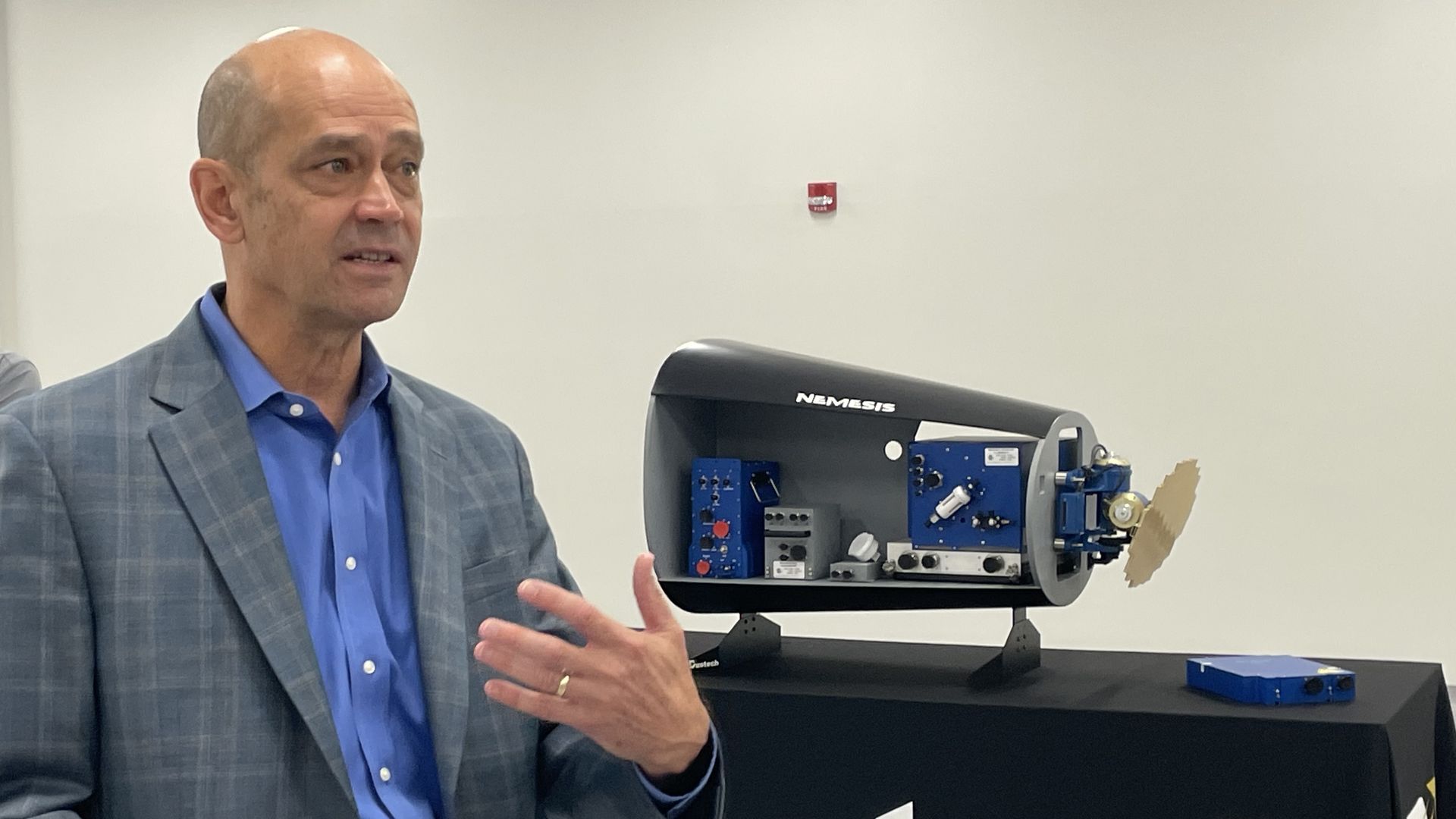
Zoom in: On display Thursday was the Nemesis radar system for F-5 aircraft (in its nose cone) used in training for the military, custom-engineered by Duotech.
- The company also ended up with a product when building its own test system, one which has so far been delivered to primes, partners and other nations around the world, Bader told Axios.
- "We built ourselves a test system, a full rack, just about our own needs, and we stumbled on a product," he said.
- Test systems are traditionally expensive, proprietary and focused on individual components, he said. Duotech created its basic test configuration, then modifies it for the component and end user.
The bottom line: "Sustainment is often the last thing a prime or an end user or the United States government thinks about, right," Bader told Axios. "It's additional cost, so it winds up being a delayed, deferred cost."
- "Our job is to fill that gap," he said. "Yesterday's F4s are today's F16s and tomorrow's F22s. The sustainment business is a very sustainable business."