Catching up with NASA engineer John Blevins

Add Axios as your preferred source to
see more of our stories on Google.
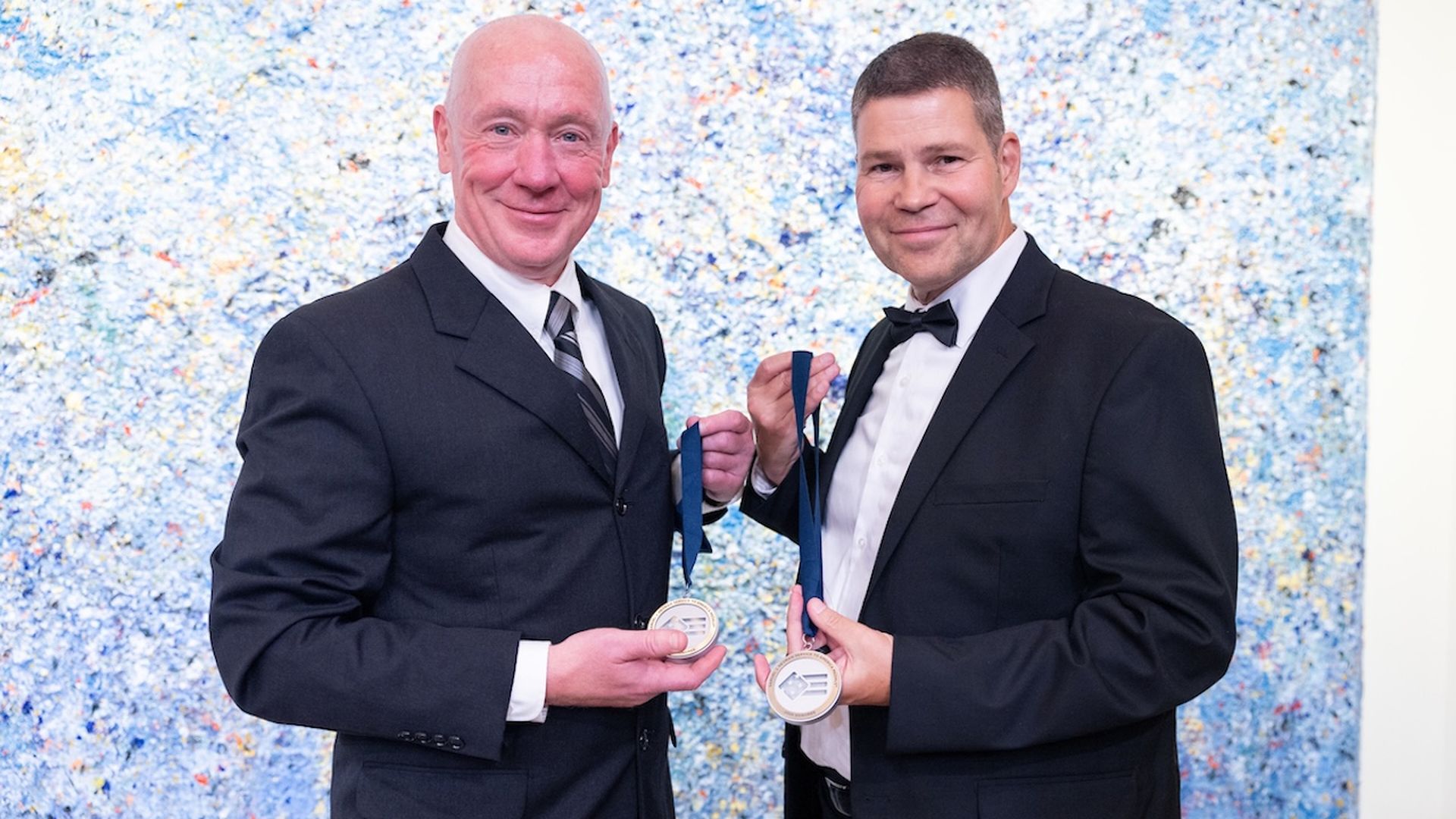
John Blevins, at right, with NASA's other Sammie winner, Richard Burns. Photo: Courtesy of NASA
John Blevins, chief engineer for NASA's Space Launch System, was recently awarded the Samuel J. Heyman Service to America Medal, the highest honor a civilian federal employee can earn.
Why it matters: NASA is an integral part of Huntsville's character, and people like Blevins and his team are a big part of what makes NASA the premier space program on the planet.
- Work he's leading is key in taking humans deeper into space than ever before, as well as in NASA's effort to put four astronauts back on the Moon: the first crewed Moon mission in more than 50 years.
- The "Sammies," considered the Oscars of public service, shine a light on the remarkable accomplishments of folks who may mostly fly under the radar.
- Axios Huntsville sat down with Blevins (virtually) Friday to talk about the award, his career at NASA and what he's looking forward to, and we snagged a couple podcast recommendations while we were at it.
What's it mean to win a Sammie?
Blevins called it "a huge honor" to win the award but said it's really a team win, pointing to the roughly 5,000-person Space Launch System team, nearly 800 of whom are in Huntsville at the Marshall Space Flight Center.
- "When John F. Kennedy spoke in 1962 at Rice University, he said ... going to the Moon will serve to measure the very best of who we are as a group," Blevins said. "I'm just trying to get the job done and be a chief engineer and represent these folks."
How has your job changed over the past 25 or so years?
Blevins, now 58, already had his Ph.D. when he started working at NASA in 1999. His job was "all about rockets. And I loved it — absolutely loved it."
Over time, Blevins was assigned more and more tasks, eventually becoming team lead for aerodynamics, which "really opened my eyes to this launch-vehicle engineering world that existed, that I was only a peripheral part of."
- "We were really kind of creating primary products for the launch vehicle, and I just fell in love with that."
When the Space Launch System started, he was asked to lead the aerodynamics effort, eventually working a lot with former chief Garry Lyles, who named him deputy chief in 2017. In 2019, Blevins became chief himself.
What particular challenges or engineering problems stand out over that time?
Good engineering isn't about big moments like the Artemis I launch, Blevins said, but about the daily efforts that accumulate into those moments.
He pointed to a problem with the Artemis 1 launch, when issues arose with fueling the rocket, leading the team to stand down for three days before the ultimate launch.
But, he noted, being able to sit at launch control representing all those engineers was a "pinnacle."
- "I've had the privilege of being on the very early end, before we even had a project," he said. "What does it look like to carry large objects deep into space, you know?"
What are you excited about for the future of the program?
"The most exciting thing today is the Artemis II mission. For the first time in over 50 years, four people are going beyond the Moon — we'll go the longest distance we've ever seen anybody [travel] from the planet Earth — to go around the Moon in a brand-new capsule. ... For the first time in virtually anybody's career that still is working on these machines."
It's a privilege to work on that mission, including with the four astronauts, he said. "There's no other machine currently in the Western Hemisphere, the United States and our allies, that has this capability."
Bonus question: What's your favorite space movie?
Blevins threw a curveball, recommending a couple podcasts first: "Moonrise" by the Washington Post, and "13 Minutes to the Moon" by the BBC.
He also recommended Ken Burns' "The Dust Bowl," noting clips were used in "Interstellar," as well as Tom Hanks' "From the Earth to the Moon" and the documentary "Apollo 11."
Also, he said, "I love 'Star Wars,' and I like 'Star Trek,' maybe to a lesser degree."