Heat streaks are hitting Huntsville and other U.S. cities more often


Add Axios as your preferred source to
see more of our stories on Google.
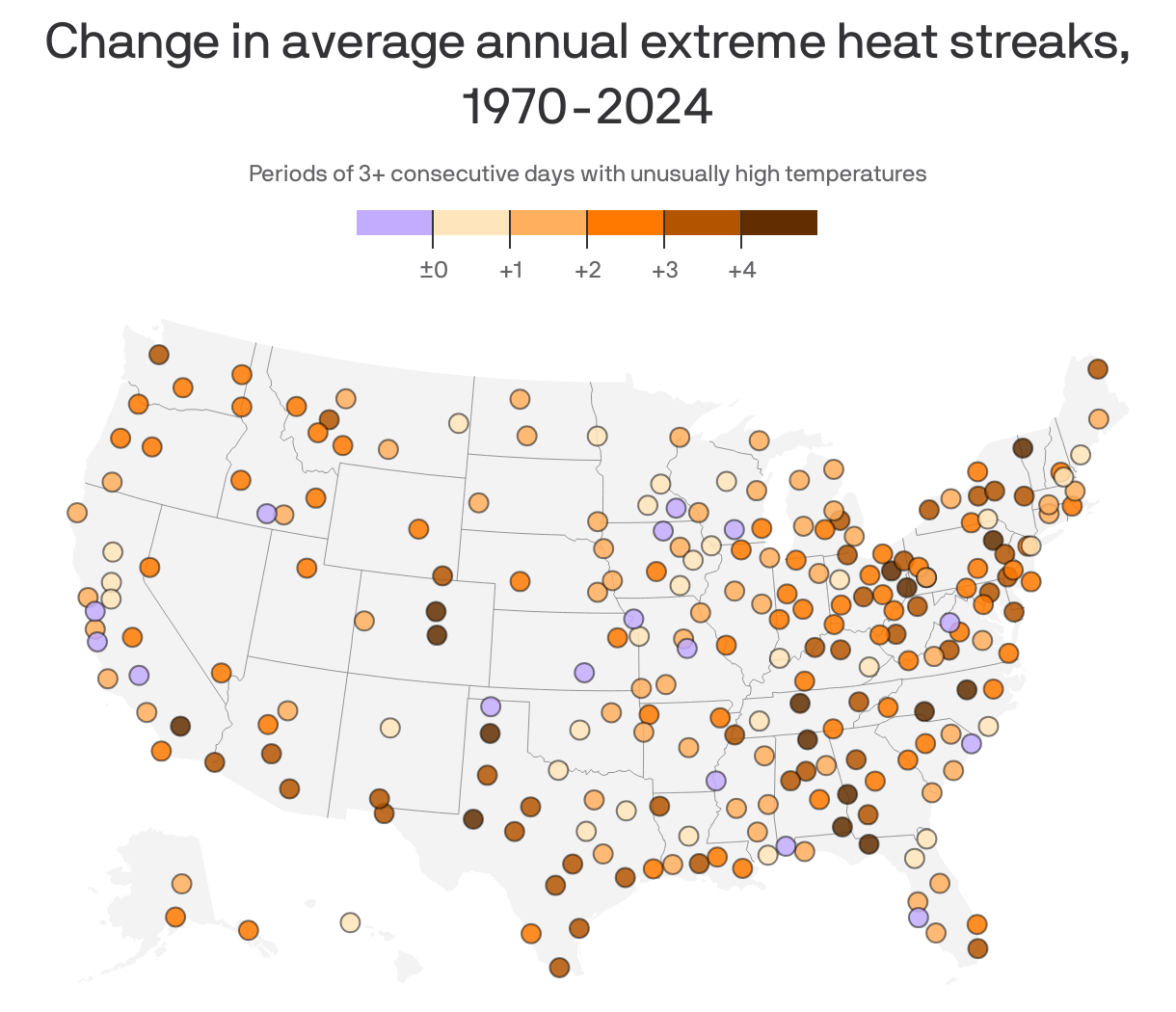
Many U.S. cities, including Huntsville, now have more heat streaks on average each year compared to 1970, a new analysis finds.
Why it matters: Prolonged heat — as much of the U.S. has experienced this summer — is particularly hazardous to human health.
- Extreme heat's effects on the body tend to be cumulative, and warm nights offer little reprieve for those without air conditioning.
- Multi-day heat streaks are also challenging for power grid operators, given all the energy-intensive AC use.
How it works: Climate Central, a climate research group, defines an "extreme heat streak" as three or more days in a row with maximum temperatures over the 90th percentile of a given location's daily max temperatures during the 1991-2020 period.
- "Across the 247 cities analyzed, this temperature threshold ranged from 66°F in Juneau and Anchorage, Alaska to 100°F in Yuma, Arizona," per a new report, which is based on publicly available NOAA data.
Zoom in: Huntsville has four more extreme heat streaks on average, per the data, and has sweltered under multiple several-day-long heat advisories this summer, including recent advisories warning of indexes as high as 111.
- National Weather Service data shows temperatures above 95 for three days in a row on June 23-25, including a high of 98 on the 25th.
- July has seen two stretches of highs over 95 degrees lasting at least three days — including a four-day run from July 26–29, with the hottest day of the year being Tuesday at 99.
Context: Katie Nagee, science and operations officer at NWS Huntsville, tells Axios that "heat streaks" isn't a term NWS uses, and such events may be difficult to quantify as each calendar day has its own 90th percentile temperature.
- The NWS takes into account both temperature and humidity in order to compile its heat indexes, she said, which other organizations may describe as the "feels like" temperature.
Driving the news: The average number of annual extreme heat streaks rose between 1970-2024 in 80% of the 247 U.S. cities analyzed in Climate Central's report.
- The nearly 200 cities with an increase now have two more annual heat streaks on average.
Zoom out: Some areas, like Nashville and Raleigh, now have five more heat streaks on average each year.
- A few places, like Myrtle Beach, South Carolina, and Sarasota, Florida, have fewer heat streaks compared to 1970.
Between the lines: Climate change is making extreme heat more intense and more frequent, studies have shown.
- Many urban neighborhoods suffer from the "urban heat island" phenomenon, where buildings, roads and other structures trap heat, making it even hotter.
Go deeper: Millions of U.S. kids attend schools in "urban heat zones."