NASA pours millions into Alabama, but future funding is in limbo


Add Axios as your preferred source to
see more of our stories on Google.
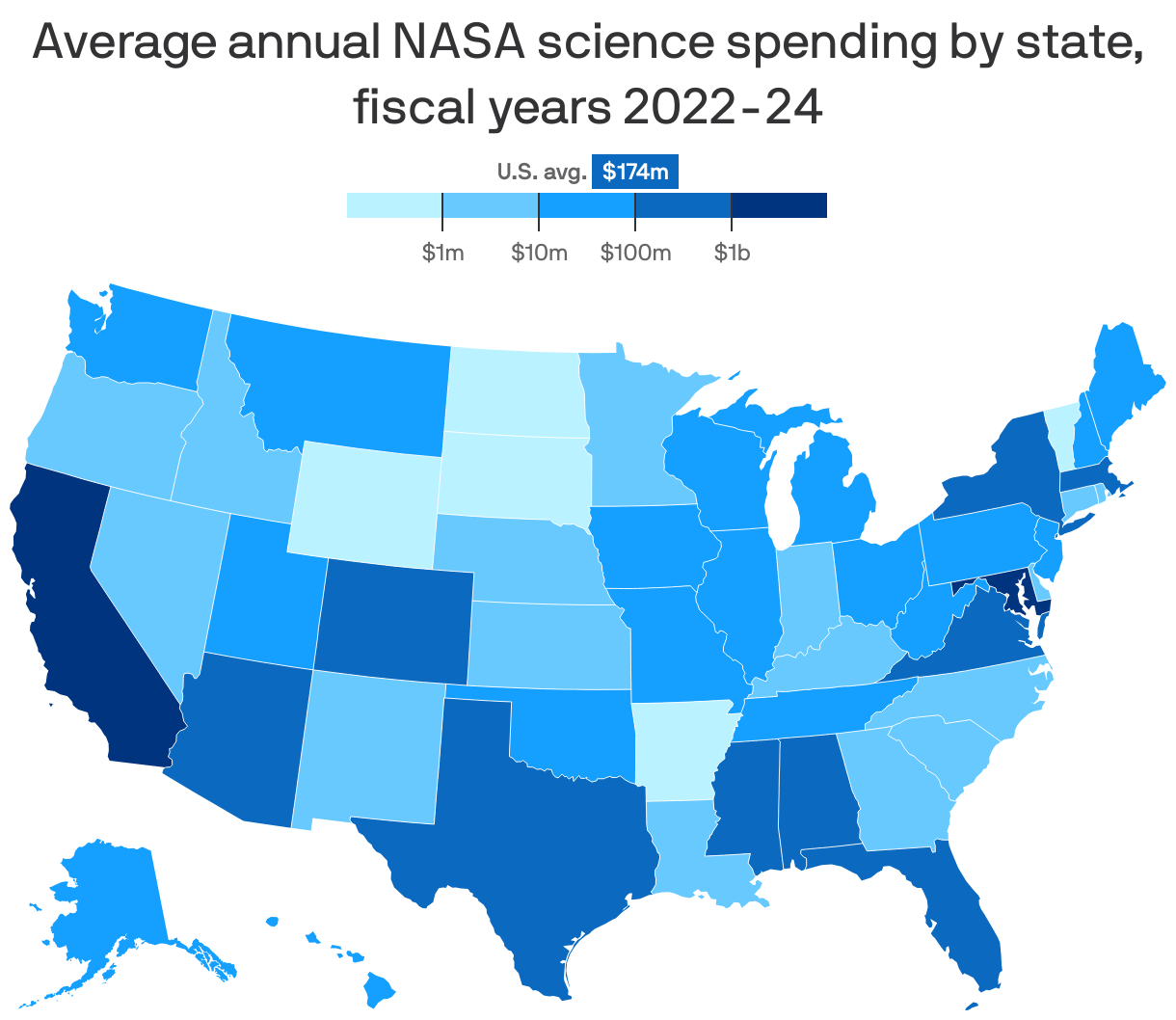
NASA spends hundreds of millions of dollars per state on average annually through its scientific missions, a recent analysis shows.
Why it matters: The space agency's science efforts bear the brunt of the cuts in the Trump administration's proposed budget, down nearly 50% to $3.9 billion.
Zoom in: Data from pro-space nonprofit The Planetary Society ranks Alabama fifth in NASA science spending, with an average $586 million spent annually.
- But the state's Fifth Congressional District, which includes Huntsville and NASA's Marshall Space Flight Center, ranks third among congressional districts nationwide, at $580.8 million.
- That funding drives an annual $1.6 billion in economic activity and supports thousands of jobs in the district.
- The University of Alabama in Huntsville is among the largest grant recipients, with a total of $272 million in active grants across fiscal years 2022-2024 supported by NASA science spending, per Planetary Society data.
Yes, but: Senate lawmakers introduced a proposal to add nearly $10 billion in NASA funding to the budget, a move commended by the Huntsville/Madison County Chamber, but it's generally focused on specific missions.
- That money would fund programs key to NASA efforts in Huntsville, including the largest piece: $4.1 billion to fund Space Launch System rockets for the Artemis IV and V missions.
- Another $1.25 billion over five years is earmarked for operations of the International Space Station, and $100 million is earmarked for facilities upgrades at the Marshall Space Flight Center, which houses the ISS Payload Operations Integration Center, NASA's primary space station science command post.
What's next: Answers on the pending budget proposal could come in the next few weeks, with Senate Republicans setting July 4 as the deadline to pass the bill and send it back to the House, per NPR.
The big picture: Science represents about 30% of NASA's overall budget and includes missions like space telescopes, robotic probes and satellites that gather data about Earth's changing climate.
- While not always as headline-grabbing as human spaceflight, NASA's science activity has greatly enhanced our scientific understanding of both Earth and our celestial neighborhood.
By the numbers: California (about $3 billion), Maryland ($2 billion), Texas ($614 million), Virginia ($612 million) and Alabama ($586 million) saw the most NASA science spending on average annually across fiscal 2022-2024, per data from The Planetary Society.
Between the lines: Trump's proposed NASA science cuts fit into a broader pattern of pulling resources away from scientific endeavors and data collection, especially involving climate change.
- The White House has also proposed major cuts and culled staff at agencies like NOAA, and is pulling federal funding for climate-related research.
The bottom line: Congress, not the president, sets NASA's budget — but Trump's proposal suggests he believes the agency should be focused on human spaceflight rather than a broader scientific mission.