Inside Fort Lauderdale's unconventional community court

Add Axios as your preferred source to
see more of our stories on Google.
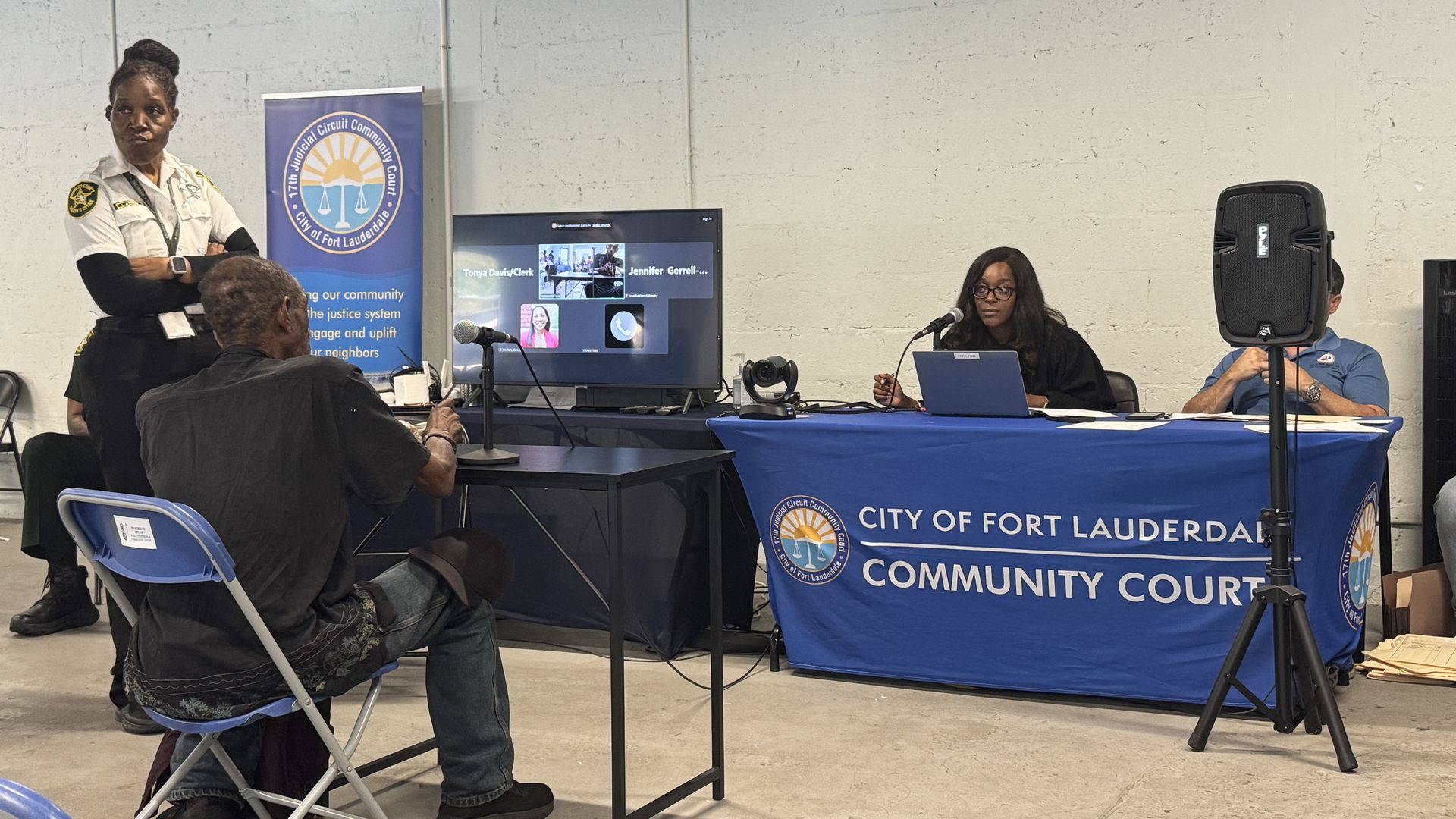
Community court is an integral part of Fort Lauderdale's plan to tackle homelessness. Photo: Naomi Feinstein/Axios
Fort Lauderdale's community court isn't your traditional legal proceeding: Judge Florence Taylor Barner, known as Judge Flo, is more problem-solver than arbiter, and defendants are called participants.
Why it matters: The seven-year-old program connects unhoused people with services while diverting those with minor offenses away from the criminal justice system.
How it works: At 9am, two hours before court begins, people file through the building by the bus terminal to meet with service providers for housing, detox services, SNAP benefits or getting their license.
- There is also a mobile medical clinic, along with a bus with showers and free haircuts from a local barber.
- People don't need to be cited to take advantage of the services.
At 11am, court is in session. Judge Flo goes through the docket. She checks in with participants or explains next steps for those who received a notice to appear.
- She asks if they're going to the doctor or staying sober.
- Once they complete their 10 hours of community service, they graduate and their case gets dismissed. Judge Flo orders everyone to stand, gives them a hug, presents them with a certificate and cheers.
- After one man told her that he had been sober, she shouted, "Folks, do you hear that?" He's sober for a month!" The room erupted into cheers. "I'm so proud of you," the judge added.
What they're saying: "I keep telling folks, 'It's just me, just Judge Flo,'" she tells Axios. "There's a reason I sit at eye level. I want to be less intimidating. I want people to be comfortable asking for help."
Officer Brian Blount of the police department's Homeless Outreach unit says the team is constantly on the streets telling people about the services available at community court.
- "We are not going to arrest anybody out of homelessness," Blount adds.
By the numbers: From last October through June, 171 notices to appear were written, 93 were fulfilled and 45 people graduated from community court.
- During that same period, there were nearly 3,000 walk-ins and 2,400 service referrals provided.
The bottom line: "It's part of the lifeblood of this community," Judge Flo tells Axios. "We see on average 50-60 people a day that come through this courtroom just needing help."