An oasis hiding amid Douglas County's growth boom

Add Axios as your preferred source to
see more of our stories on Google.
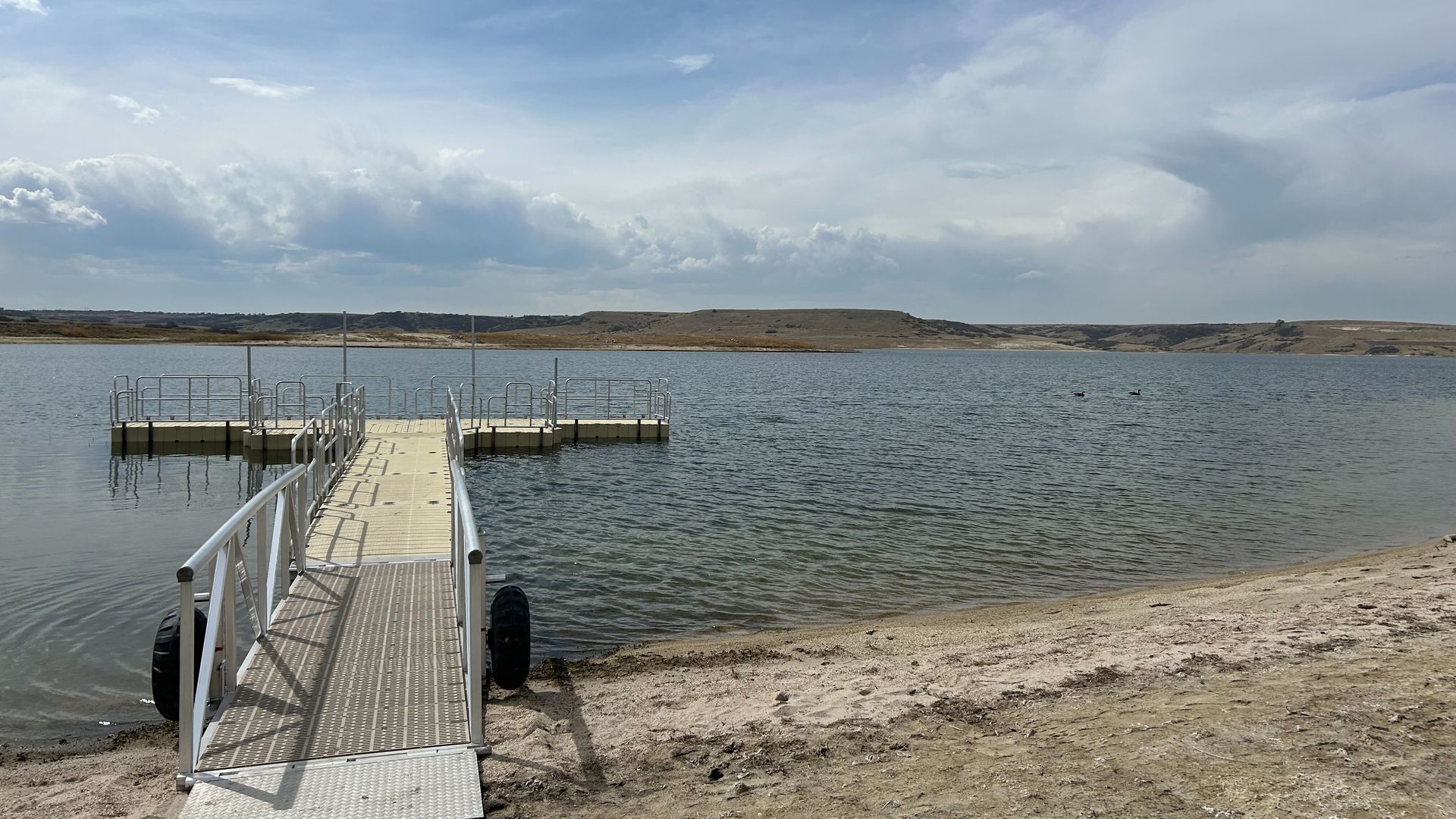
Rueter-Hess Reservoir. Photo: Robert Sanchez/Axios
Rueter-Hess Reservoir is, at its core, a water bowl for many of Douglas County's thirsty residents.
Yes, but: Standing at the water's edge, it feels more like an oasis amid the area's explosive growth.
Why it matters: The south Parker reservoir is one of the Front Range's most unusual — and underused — outdoor spaces, balancing two distinct duties: sustaining the region's water future and offering a rare low-key place to recreate.
The big picture: Rueter-Hess was built to reduce reliance on nonrenewable groundwater from the Denver Basin, serving about 178,000 residents in Parker, plus parts of Lone Tree and Castle Pines.
- At roughly 25,000 acre-feet of water, Rueter-Hess is only about 33% full.
- It could reach maximum capacity in the 2040s.
State of play: The body of water offers more than mere utility. Rueter-Hess is also an emerging recreational gem.
- Anglers, kayakers, paddleboarders and trail runners spread out across the 1,300-acre site year-round, and at least eight fish species call this place home, including largemouth bass, walleye and wiper.
Behind the scenes: On a recent Friday, only a few anglers were visible along the waterline.
- "I didn't even know this place existed," says Jack Barr, 28, who drove from Denver to fish the reservoir for the first time. "I was looking for a low-pressure environment, and I think I found it."
Unlike many Front Range reservoirs, Rueter-Hess rarely feels crowded.
- It's big, but not as big as Chatfield or Cherry Creek reservoirs. Chatfield's maximum capacity is 355,000 acre-feet, while Cherry Creek can hold 134,470 acre-feet.
- Rueter-Hess exists for water storage, but Chatfield and Cherry Creek are used primarily for flood control.
How it works: Visitor capacity is tightly regulated.
- The reservoir is open Friday through Monday, costs $10 per vehicle and requires a reservation.
- Only 230 parking spots are available for visitors.
Zoom in: That careful balance is the secret sauce.
- Staff say protecting water quality comes first, and biologists manage fish populations using annual surveys and strict catch limits.
- Only hand-launched craft — like kayaks and canoes — and small electric trolling motors are allowed.
Zoom out: "This is true old-school programming," recreation manager Amy Knopp tells Axios. "It's like a reservoir in the 1920s."
Flashback: Rueter-Hess was completed in 2012 after seven years of construction, at a cost of $170 million.
- Parker's Water & Sanitation District owns the reservoir, but Douglas County handles recreation and staffing.
Follow the money: Five local governments — Parker, Castle Pines, Castle Rock, Lone Tree and Douglas County — chip in a combined $870,000 annually to fund recreation and operations.
Fun fact: Long before it stored water — or accommodated weekend anglers — the site was home to a gold mine, now submerged on its west side.
- During construction, workers uncovered tools, buckets, forks and spoons.
- "It was like the miners just walked away," Ron Redd, Parker Water's district manager, tells Axios.