A highway fix that could save Colorado's wildlife

Add Axios as your preferred source to
see more of our stories on Google.
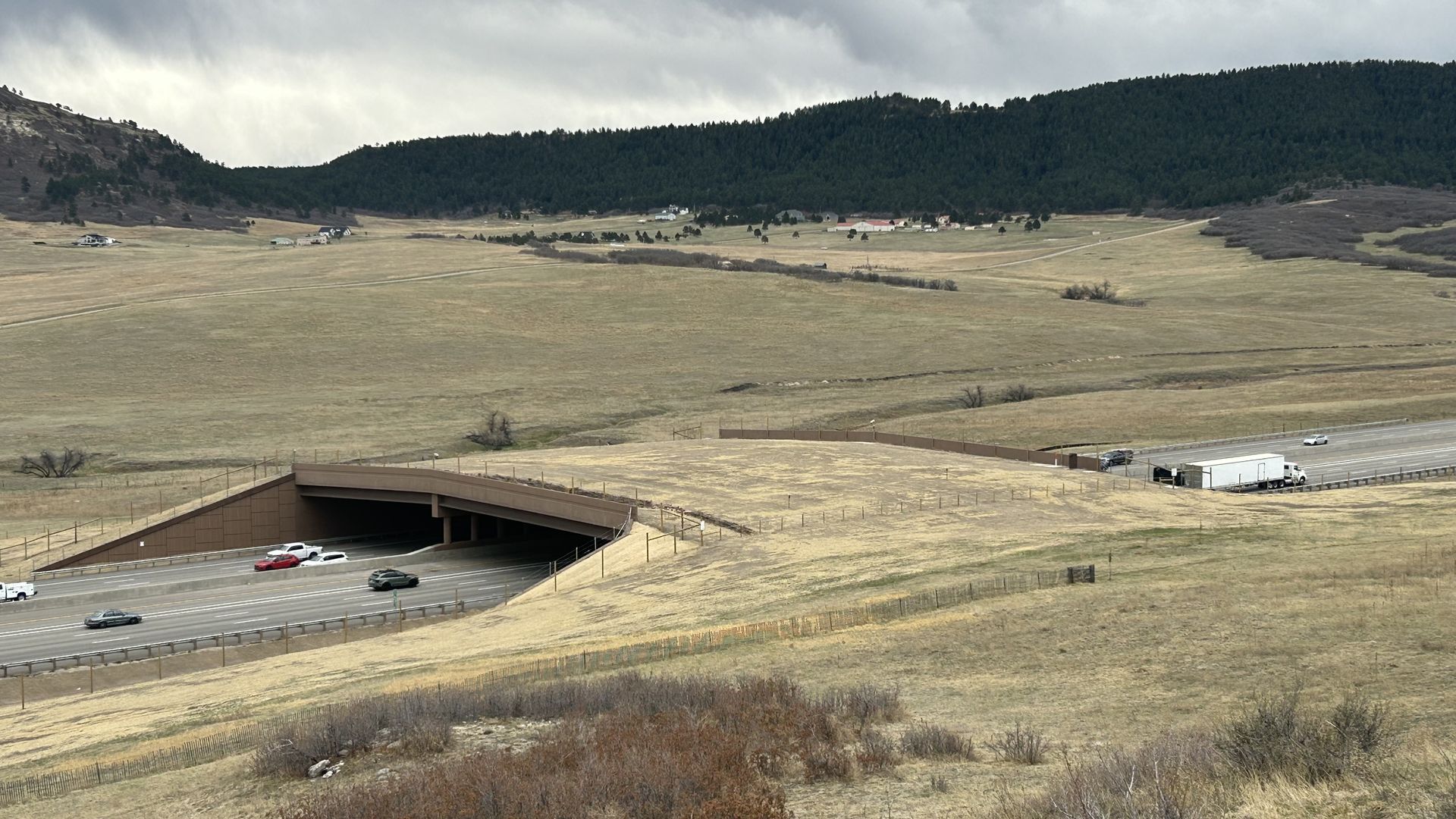
The I-25 Greenland Wildlife Overpass in Colorado. Photo: Robert Sanchez/Axios
The Greenland Wildlife Overpass is lauded as an engineering marvel that not only reduces animal strikes on Interstate 25 but could help to ensure elk and pronghorn survive for centuries to come.
Why it matters: Highways don't just kill animals — they cut off movement and weaken herds over time.
The big picture: The crossing opened in December, but the heavy lifting is happening underground: five wildlife underpasses stretch along 18 miles of I-25 between Castle Rock and Monument.
- Three — which are 18 feet tall and 110 feet wide — are among North America's largest.
- Wildlife crashes on the stretch of interstate have dropped 91% since the underpass work was completed in 2022.
Reality check: Still, some animals refuse to use them.
- Enclosed spaces can act as "kill zones," leaving animals vulnerable to predators.
- Pronghorn, for example, routinely walk up to entrances, look inside and turn around.
Zoom in: Elk herds on either side of I-25 have been largely cut off for decades, raising concerns about inbreeding.
Between the lines: This is where the massive, open crossing comes in.
- At about 200 feet wide and 290 feet long, it's North America's largest single wildlife overpass.
- Engineers designed it wide and open, but with walls that block animals' traffic views.
- The goal is to make the bridge feel like part of the natural landscape.
How it works: Researchers from Colorado Parks and Wildlife, the Denver Zoo, and the University of Denver collected feces samples before construction.
- They'll collect more in a few years to see if herds are using the overpass and mixing.
Yes, but: On a recent weekday, the overpass was empty.
- Patience is key.
- Research from Canada's Banff National Park showed some species take around five years to consistently use crossings.
The Greenland Wildlife Overpass has already attracted interest from transportation and wildlife officials from South America, Europe and Canada.
- "This is going to be a project of international significance," Chuck Attardo, the Colorado Department of Transportation's I-25 south corridor environmental project manager, told Axios.
Follow the money: The crossing was funded partly through the Biden administration's Wildlife Crossings Pilot Program.
- It cost $15 million, only half of its $30 million budget.
- CDOT used roughly $6 million in leftover funds — plus $3 million in state money — and reinvested it into wildlife mitigation along the corridor.
Behind the scenes: CDOT needed consent from billionaire John Malone — who owns nearby land — to build on a two-thirds-acre parcel east of I-25.
What we're watching: This isn't a one-and-done job. Six priority wildlife crossings are planned across Colorado. They'll be at:
- I-25 at the New Mexico border.
- U.S. 40, in Empire.
- I-70 on Vail Pass' east side.
- U.S. 287, between Fort Collins and the Wyoming border.
- State Highway 13, west of Craig.
- U.S. 160, east of Mesa Verde.
My thought bubble: I walked 8,000 steps for this photo.
- I hope you like it.