Education Brief
The new college graduation ritual: booing AI

Add Axios as your preferred source to
see more of our stories on Google.
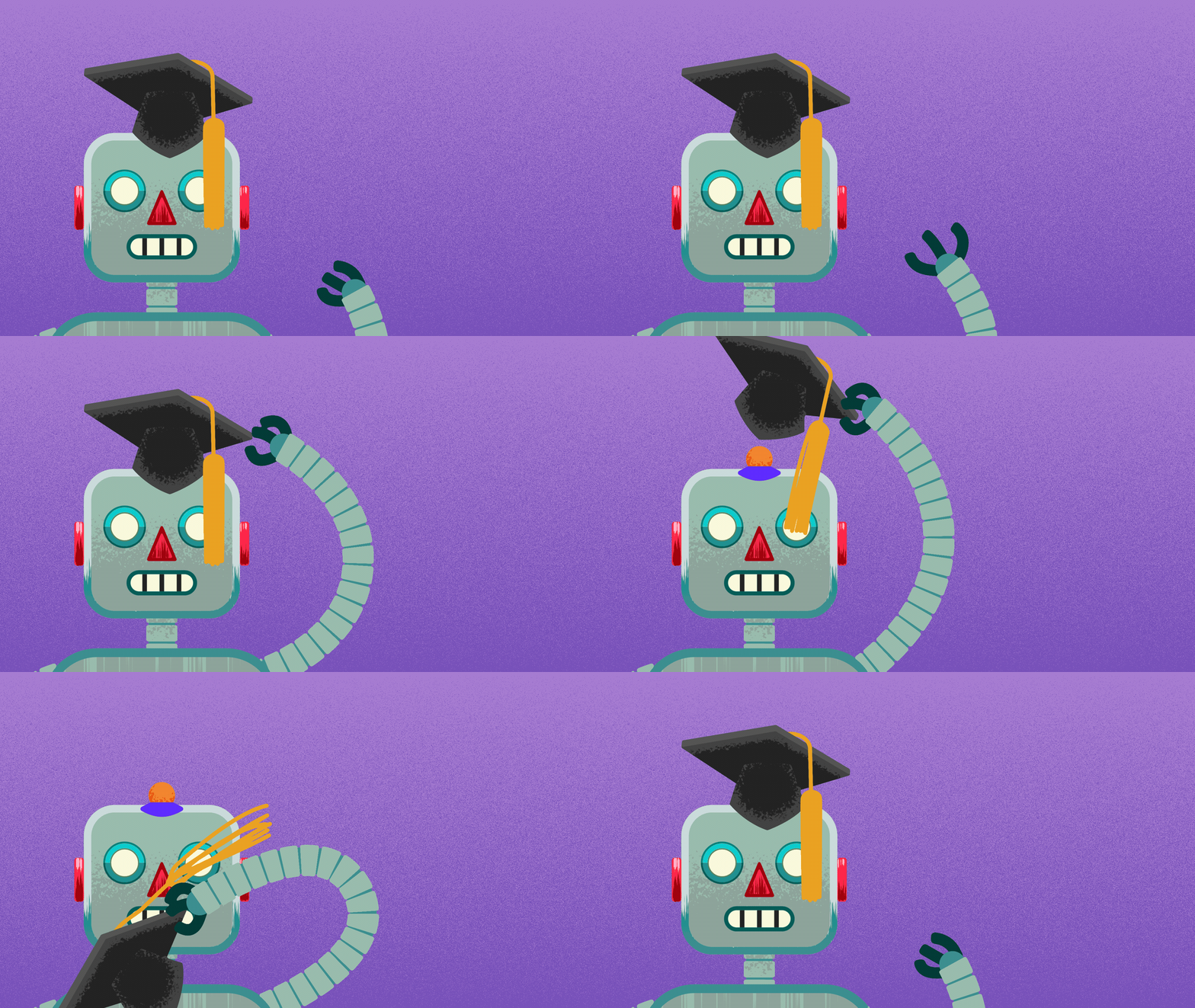
Illustration: Brendan Lynch/Axios
As artificial intelligence forces students to rethink their majors and reshapes the job market, it's clear that many graduates don't want to hear about the technology on their big day.
The big picture: Several commencement ceremonies last month were interrupted by boos and jeers when speakers brought up AI.
Driving the news: Former Google CEO Eric Schmidt drew repeated boos while discussing AI at the University of Arizona's commencement.
- Real estate executive Gloria Caulfield called AI "the next industrial revolution" at the University of Central Florida's commencement, and was immediately drowned out by boos from arts and humanities graduates. "Okay, I struck a chord," she said.
- Music executive Scott Borchetta told Middle Tennessee State University graduates that "AI is rewriting production as we sit here," prompting boos. He retorted: "deal with it … Like I said, it's a tool. You can hear me now or pay me later."
The other side: Not every commencement speaker who mentioned AI was jeered.
- When Nvidia CEO Jensen Huang told Carnegie Mellon graduates that AI will be a net positive and cause "every industry to change," but that "the answer is not to fear the future," he drew no audible pushback.
By the numbers: Roughly 42% of Gen Z say AI will harm job opportunities and wages for people like them, compared with 33% of millennials, 39% of Gen X and 37% of baby boomers, according to an Axios Harris Poll.
- Those concerns show up in job hunting data too, with 43% of Americans aged 15 to 34 saying it's a good time to find a job, compared to 64% of those 55 and older — a 21-point gap, per Gallup.
Reality check: Concerns of the AI boogeyman are not without merit.
- A slew of top companies, including Meta, Pinterest and Block recently cited AI automating some tasks as they announced layoffs.
Between the lines: Schmidt seemed almost apologetic to the graduates during his speech, acknowledging uncertainty about AI's long-term impact.
- "There is a fear in your generation that the future has already been written, that the machines are coming, that the jobs are evaporating, that the climate is breaking, that politics are fractured, and that you are inheriting a mess that you did not create," he said.
- Still, he compared being AI-adverse to missing a defining opportunity: "When someone offers you a seat on the rocket ship, you do not ask which seat, you just get on. Graduates, the rocket ship is here."
Zoom out: AI is creating more jobs than it's killing, and fewer CEOs now expect AI to reduce hiring than they did last year, per EY-Parthenon research.
- Huang warned graduates that "AI is not likely to replace you, but someone using AI better than you might."
- Despite fears over job displacement, young people are increasingly using AI to help with homework, brainstorming, news consumption and entertainment — suggesting they see AI as a useful tool.
The bottom line: Young people aren't vehemently anti-AI — they're just scared of being left in the digital dust.
Axios' Avery Lotz contributed to this reporting.