Pearl Street attack deepens Boulder's political divide

Add Axios as your preferred source to
see more of our stories on Google.
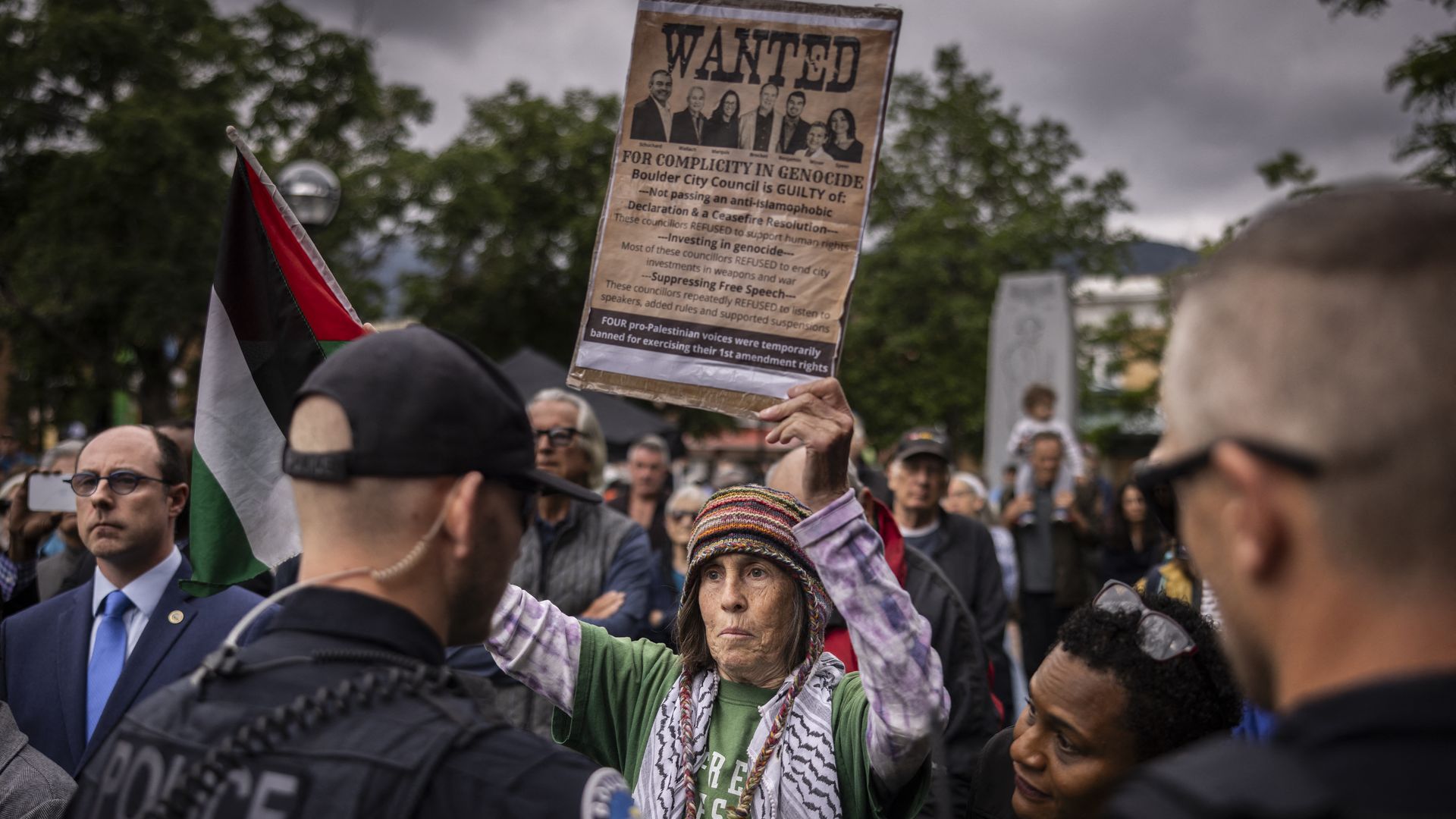
A protester holds a sign supporting Palestinians and targeting Boulder councilmembers at a rally Wednesday. Photo: Chet Strange/AFP via Getty Images
Sunday's firebomb attack at a pro-Israel rally is intensifying a political split that's been brewing in Boulder for months, if not longer.
Why it matters: The Israel-Hamas war is fracturing even the bluest communities, with Boulder's once-cohesive left splintering under the weight of geopolitics.
Driving the news: The attack — which injured at least 15 and was allegedly carried out by a Colorado Springs man who told authorities he wanted to kill all Zionist people — prompted Boulder councilmembers to swiftly condemn the violence as antisemitic.
Yes, but: There was one exception. Councilmember Taishya Adams declined to sign the city's statement, saying it failed to include anti-Zionism as a potential motive alongside antisemitism.
- Adams, who has been vocal in her criticism of the war in Gaza, said in a statement that the omission doesn't tell "the full truth."
Between the lines: Antisemitism and anti-Zionism are often conflated, but they refer to different ideas — the former targeting Jewish identity, the latter the modern state of Israel. Critics of Adams said her framing minimized the hate behind the violence.
The other side: Adams' stance sparked criticism online and in City Hall.
- A recall petition began circulating within 24 hours of her remarks. As of Thursday afternoon, it had garnered more than 2,600 signatures.
- Reality check: A councilmember can be removed only by a citizen-initiated recall ballot measure.
The big picture: The attack came amid months of increasingly hostile Boulder City Council meetings, where pro-Palestinian activists have called for a ceasefire resolution and, at times, disrupted proceedings.
- In April, a "Wanted" poster targeting seven members for "complicity in genocide" spread online.
- "In short, it has been chaos," Boulder Councilmember Mark Wallach wrote in an op-ed Tuesday.
State of play: Boulder's City Council has refused to take a position on the war, despite activist pressure and precedent on past global conflicts like Iraq and Myanmar.
- Mayor Aaron Brockett insists the council focus on local issues — but he acknowledged to the New York Times that city leaders "have a lot of work to do in the coming weeks and months to cope with what's happened, and also to show people that being Jewish in Boulder is safe."
- "People do not feel safe, and we have to change that," Brockett said.
The bottom line: What began as a war half a world away is now playing out on Pearl Street and in City Hall — testing Boulder's political identity and the limits of its progressive coalition.