How Europe’s green pandemic recovery will push the rest of the world

Add Axios as your preferred source to
see more of our stories on Google.
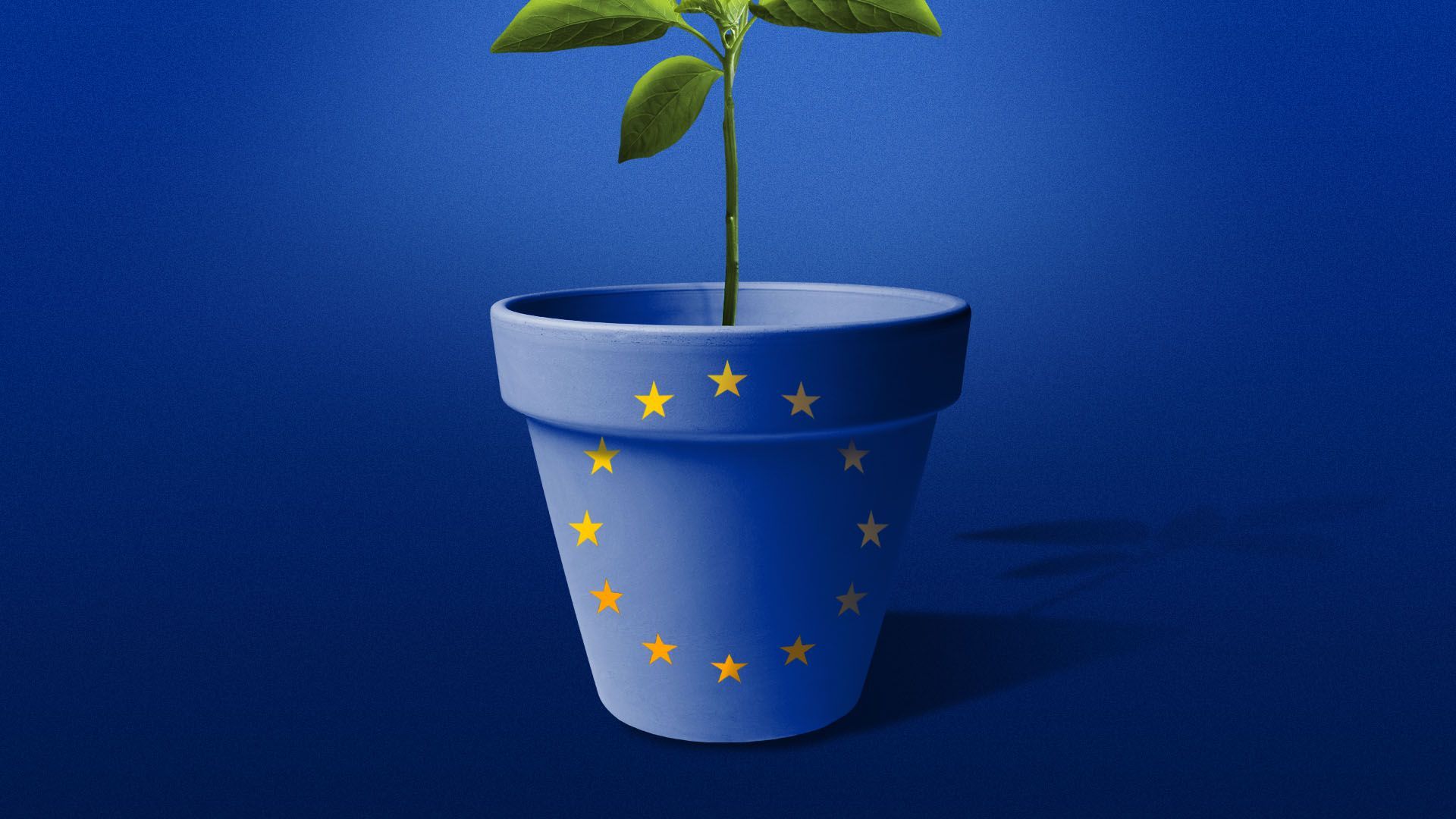
Illustration: Sarah Grillo/Axios
Europe, long the most progressive continent when it comes to tackling climate change, is doubling down on this ambition to revive pandemic-ravaged economies.
Why it matters: The European Union is the world’s third-largest emitting region after the U.S. and China, but it’s not just that. These plans will push global corporate behavior and prod other governments by creating either templates to follow or protectionist battles (or both).
Where it stands: European nations account for three-quarters of the green stimulus funding announced as of early June, according to a BloombergNEF report.
- Other countries are not being nearly as aggressive in this space, despite mounting calls from the United Nations, International Monetary Fund and International Energy Agency.
Driving the news: Three different areas of Europe’s policy push are especially worth watching for their global implications. Many of these proposals come from the region’s Green Deal plan it unveiled late last year.
- The proposed recovery package itself, which will showcase to what degree $825 billion in clean-energy funding — especially for electric vehicles, hydrogen and energy efficiency — creates jobs and cuts emissions.
- Forthcoming standards on methane emissions and finance, which will affect virtually all oil and gas companies and countries seeking investments from them.
- To what degree Europe pushes forward with a border tax on imported goods from nations without similar climate policies.
“We’re keenly watching it,” Ilmi Granoff, who directs the finance program at the California-based ClimateWorks Foundation, said of these actions by Europe. “It may take different forms in different jurisdictions, but I do think it’s a bellwether for how we understand a truly mobilized climate policy.”
The intrigue: The role of natural gas in addressing climate change, controversial for years, is coming to a head in Europe, which will draw more attention to the topic around the world.
- The European Commission is set to release a strategy soon to cut emissions of methane, the primary component of natural gas and a potent greenhouse gas.
- The commission is also set to decide by year’s end on whether natural gas (and other types of energy sources and technologies) is considered sustainable and worthy of investment by European governments and institutions.
- Experts say it’s unlikely natural gas will be included, considering that the European Investment Bank already said late last year it would stop funding all fossil-fuel projects by next year.
“The role of natural gas ... toward a climate-neutral economy very much depends on the ability of the sector to adapt,” said Ditte Juul-Jørgensen, the European Commission’s director-general for energy, in an interview with Axios recently.
- “To address methane emissions, we need international cooperation because we are an energy importer,” she said. “It would be important to have a close dialogue with the producing countries and what can be done.”
The other side: At the top of that list is the United States, the world’s biggest producer of natural gas (and oil).
- The Trump administration is repealing regulations on methane, while the American Petroleum Institute released a study last week concluding American liquefied natural gas is already far cleaner than coal in the three key markets it studied: Germany, India and China.
- “The conversation going on in Europe is a very important one,” said Dustin Meyer, API’s director of market development. API will share the report with its European counterpart, the International Association of Oil and Gas Producers, which is urging the region to include natural gas in its clean-energy and sustainable finance plans.
What’s next: Europe remains on course to impose a border "carbon adjustment" (a tax) sometime next year on certain imported products from nations that don’t have similar climate policies, which under President Trump would surely include the U.S.
- Juul-Jørgensen deflected when asked whether Europe would reconsider the policy given the global economic recession brought on by the pandemic.
- “A border carbon adjustment mechanism, or carbon border tax, has nothing to do with economic objectives and everything to do with climate objectives,” Juul-Jørgensen said.
Reality check: The official purpose of this policy is to make sure companies making carbon-intensive products like steel and cement don’t move their emitting operations elsewhere. In practice, the policy would have big economic impacts and — if Trump wins re-election — would likely fan the trade-war flames across the Atlantic.
- “This is a big deal. Countries have talked about it for 20 years. This is the first time someone said we’re going to do it,” said George David Banks, senior Republican staff member on the House Select Committee on the Climate Crisis and former top Trump administration official.
What we’re watching: If Joe Biden wins the presidential contest, expect America to start looking a lot more like Europe when it comes to climate ambitions.
- “That is exactly where we are headed,” said Granoff. “That’s true not just of the U.S., it’s true globally. Any serious state that is trying to grapple with climate change is now coming to the realization that it would have to be across every aspect of its economy including [issues like] financial regulation and trade policy.”
