Axios Austin

July 23, 2026

👋 Happy Thursday! Today, we're bringing you a special newsletter from our colleagues examining America's entrepreneurial streak — a time when small business applications are booming.
☀️ Today's weather: A heat advisory, with a high in the upper 90s and a heat index reaching 108.
🎂 Happy birthday to our member, Marianne Rochelle!
Situational awareness: Austin ISD plans to close Paredes Middle School in South Austin ahead of the new school year, pending school board approval.
- The district expects Paredes will receive a fourth consecutive F accountability rating by the state, teacher union Education Austin said.
- Trustees voted last fall to close 10 other campuses amid declining enrollment and a budget crunch.
Today's newsletter is 1,018 words — a 4-minute read.
1 big thing: 🧨 Small business dynamism

Americans are starting businesses at a record pace — an entrepreneurial hot streak that helps set the U.S. apart from the rest of the global economy.
Why it matters: The strong pace of new startups in the years since the pandemic likely plays a role in U.S. economic resilience and dynamism.
- It's amplified by AI, which gives the smallest startups new capabilities that once required much larger operations.
The big picture: Small businesses employ about half of the American private-sector workforce. So far this year, the nation's smallest businesses are doing the bulk of hiring.
- Through the first four months of 2026, the smallest companies — those with fewer than 20 employees — have added 236,000 jobs, according to payroll processor ADP. That accounts for a whopping 95% of the economy's net gains over that period.
Small businesses drive our economy. "You rarely find a large business that just appears out of nowhere with hundreds, if not thousands, of employees," Holly Wade, executive director of the National Federation of Independent Business, a small business lobbying group, tells Axios. "They start off small."
State of play: Americans are filing paperwork to start new businesses at near-record rates — averaging 470,000 applications a month in 2025. That's about 66% above pre-pandemic norms.
- This year, those applications are running even higher.
Yes, but: The startup surge is increasingly composed of solo operators rather than businesses with plans to hire.
- AI tools may be enabling this. A one-person business can do the work that previously required staff.
What to watch: The White House is betting AI will be the "great equalizer," Trump's top economist Kevin Hassett tells Axios.
- "It's making it so that small businesses who start to use AI can compete better with big businesses," Hassett says.
2. 😓 Reality check: It's hard!


The pandemic may have touched off a historic startup boom, but many of those new businesses have struggled. Truth is, it's been pretty hard to run a business in the recently rocky economy.
State of play: Among the new businesses started in 2022, an above-average share shuttered within three years, according to government data.
- Those businesses launched on the assumption that low interest rates and strong demand would last. But they got hit right out of the gate with rapid rate hikes and an inflation shock.
The latest: Confidence among small business owners fell below historical norms in March in the wake of the Iran war energy shock, according to a survey by the National Federation of Independent Business that has been conducted for the last 50 years.
3. 🤠 The Roundup: Wrangling the news

🚧 Amazon is the company behind a proposed advanced manufacturing project in the Dog's Head region in Southeast Austin. (Austin Business Journal 🔒)
👩🍳 Fermín Núñez of Este and Kevin Fink of Emmer & Rye are among the chefs on the roster for this year's Hot Luck, scheduled for Oct. 16-17. (Austin American-Statesman 🔒)
🚨 The Hays County Sheriff's Office says a jail inmate who escaped on Sunday is back in custody. Authorities suspect 21-year-old Xavier Isiah Gutierrez escaped by posing as another inmate who was being released. (KXAN)
4. 👏 The fanbase economy
Your local coffee shop isn't just selling breakfast anymore — it's building a fanbase.
The big picture: The pandemic forced small businesses to get more creative online about reaching customers. The loyalty forged during that period has stuck around and evolved.
State of play: Restaurants, coffee shops and fitness studios aren't just selling their core products anymore. Hats, hoodies and pins are now part of the playbook.
- They drop merch like streetwear brands, crowdsource ideas from followers, and document behind-the-scenes stories on Instagram and TikTok.
Even unlikely businesses are playing along: A brother-run pest control company in Miami posts videos of critter removals to a few hundred followers.
5. 🌏 Immigrants' entrepreneurial spirit

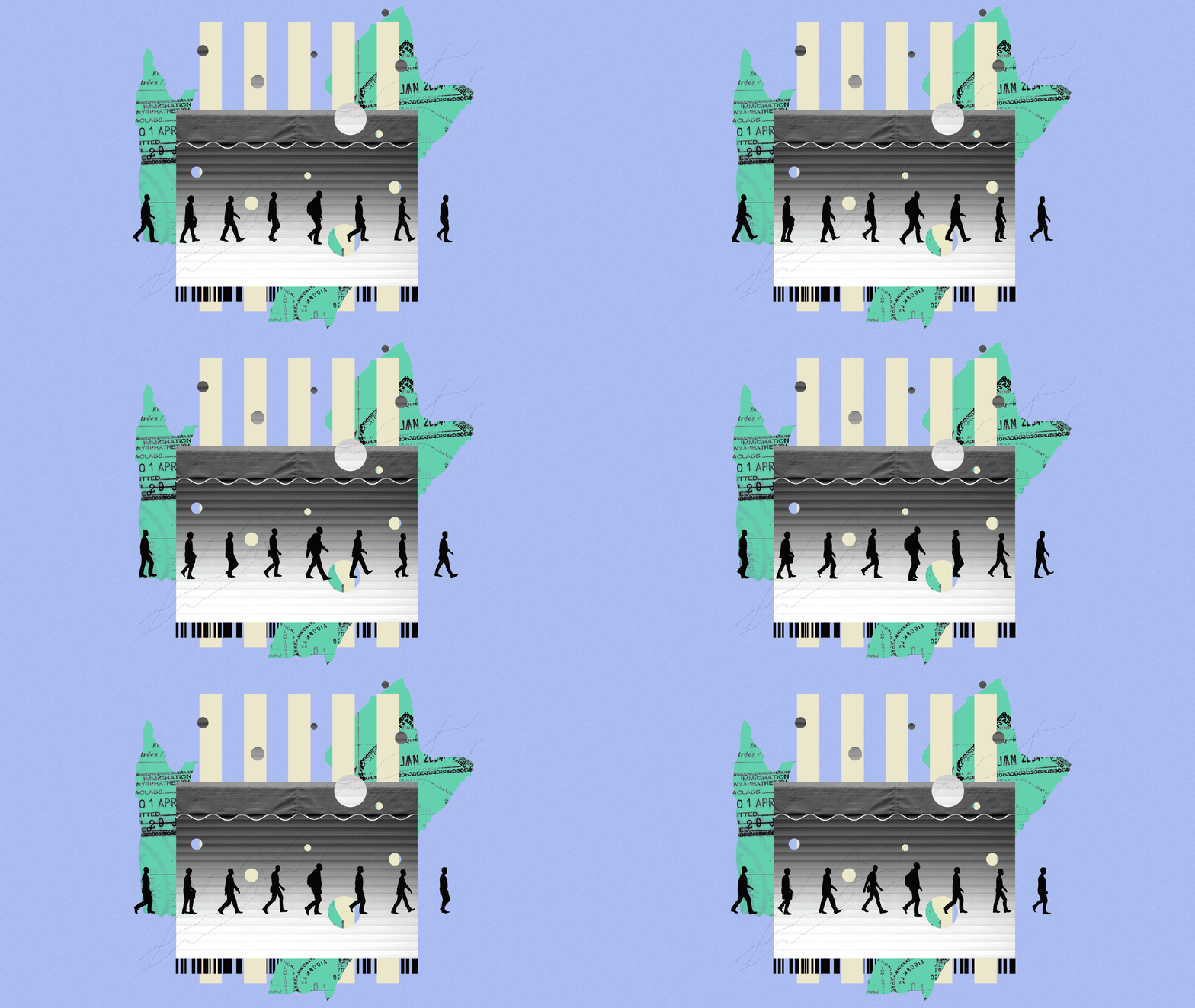
Immigrants play an outsized role in entrepreneurship, launching more than 20% of U.S. businesses while representing just 15% of the population, according to a National Bureau of Economic Research paper published in 2024.
- About 3.5 million immigrants are self-employed, according to the Immigration Research Initiative.
Zoom in: Many of the country's most valuable companies had immigrant founders.
- Immigrants or the children of immigrants founded nearly half of Fortune 500 companies as of 2023, according to one analysis.
- Those include Jensen Huang's Nvidia, Elon Musk's SpaceX and Tesla, and Sergey Brin's Alphabet.
What to watch: Mass deportations and stiffer immigration restrictions could undermine small businesses, as entrepreneurs fret about their own residency, face expensive visa rules and struggle to retain foreign-born employees.
6. 👥 Boomer succession crunch
The largest ownership transition in American history is quietly underway: Baby boomers are retiring, and no one knows who — if anyone — will take over their small businesses.
Why it matters: Baby boomers own about a quarter of all small businesses, about double the share held by their predecessors 20 years ago, McKinsey estimates.
- Their children often don't want to take over the family business. The risk is those firms close instead of selling to a capable investor, slowly wiping out jobs and economic anchors in communities across the country.
By the numbers: About 6 million businesses with fewer than 500 employees will face ownership transitions between now and 2035 as owners retire, up from about 4.5 million in the prior decade, according to McKinsey.
The bottom line: Millions of small businesses will soon face a moment of truth: Find a successor or a buyer — or close.
📬 If you enjoyed this dispatch, check out our free Axios Business Suite.
Sign up for Axios Austin

Get smarter, faster on what matters in Austin with Asher Price and Nicole Cobler.