
Read the transcript of Bob Woodward's interview with "The Axios Show"

Add Axios as your preferred source to
see more of our stories on Google.
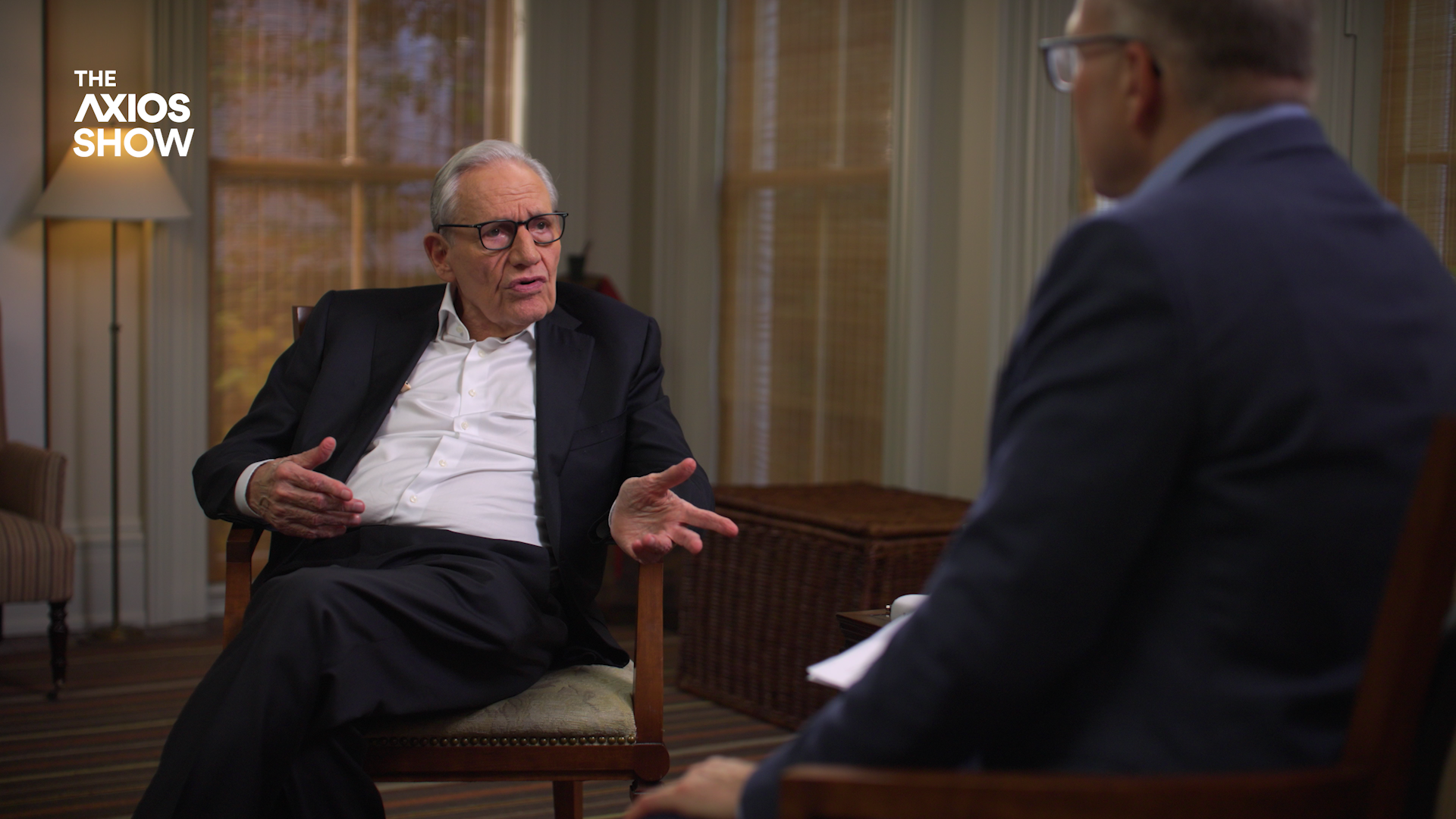
Bob Woodward interviewed by Mike Allen. Photo: Axios
Axios' Mike Allen:
- Bob Woodward, you're the most famous journalist alive. You've inspired... you shake your head, but you are —
Bob Woodward:
- Yes, I do shake my head.
Allen:
- You have inspired generations of journalists, including me, with your Watergate revelations and reporting. Now you're spilling some of your secrets in "Secrets: A Reporter's Memoir." Bob Woodward, double winner of the Pulitzer Prize, author of 24 cinematic bestsellers. Welcome to "The Axios Show."
Woodward:
- Thank you.
Allen:
- Bob, as you were mic'ing up, you were just saying that reporting in this time is more important than ever.
Woodward:
- It is. And I was thinking of an old story, which I recount in the book, in my early days at the Post as a reporter, and I was covering these sanitation inspection reports.
Allen:
- Yeah, you were on the Metro staff. You were a D.C. reporter.
Woodward:
- Yes. And we would get the reports and we would put them in the paper. And I had a source in the company, the business that did this for the city. And he called me one morning and said, "I've got the best example of an unsanitary restaurant we've ever had, and it's the Mayflower Coffee Shop." And I go, "Ah, the Mayflower Coffee Shop. Mayflower is a big hotel."
Allen:
- It was across the street?
Woodward:
- Across the street, right there, under my nose. So I thought, oh, well, that's maybe an interesting story, to say the least. So I go and I had a source in the health department. I said, "Give me the report on this." Because they wrote them up and he handed me the report and it was so yucky. … The Mayflower Coffee Shop had roaches crawling all over everything. And I thought, oh, this is a fabulous story because if it bleeds, it leads. And I took it to the city editor. He said, "Oh, that's a great story. The Mayflower Coffee Shop, the worst health inspection in the history of the city, write it up." So I drafted a story and [I had] seen, I had the document itself. It was safe and secure and accurate. And so I handed it to Barry Sussman, the city editor, and he said, "Oh, that's a great story.
- That's a front page story. Have you been there?" And I said, "No." And I'm thinking picky, picky. And he said, "Well, get your ass out of the chair. It's two blocks away." So I go over to the Mayflower Hotel, big hotel on Connecticut Avenue in Washington. And I go in, say, "Where's the coffee shop?" And he said, "We don't have one." And I said, "What do you mean you don't have one?" He said, "We don't." And so I look at the address of the health inspection report and it says Mayflower Coffee Shop and a different address on Connecticut Avenue. So I go to that address, and it's the Statler Hilton Hotel. And it turns out that the Mayflower Coffee Shop was in the Statler Hilton Hotel, not the Mayflower Hotel. So I realized, oh, I've got it wrong. Went back to the city editor and I'm thinking, wait a minute, why would the Mayflower Coffee Shop be in the Statler Hilton, not the Mayflower Hotel?
- Well, it wasn't. And I wrote up the story and the city editor, OK, fine, that's great. And we ran it correctly, but in my head clanking around was this idea, wait a minute, sometimes what's on the surface is not correct, that it's not the Mayflower Coffee Shop in the Mayflower Hotel, it's the Mayflower Coffee Shop in the Statler Hilton.
Allen:
- You have to get your ass out there.
Woodward:
- Yeah, but it's about two blocks from the Post. It's not hard. And so I corrected it and we ran it and it was a front-page story about these awful conditions in the Mayflower Coffee Shop in the Statler Hilton Hotel. I got it correct. Now, I realized if the city editor had not been picky, picky, had you been there, get your ass out of the chair, this would've been published on the front page of the Washington Post, and it might've been the end of my reporting career. So the idea — and it goes for national security stories, any presidential politics, White House stories, Congress stories, sometimes the Mayflower Coffee Shop is in the Statler Hilton Hotel — so you have to check, check within an inch of its life. And that's a permanent lesson. Look at the addresses, try to match them up. Maybe the names are not congruent.
- Maybe there's something left out. Maybe, as always, there's something you don't understand. So in my head is this idea, somebody says something's going on in the White House, somebody named is doing something and so forth. Well, maybe that's not right. I better check and the old routine, knock on doors.
Allen:
- And you made that famous. An editor at the New York Times was just talking about how for their great Nvidia scoop, they followed the money and knocked on doors. I thought that sounds familiar.
Woodward:
- Yes, it's true. And sometimes it, gee, that's extra work. I don't want extra work. I'm looking for the shortcut. We should bask in extra work.
Allen:
- I've had the privilege of knowing you for 29 years. I walked into the Washington Post as a young whippersnapper in 1997. You and I were just reminiscing about some of our time on the road.
Woodward:
- Yes. And what you were so nice about, you were covering the White House, the [George W.] Bush presidency. I was writing about it and there was a time I had an interview set up with President Bush, and just I wanted to tell you that I was going to interview the president. It's your beat, it's the White House. And instead of getting your backup, you said, "Let me tell you when you get to where —
Allen:
- Crawford, Texas was the ranch.
Woodward:
- Yes, that's right. The best place to stay is this hotel, the best place to eat. And then when I showed up outside Bush's ranch, there you were with, I think, breakfast and — Bob Woodward. No, no, it's not. It's kind of common courtesy, which is one of your trademarks.
Allen:
- Well, thank you. And you do the same. Administration after administration, decade after decade, members of the president's inner circle spill to you. Sometimes they regret it. Why do powerful people talk to Bob Woodward?
Woodward:
- Well, I think why they talk to reporters is because it's important to slow the process down. Don't run and sort of look for the breaking news headline. I recount in the book long interviews with people like CIA Director Bill Casey, and we never got to anything I wanted to ask about, but I wanted him to talk about what was on his mind. And so it's that old rule, listen. And then once you've listened, listen again.
Allen:
- Now, sometimes these officials regretted it. Why did people then talk to Bob Woodward again?
Woodward:
- Well, regret is sometimes people think they shouldn't have disclosed something.
Allen:
- Well, sure. Lots and lots of times over the decades, over the administrations, there've been embarrassing revelations in your book, which were therefore on the front page of the Washington Post. And I can tell you those officials were like this, and of course they would publicly deny it, but you always had receipts.
Woodward:
- Well, I tried, but sometimes you make mistakes. Sometimes the Mayflower Coffee Shop is not in the Mayflower, but in the Statler Hilton, and it's a version of so many errors.
Allen:
- All your life, including at Yale, as a young Navy intelligence officer.
Woodward:
- I was never an intelligence officer. This is one of these things [said by others] that I was an operations officer in the Navy. I was communications officer.
Allen:
- OK. Can I call you a young Navy lieutenant?
Woodward:
- OK, you may. Who's defensive about not wanting to be known as an intelligence officer? Because I wasn't.
Allen:
- Bob, all your life, including at Yale and as a young Navy lieutenant, 55 years at the Washington Post, you've been a student of power. What are the enduring commonalities, good and bad, of powerful leaders?
Woodward:
- Well, boy, they're all different. And that's if you try to put them in, oh, he's in this category or he's in that category. I remember when I started on the Supreme Court book, this was decades ago.
Allen:
- "The Brethren."
Woodward:
- "The Brethren." And I thought, well, I'm going to use the knock-on-door routine. And I found out … where Justice Potter Stewart worked, lived, I'm sorry, where he lived. He worked at the Supreme Court. So I knocked on his door, and he let me in and he almost was grabbing me by the shirt, saying, "No one understands the court." And of course, that's catnip to a reporter. You want to report on an institution, and here's one of the critical members saying, "No one understands it." And he let me in. We went for a walk with his dog. His dog's leash was a closed line, and he had a mint julep cup. And he said, "Let me tell you about the Supreme Court.
- Everyone thinks about the liberals and the conservatives, and one will be in control for a while, [then the other] one will be in control." He said, "But that's not the way it works. There is a group of centrist justices — himself, [Byron] White." He actually put [William] Rehnquist in this group, who was quite conservative, and said, "It's the center that's in control, and we've got three or four votes, and we can pick up three liberals or three conservatives and make a majority." And I remember taking that memo I typed that night, showing it to my colleague at the Post, Scott Armstrong, saying, "Look at this. This is an institution that a key member says no one understands. We should do a story 30 days maybe." And I said, "What do you think?" Scott, very smart, very... "Oh, it's a book." And so we dropped everything, found five of the justices who would talk to us, 170 law clerks.
Allen:
- Yeah. And the Supreme Court, for the viewers, the Supreme Court had never been penetrated. This simply was not done.
Woodward:
- That's right. You couldn't get there.
Allen:
- And nobody had conceived of it. And the fact that one of the most valuable sources in the world wanted to talk, or wanted to talk at least to Bob Woodward, fascinating.
Woodward:
- Yes, but his argument was the centrists [were] in control, and Scott and I took two years to do "The Brethren." I remember, so we talked to five of the justices who would talk to us, 170 law clerks. So I'm going through them, lunch, dinner, lunch, dinner, and there was a clerk named Goldberg, and I took him to lunch, and I said, "What's it like?" And he talked a little bit and he said, "No one understands the court, but where the understanding of the court can come from are case histories." I said, "What's a case history?" He said, "Oh, each clerk will do a case history on a major case." I said, "Did you ever do one?" He said, "Yes, I did it for the court, access to all the justices, all the files, all the records on the Nixon tapes case, which was the story everyone wanted." And so I went to his house, and he was reluctant to let me in.
- And I said, "I just need 15 minutes." And we sat there, and I said, "OK, I'll take notes." And he's talking and I'm taking notes for at least two or three hours. You ever taken notes for two or three hours? It's hard. My hand was hurting. He was going on and on, and he said that there are these case histories and the one for the Nixon tapes case he had at home. And I asked him to get it out and read, and he read and read and read, and I took notes. And then I thought I knew something about rapid eye movement sleep. And this went on for two or three hours, and he finally fell asleep. It was a couple of hours. I thought he'd gone into REM sleep, but I didn't want, maybe there's a security camera seeing me take the case history from him that he'd been reading from, and I want to do the proper thing, but the very aggressive thing. I want that. I don't want just —
Allen:
- Of course.
Woodward:
- And so he finally fell asleep. And this is not a tactic, necessarily, that should be endorsed, but he fell asleep. I waited that two hours, went over and said, "Let me just take this." And he's groggy and kind of. I said, "I'll have it in your office at 8:00 AM." And OK, OK. And I called Scott Armstrong. We were working on this together, and I told him the story of the clerk falling asleep and getting this. I remember Scott, who, toughest reporter I've ever known, said, "You really had balls." And having that case history, of course, took us to ... because the public story about the Nixon case was that Chief Justice [Warren] Burger had written a majority opinion and everyone had gone along. But then when you got the details of the case history, there was all kinds of infighting. Justice White threatened, "I'm going to write separately."
- He's going to break the unanimity. And of course, the power of unanimity was key in this case. You're telling the president of the United States he has to turn over his secret tapes.
Allen:
- And of course, you took it and fired up the Xerox machine.
Woodward:
- Yes. Took it to the Post, and I didn't have to fire up the Xerox machine, they have it always going, and made the copy. And then that was our path to getting inside the court. And we would talk to justices and clerks about the case, and we were finally able to publish our book, "The Brethren," which was, I think, the first time somebody really explained what went on.
Allen:
- No question. Nobody had tried. Nobody would've thought it could be done.
Woodward:
- Well, I think people had tried. I don't know. I mean, this was just a lot. But —
Allen:
- Nobody thought you could talk to a majority of the justices. It's the Woodward majority.
Woodward:
- No, no, it's not the Woodward majority. It's the reporting to show up at his house and let him read and talk and finally get the document without doing something untoward or illegal, kind of snatching it, but only waiting till he fell asleep. Does that make it more honorable? I believe so, because if there was a video of the whole engagement, I did everything aggressively, but not in a way where I was taking documents off his desk or doing something that would embarrass me or the Washington Post or the publisher.
Allen:
- We're going to pause for just one second. I'm going to let you tuck something in right here.
Woodward:
- OK. OK.
Allen:
- Yeah, perfect.
Woodward:
- Good. I'm sorry. Yes, you're right. What did I not?
Allen:
- No, these were good stories, but we'll do short from here.
Woodward:
- OK, good.
Allen:
- Smart brevity, as they say.
Woodward:
- OK. Yes, right. No. Didn't you write a book with that title now?
Allen:
- Most people aren't journalists, but everyone wants to learn secrets. They want their spouse or their kid or their coworker to tell them something. How do you cleverly get information out of someone who doesn't want to share it?
Woodward:
- It doesn't have to be clever. You just go and talk and listen. And I developed a little something that reminds me of this because I listened to some of the recordings of some of the interviews I'd done, and the recordings were done with the permission of the person I was interviewing. My wife, Elsa Walsh, who you know, a great reporter, listened to some of these, and I said, "What do you think?" And read the transcripts, and she said, "You talk too much." And I looked at them myself, and I do talk too much. And I learned you've got to listen more strategically, just shut up and develop this idea of jamming this finger into my little finger so it goes into the fingernail and it hurts. And it's a reminder, shut the fuck up. Listen.
Allen:
- Strategic listening, shut up.
Woodward:
- Yes.
Allen:
- Who's the most powerful manipulator of information you've ever met, good or bad?
Woodward:
- Oh, wow. From the files, give me a clue. I mean, I can ... well, OK. [President] Trump works at it and works at it very skillfully. I did interviews with him in 2020.
Allen:
- This was COVID.
Woodward:
- Last year of his first presidency, and he's smooth.
Allen:
- So he was trying to manipulate you?
Woodward:
- Yeah. Well, of course, and he's making his case, but I finally reached a point, and I'm trying to ... I mean, this is one of the luxuries of time, asking what's going on that's really important now, the Iran war. This is a war that Trump has started, is conducting. There's no provocation. He doesn't like Iran, and it's certainly not a great regime, but he's launched a war. Now, if you look at the history of the United States, when we've launched wars on our own, [it] leads to things like Vietnam. We need to not launch wars. We need to only respond militarily if we're attacked.
Allen:
- And let's be clinical. How does Trump do that? So let's talk about the dark arts of manipulating people. You've seen it all. You're a master of the dark arts. How do people —
Woodward:
- I'm a master of manipulation.You're —
Allen:
- A student of it.
Woodward:
- It's the rules. Slow down and listen. Go back. ... And if you read some of the interviews in here, you say I'm willing to spend hours with people just listening to something they want to talk about, not that I want to talk about.
Allen:
- You famously did 20 interviews with President Trump. All during COVID, you were phone pals, and this was when he was not being super promiscuous with reporters and his phone. Was that part of it? How did you keep President Trump talking?
Woodward:
- Well, I would call and ask, "What happened? Why? Why'd you do that?" And again, it's this mental attitude of not looking for a headline, but looking for the relationship. And he would always take my calls. He would call me.
Allen:
- Wait, Trump called you?
Woodward:
- Yes, he would call me.
Allen:
- Oh, that's right. You put him on speaker for Elsa, right?
Woodward:
- Yeah. My wife answered, once picked up the phone and said ... And it was Trump, and he said something like, "I hope you'll come to the White House and we can meet."
Allen:
- Wait, what?
Woodward:
- — That "we can meet." He wanted to meet my wife. He was laying it on pretty thick.
Allen:
- And you went.
Woodward:
- He was good. Well, not with Elsa, but it was an invitation. And look, he wanted to talk. He wanted to explain himself.
Allen:
- I mentioned this to Claire [McMullen, Woodward's assistant]. I'm going to ask you about the story when you took the manuscript into Ben Bradlee, and was it "The Final Days" or "All the President's Men" where he pulled out the page, where, was it Kissinger talking to the paintings? Remember that? And he said, "I'm putting this on the front page of the paper."
Woodward:
- Yes.
Allen:
- Was that "All the President's Men" or "The Final Days"?
Woodward:
- Yeah. Pardon? It was "The Final Days." It was the scene in which Kissinger was then secretary of state [and] national security adviser to the president.
Allen:
- OK. I'm going to ask you that differently. Ben Bradlee was the iconic executive editor of the Washington Post. He was your boss, and he was a legend and a celebrity because of your book and the movie, "All the President's Men." So when you wrote your book, "The Final Days," about the end of the Nixon administration, and Henry Kissinger was the national security adviser [and] the Secretary of State, you took a paper manuscript of all of "The Final Days" into Bob Woodward, into —
Woodward:
- Into Ben Bradlee.
Allen:
- You took a paper manuscript galley of "The Final Days" into Ben Bradlee. You took it into his office, and he found a page that he thought was news. And at this time, you wanted to keep it secret because you wanted the drama of the publication. What happened next?
Woodward:
- OK. Well, what he picked out wasn't just a single page. It was the scene in which Kissinger and Nixon get down on their knees and pray. And it was a real moment of ... it was so emotional for Nixon, and Kissinger initially denied it and didn't talk about, finally confirmed it all in his memoirs. But what happened is, and this is the power of reporting, is that after the prayer scene, Nixon was quite distraught and called Kissinger and said, "Henry, please don't ever tell anyone that I was not strong and that I cried." In Kissinger's office, he had two aides, Larry Eagleburger and Brent Scowcroft, who routinely picked up the phone when the president or somebody important called, and they were the sources of this. We printed it, and it was denied by Nixon for a while, and then finally he acknowledged that it was true.
Allen:
- Ben Bradlee spotted this passage, and he said, "I'm going to put this on the front page of the Washington Post." And you said, "No, you're not."
Woodward:
- "No, no, you can't do that. That's for the book." And Ben said, "One thing I know is when something is news, and I've got it in my hand, it's going in the paper, not next week, but tomorrow."
Allen:
- You wrote a trilogy about President Trump's first term, "Fear," "Rage," "Peril," with the titles. Based on your reporting and your rich understanding of governance, put President Trump's level of corruption in historical perspective. How does President Trump compare to Richard Nixon, the president you helped bring down?
Woodward:
- Trump is worse, much worse than Nixon. And the evidence is on two fronts. First of all, how much money he's made — billions of dollars himself as president. I mean, imagine that. It used to be a scandal if the president was getting a free ride on somebody's jet. Two billion —
Allen:
- Now he gets a free jet.
Woodward:
- Yes, now gets a free jet. So that kind of corruption is so deep and embedded, but I think what we'll remember and endure from the Trump presidency is the Iran war, which he's launched, as I say, without provocation. Bring the U.S. military in to attack another country. Yes, an unsavory country. But if we ever made the standard, "That's an unsavory regime," we'd be in wars all the time.
Allen:
- That's one of your singular insights is that presidents are known for their wars.
Woodward:
- They are known for their wars, but in this case, I mean, it's such a mistake. It's a mistake for Trump to use that power to launch a war against a country that, yes, as I say, unsavory, but what have they done to us? What in the foreign policy or the moralistic world? Do we have evidence they're enslaving children or something like that? . No, we have evidence this is a regime that is doing things and gathering power for itself. And Trump just says, "OK, we're starting a war." We shouldn't start wars. We should prevent wars.
Allen:
- You've spent hours and hours and hours with him. What is President Trump's strength? What is the best thing about President Trump as a human or as a president?
Woodward:
- Best. See, I'm not sure what best means.
Allen:
- Or what is a quality of his that you —
Woodward:
- Well, he persists, he doesn't give up, and we're now in a situation who knows what he'll ... he'll do anything to stay in power, and he proves it every day. And here's the great example of Trump that he presents to us. So go ahead.
Allen:
- You write in the book about how Nixon had people around him, reluctant wives who were able to check his worst impulses. … Trump has surrounded himself with people who don't check those well. So maybe just talk about —
Woodward:
- Yes. President Nixon had people who were in his circle who tried to stop wars and prevent wars. In Trump's circle now, there are all these people who are just feeding the beast and —
Allen:
- He's the beast.
Woodward:
- He's the beast, and he's being fed with kind of, "Oh, it's OK to start wars." Boy, I served in Vietnam during the Vietnam era in the U.S. Navy, and I just now realize war is the ugliest thing that can happen to a country, to people, and to be the one inflicting war on another country, no matter how bad it is. Yes, if they've attacked us or they've done something, sent chemical weapons into our midst or nuclear weapons, but this is not the basis for starting a war, and that's what he's doing. And that is so corrupt, that is so outside of presidential responsibility as I've tried to understand it.
Allen:
- You're still an associate editor of the Washington Post, the paper you helped make world famous, a place where we were colleagues. You've worked there 55 years. This morning's hard copy is sitting right over here on your kitchen table. You've been blunt about your concerns about the ties that the owner, Jeff Bezos, has to President Trump. Did Jeff Bezos put the Washington Post's reputation and future at risk?
Woodward:
- Yes, certainly. I mean, he's the owner and to show up at Trump's inaugural voluntarily in a very visible way, which is not just, oh, I'm going to the movies, it's, I am blessing and endorsing this man. And I remember seeing it and just feeling sick to my stomach and that I knew Katharine Graham, the owner of the Post during Watergate, would never do anything like that because she wanted the reporting to be hard and fiery and she didn't want to take sides. And I think it's important that the owner not take sides and Bezos to take that side of showing up at the inaugural. I literally felt sick to my stomach that that had happened, that he would do that. I've known Bezos for years. He used to have me before he really became rich out to the West Coast to talk to his staff, got to know him, and when he bought the Post, I though this is salvation that's come. And he has tarnished not only his own reputation, but that of the Washington Post.
Allen:
- Have you told him that?
Woodward:
- I've said it publicly.
Allen:
- Does he answer your emails?
Woodward:
- I don't send emails to him. I just thought any sort of indirect private communication, if I'm going to say something that's critical of him, I want to say it publicly. I don't want to hide.
Allen:
- When I first walked into the Post as a young Metro reporter, I was hired to cover the Alexandria City Council. I walked into that newsroom on 15th Street and it was like walking onto Lambeau Field. It was a show. The Post has shriveled since then. If we're being honest —
Woodward:
- Shriveled is the wrong word. I mean, there've been some valleys, there's no question about that, but I still, from my contacts and dealings with Matt Murray, who's the executive editor, I think he sees, understands the weaknesses and wants to make improvements and is regularly.
Allen:
- If we're going to be honest, we're going to say that —
Woodward:
- Let's be honest.
Allen:
- That it is no longer the player, the force, the destination that it was. How did that happen?
Woodward:
- Well, you could write not just a book, but volumes on that. And that happens when ownership forgets what the job is, and the job is to be aggressive, neutral, examinations, conduct those examinations of everyone, all individuals, all ideologies. And I fault myself, before I said this about Bezos and criticized him, I should have called him and said, "I'm going to say this, and I think you're making a mistake." And I didn't do that, and I should have.
Allen:
- The Post once rivaled the New York Times. The New York Times now is vastly deeper, more influential.
Woodward:
- And is making more money.
Allen:
- 100%. Are you bitter about that? Whose fault is that?
Woodward:
- No, no, no. Bitter is not a word that I try to allow into my bitter heart.
Allen:
- Who's fault is that?
Woodward:
- Who's fault is that?
Allen:
- Who's to blame?
Woodward:
- It's about leadership and the Post should have realized the opportunities and made no compromises. And it's made compromises, and you shouldn't. You want to go out and be the loud call on anyone's behavior.
Allen:
- A very raw and honest revelation in "Secrets" is that the publisher, Don Graham, he called himself the proprietor when he walked through the newsroom. He took you to lunch and he said, "You will always have a place at the Washington Post, but you will not succeed Ben Bradlee as the executive editor." If you had, how would Bob Woodward's Washington Post have been on a different course?
Woodward:
- It's an if question, and it didn't happen because as Don Graham said to me, "You will have that position here always, but not as an editor, you are reporter." And I thought that was personally very good advice. I love reporting.
Allen:
- But it was painful at the time.
Woodward:
- You were ambitious. No, it was when you're told about a defect, yes, it's a little painful, but sometimes the painful's true and it was in this case.
Allen:
- And what was the defect?
Woodward:
- The defect on my part that I was the editor, one of the editors [on a story by] Janet Cooke, who was the young reporter who made up a story about an 8-year-old heroin addict that she said existed, called him Jimmy.
Allen:
- "Jimmy's World" was the —
Woodward:
- "Jimmy's World" was the ... and she won a Pulitzer Prize for this. It turned out that it was a fraud and made up. And I should have, as soon as, because Janet Cooke came to me, and the other editor said, "This 8-year-old is being made a heroin addict by his mother?" I should have taken that lesson that I knew, go to the scene, see for yourself." And I said, "Janet, let's go hop in a car and we're going to see Jimmy." What's important if I had done that, it not only would've exposed the journalistic fraud, but the moral fraud. How are we printing a story about a mother making her son, 8-year-old son, a heroin addict? And the alarm bells should have gone off. If this is true, I want to see, I want to be the reporter on this. And that was a journalistic failing.
- And as I say, a very deep moral failing because if I'd said, "Let's go see the kid," there would've been no kid, and I would've not been responsible for this moral failing.
Allen:
- The Post returned that Pulitzer, and something very touching that you say in "Secrets" is that if you had been focused on the child, then it would never have happened.
Woodward:
- Exactly. And somebody runs and says, "Oh, there's a child being beaten in the alley over here." And am I going to send reporters out, "Oh, well, let's get everything that happened." Say, "Worry about the child who's being beaten." And if I in particular had had the wisdom, I would've said, "OK, hell of a story. I'm going to go see it."
Allen:
- A flashpoint for some of the early reviews of "Secrets" has been what we might call the Woodward rule, and that is you have long said that once a source dies, they're fair game to be exposed, and there are sources in here who are dead who were exposed. There was no Miranda, no Woodward for them at the time telling them when you're gone, you could be exposed. But you went through a very careful process.
Woodward:
- Yes. And I think what you want to do, what happened with these people is they made it history. I made it history. The Post made it history. Claire McMullen, my assistant, and I talk about this. What's the point? Because she's just starting.
Claire McMullen, Woodward's research assistant:
- Well, the point is that a lot of these people were already historic figures. They've already written a lot about the period. They were secret at the time, but they have since been revealed in some way, revealed themselves or active involvement.
Woodward:
- There's so much on the public record.
Allen:
- Well, I mean, that is the longtime inside joke in Washington is a lot of your sources were well apparent to anyone involved, but you had never said to them, "If you kick the can, I will expose you should you have." And the Woodward rule is unique to you. That's not a thing in journalism.
Woodward:
- Well, but it's history. Once it goes into history, you can't say ... I mean, look at the histories that come out, the Adams-Jefferson letters, which were very secret, but when they come out, historians rejoice. We now see what they were saying to each other, and that's often the case. And I'm for history on occasions like that.
Allen:
- So you have zero qualms?
Woodward:
- Well, you always have qualms, but what's your responsibility to get the history right and take people who are reading the history and trying to understand it deeper into the story? And deeper is naming those sources. They're not vulnerable. They're almost all deceased or have outed themselves in memoirs and interviews. So history really is important, and in journalism, we can't shy away from it. We need to run into its arms.
Allen:
- One of my favorite parts of the Woodward reporting lore is your dining room right over here in Georgetown. So sources come into your dining room and it's almost like there's hypnotic gas comes out of the lights.
Woodward:
- Bullshit.
Allen:
- No, I've talked to them. So I've talked to your sources after they come in.
Woodward:
- Oh, and they say there's this gas coming down.
Allen:
- No, no. But what they say is, "I come in there and I think that I know what I'm going to say, and then I get around the table." And it's like my mother used to read us that poem, "Come into my parlor, said the spider to the fly." So in your parlor, they get around your table and they think, "Shit, I'm with Bob Woodward. I better be good." And they spill.
Woodward:
- Sometimes people do, but it's always so straightforward. This is the work I've done. This is what I know. Help me fill in the gaps. And there are always gaps. I tell you, there's no magic gas coming from the ceiling in my living room.
Allen:
- But people get in here and they talk.
Woodward:
- People love to talk. You know that. Any reporter, what stumps us often is we're in such a hurry. I describe in here in detail, again, spending hours with people like Bill Casey, the CIA director. What does he want to talk about? I'm here to listen. I'm not trying to get a scoop or something. I want the relationship, and that relationship turned out to be journalistically very important to me.
Allen:
- You may remember a Georgetown kid who was the news aide on the National Desk, Nick Johnston. He sorted your mail, he would answer the phones. Nick Johnston is now the publisher of Axios. We've been at this a while, so keep an eye on the news aides.
Woodward:
- Yes, of course. How old is he?
Allen:
- Younger than us. Pardon? Younger than us, but now has two kids. But when he was coming by, you were walking by, you were on duty as the editor doing the front page, and Jim Rowe, who was the night national editor, he introduced Nick. Nick was in awe, couldn't say anything. Jim said to you, "Maybe you want to give this Georgetown kid some advice." And you said, "Keep a diary." You've given that advice a lot. What are your own diary habits, and why do you give that advice?
Woodward:
- Because it puts down the personal record. My own diary, I mean, I am incessantly doing memos and notes, and Claire McMullen will be over there asking for more. "What exactly was said? What happened? Why did you do this? "Not letting me off the hook from my own goals, which are "get the whole story."
Allen:
- So your memos to the file are faith. So for 50 years, every time you had a lunch, every time you had an interesting dinner party conversation, ran into somebody at a holiday party, if there was something good, you came back and you typed it up or dictated it, and it's all in filing cabinets here. Tell us how the memos to the file came to be. It's like 50 years of Washington's most interesting, consequential conversations.
Woodward:
- Well, Claire, you've looked at them and read them and emptied them out, and I'm embarrassed to say sometimes they're better than the memos or the transcripts of the conversation. Why? Yeah, because I'm talking about feelings and reactions to people and circumstances, and part of journalism is taking the informal life and making it part of the formal life of getting that stuff out, and I've done a lot of it in this book.
Allen:
- And then you would draw on the memos to the file for your books?
Woodward:
- Yes, in many cases, and sometimes they're better, as I say, than the books.
Allen:
- We talked at the top about you and I crossed paths in Crawford, Texas, George W. Bush W, as he called himself, at his ranch. You were interviewing him for "Bush at War," 2002, and you didn't wing that interview. You had astonishing typewritten pages and pages of questions. Bush knew what they were. Take us behind the scenes of why you showed it.
Woodward:
- Well, in some cases, and I think in that, you send the questions ahead. Do you want the person you're interviewing to do some research, some thinking? And maybe a couple of cases it's, "Oh, I wrote a memo on that," and it would get one of the national security advisers or somebody to unearth that memo. It's always important to understand what you didn't unearth, because it's always something.
Allen:
- No, what was interesting to me about it was you weren't trying to catch him or trip him up. You wanted to know what was in his mind, and I think what surprised some people at the time was President Bush had very vivid and specific memories of what he was doing at every single one of those decision points. If I remember from the book, "Bush at War," he aced your test.
Woodward:
- Well, I mean, he provided answers, but I said in questions —
Allen:
- From his perspective, yes.
Woodward:
- And this is, if I recall correctly, this was after 9/11. One year, he wouldn't see me and wouldn't see me, and finally I'm sending these questions and said, "I'm doing a book on this." And soon as they discovered that, they were much more willing to talk, as was he.
Allen:
- In "Secrets," you reproduce a letter on Washington Post letterhead that you wrote to former President Gerald Ford in 1997, asking for his help with a project about the impact of Watergate on the succeeding presidents. You asked him, showing your hand ahead of an interview, "Why does a climate of scandal and distress seem to pervade post Watergate Washington?" 29 years after you typed that letter, that's even more true. Why? Scandal and distress pervading Washington.
Woodward:
- Well, it does. Maybe it's in our DNA. I'm not sure. But again, though. it's a way of ... one of the things, it's always important, and I try to do this all the time, ask for the maximum. I'm calling Casey, I want to talk when? Now, now, leaving messages. So whoever's answering the phone, taking messages, says, "This a-hole keeps going, here's the ..." And finally, you can break through often, not always, but a kind of urgency is important to communicate because telling the truthful story as best you can is important to journalism. I think it's important to democracy. I think if it turns out, as it has often turned out, that journalists have missed the story, got it in completely wrong.
Allen:
- One of your secrets, and as a student of Bob Woodward for decades, I've talked to your —
Woodward:
- No, don't be a student of me, please.
Allen:
- But I would talk to your sources after they talked to you, and part of your secret was you would have so much preparation, you would go in and you could tell them verbatim what had happened in a meeting, and then you would basically say, "And then what did you say?"
Woodward:
- Yeah, and what's missing? What don't I know? I did this, and George Stephanopoulos, who was [President] Clinton's communication director, writes extensively in his own memoir about coming over here, and the polished wood of the table, and the really great roasted chicken, and then me getting out, "I understand at the first meeting on the economic plan, you said X and Y, the president did this and so forth." And this is important, he's kind of repelled by it but drawn to it. And when I first called him and he says in his own memoir, he got the call from me, and he said, "I had two reactions. Oh, yes." And the second reaction was, "Oh, no."
Allen:
- It's the power of the Woodward dining room.
Woodward:
- No, it's not. I mean, what for young journalists, for whatever it's worth, is don't be in a hurry. The hurry-up mentality of, is it breaking news? Somebody goes in, "Oh, maybe I'm going to get breaking news, maybe." Don't take that sleeping pill, if you will, because the sleeping pill, you're missing the story, and the story is what they want to talk about and what they will say. Yes, you're going to have pressing questions and follow up, but it's again, shut the fuck up.
Allen:
- Well, and here's another part of your magic is that you go back, you will go back and you'll ask someone about multiple things, but they perhaps wouldn't talk to me about breaking news, but months or years later, they'll talk to you.
Woodward:
- Maybe. I think I communicate to people, I want to know. I want to really go deep on this, and I say to people, I'm not looking for breaking news. And breaking news has done damage to our business because what's the short, quick answer that somebody has this ... Trump breaking news all the time, and it's often irrelevant, and it's often wrong. It's often a lie, and that's, of course, the problem with so much of this hurry.
Allen:
- Rapid round, the fatal flaw of presidents you've covered, Richard Nixon.
Woodward:
- Lying and thinking people who have questions are stupid.
Allen:
- Gerald Ford.
Woodward:
- Gerald Ford got it right. It took him a while. I spent all this time going seven trips to California to figure out about the pardon, and he made the case. And I happen to think he's right that the pardon was a good thing for America because it got Nixon off the front page into the history books.
Allen:
- Jimmy Carter.
Woodward:
- I had interactions with Jimmy Carter in the first week of his presidency. Somebody told me a big CIA secret that King Hussein of Jordan was on the CIA payroll, and that was a big story. And I called Jody Powell, who I'd never met and said —
Allen:
- The president's press secretary?
Woodward:
- Yeah. And I said, "And I'm working on this story about payments by the CIA to King Hussein, and it's under the code word no beef." And Powell said, "No shit." But having that code word, Powell called back and said, "The president will see you and Ben Bradlee in the Oval Office tomorrow at 9:00 AM."
Allen:
- And he did.
Woodward:
- And he did. And he answered the questions, told the truth, and then he later lied and said he had not confirmed and told us all these things. I mean, how sad, because he said these payments to a foreign leader, he had stopped. He considered them bribes, and that was in our story, but then he kind of walked away from it instead of standing up and saying, "Yes, they're bribes. We're not paying, having the CIA, our intelligence agency make cash payments to a foreign leader." In this case, for Hussein, it was for women, it was for security guards, it was for, kind of, fill my bank account.
Allen:
- Fatal flaw, Ronald Reagan.
Woodward:
- I know Reagan looks better and better with time.
Allen:
- In what sense?
Woodward:
- In the very large sense, he and Casey, the CIA director, had this idea of the real targets are communists and terrorists and we're reaching for the high bar. That's what our goal is. And frankly, I didn't understand that at the beginning.
Allen:
- At the time you thought what?
Woodward:
- I just was taking it day by day and got into this breaking news. What's new? What can I do right away? And this can be an illness in our business.
Allen:
- George Herbert Walker Bush, Bush 41.
Woodward:
- Let's see. He's the one who wouldn't talk to me, right? And he sent this letter to me when I asked to interview him, and this is after he left the presidency. I publish it in the book because he's so angry. And he tries to have it both ways.
Allen:
- So he never talked to you.
Woodward:
- He would never talk to me. And that's fine because the letter's better than any interview.
Allen:
- Why was he so angry?
Woodward:
- Because I represented this kind of intrusive investigating, wanting explanations for everything. I mean, he says it. I mean, it's really, he opens his heart and his head in that letter and it's so much better than any interview.
Allen:
- William Jefferson Clinton.
Woodward:
- Well, Clinton, I wrote the first book, "The Agenda," which showed how angry he would be and how he lost his temper. And I now go back and look at the Clinton presidency, and I've said this publicly, it gave us two things that were important to American citizens, peace and prosperity. That's not bad. How much would we love to have as a country peace and prosperity under Trump? He gives us war and an economic plan and a whole view of make the economy for me and my people, and we're going to get rich. And that's exactly what he ... I mean, that is high-scale corruption.
Allen:
- But at the time, that was not what President Clinton was known for.
Woodward:
- No, but Clinton was known for his scandals and the chaos in the administration, which I wrote about. But you have to report and make the judgment based on what you had, and that's what I had. And I look back now decades later and say, "Not a bad outcome, peace and prosperity."
Allen:
- President George H. Bush's son, George Walker Bush, Bush 43.
Woodward:
- I interviewed him, I think, more than anyone, and he was trying to sell his invasion of Iraq under the suspicion, the shaky evidence that they had weapons of mass destruction.
Allen:
- He really did want to persuade, convince you.
Woodward:
- Yes, he wanted to convince the world. When I finally got to interview him about it, there'd been no weapons found. Even to this day, there are no weapons. I mean, imagine invading a country, which is the most aggressive act a country can do and the leader can do, and not have somebody kind of say, "How good is our evidence? Do we really know?" Oh, there were 4,000 U.S. servicemen. Excuse me. There were 4,000 U.S. servicemen who died, and they called it Operation Iraqi Freedom, and never found any weapons of mass destruction. I think it was President Obama asked me when I was doing an interview with him, he said, "Have you ever thought about being CIA director?" And the answer, of course, is, "No, I don't want to be on the inside where you lose your independence." Well,
Allen:
- No, but you could read all the files. You could see everything.
Woodward:
- Yeah, but what could I do with them?
Allen:
- So you think you interviewed Bush 43 more than Trump?
Woodward:
- I believe so, but I'm not sure what the ... no, my expert says no.
Allen:
- Barack Obama.
Woodward:
- Obama had a great way of lowering the shield and letting you into the office for these interviews. And as I pointed out, he knew how to keep the shield up and joked with me about if you ever thought about being CIA director, which was a joke, not a job offer.
Allen:
- Excuse me.
Woodward:
- No?
Allen:
- Just a second here. If you want to take a sip of water. Fatal flaw, Donald John Trump.
Woodward:
- Trump's a liar, has no sense of the obligations he has to the people, the presidency. And as I say, this war in Iran, there's no justification for it. He's conducting it and using that power of the presidency for not the purpose of what's best for the country is, as far as I'm concerned, a crime.
Allen:
- Joseph Robinette Biden Jr.
Woodward:
- I only interviewed him when he was vice president and he's —
Allen:
- Why didn't he talk to you as president?
Woodward:
- Pardon?
Allen:
- Why didn't he talk to you as president?
Woodward:
- He only talked to me when he was vice president. I think I was really never focused on him.
Allen:
- What was his fatal flaw?
Woodward:
- Being president.
Allen:
- Donald Trump, round two.
Woodward:
- Yeah, we made ... yeah. Yes.
Allen:
- Fatal flaw. Donald Trump, round two.
Woodward:
- Doesn't understand how to use his power for the people. I once asked him, "What's the job of the president?" He said, "The job of the president is to protect the people." And I think that's a really good answer. And what Donald Trump has done is, most of his actions are designed to protect Donald Trump and make Donald Trump and people around him rich. And this is a corruption that goes to the core of what a president should not be or do.
Allen:
- The two of you fell out. Donald Trump sued you for $49 million. A judge dismissed it. Is there any chance that you and Donald Trump would make up?
Woodward:
- It's not a matter of making up. It is if there was a story that was so important, I would happily send over questions. I like to send Britain questions to presidents, and maybe he'd reject them, maybe he wouldn't, but he's got a lot of power and who knows where... In a sense, you can look at what's gone on in the Trump presidencies as there was never a real crisis, was there? What? Well, they were only what he thought were real crises,
Allen:
- But - I'm getting the hook, so whatever one question before penultimate.
Woodward:
- Who has authority to give you the hook?
Allen:
- OK.
Woodward:
- Thank you.
Allen:
- Thank you for telling me. Would it be better if journalists went back to being old-fashioned reporters as opposed to the current model of authors, celebrities, influencers? What's the danger, the trade-off now that so many top journalists with you as a pioneer are all those things?
Woodward:
- But it's great to write books. It's important to do that. I mean, I hate the term influencer. I don't know. People are influencers, sometimes not. I mean, to me, it's not a term I apply.
Allen:
- Is that...
Woodward:
- Yeah.
Allen:
- Now that anyone with an iPhone can say that they're a journalist or a reporter and they can be, what do you make of that?
Woodward:
- Well, it's the First Amendment. Anyone can. They may not succeed, but they may. And whoever would've thought Axios would've become this mountain in the media world when I heard... Who actually started Axios?
Allen:
- So Jim VandeHei, Mike Allen, Roy Schwartz. Axios, worthy in Greek.
Woodward:
- And what year was this?
Allen:
- 2017.
Woodward:
- 2000, which is not even 10 years ago. Yeah.
Allen:
- It will be 10 in January.
Woodward:
- My famous discredit, I thought, "What the hell is this? Is this going to work?" It's already a crowded field, but you have made a brand and you've made it successful, and I salute you. I was wrong in being skeptical. That's one of the many times I've been wrong.
Allen:
- Well, thank you. You've been a great encourager, and you start your day with Axios AM.
Woodward:
- I do. Yeah. What else do we need to be?
Allen:
- You've always been very generous with credit. You were kind to me as a young hustler. In "Secrets," you list the honor roll of 20 research assistants who've worked with you on your canon over 51 years. Many of them are famous bylines now themselves. Starts with Scott Armstrong, goes to the incumbent, Claire McMullen. They're your assistants, but you call them "my partners and crucial to my work."
Woodward:
- They're collaborators. I learned from working on Watergate with Carl Bernstein that he knew so many things that I didn't know. In my collaborations with Claire or any of these people, it's always, "What do you think? What's going on? What are your questions? Here's my memo. Give me a memo." It's real and genuine collaboration. Claire came to me once and said, "This thing you're working on isn't working." And you need and want people like that to kind of say you're heading toward the sewer."
Allen:
- As we say goodbye, you're 83. In "Secrets," you write, "The reporting job is never done. I will continue to show up and knock on doors even with a cane in my hand." It's wired into you.
Woodward:
- It is. And the reason I spend time at the beginning talking about my childhood, my parents, the experiences wired it into me, that there are secrets, that there are hidden relationships. And you need to understand and address forthrightly the emotional residue, as I try to here. I was talking to my sister yesterday, who is eight years younger, because she got the book and she said, "Wow, I mean, all of that happened." And we had a very nice talk about our parents and our mother, particularly, who was bipolar, and what childhood was like and how childhood is indelible. You don't get it out. You can't erase it. That's why I run right into it at the beginning of the book by saying, as an 8-year-old, as a child, I was always suspicious of most things. Still is the case.
Allen:
- What's your next book?
Woodward:
- Don't know. Don't know.
Allen:
- You think you have another Trump book in you?
Woodward:
- It's highly unlikely. Who knows? Who knows?
Allen:
- What's your dream? What's your —
Woodward:
- Yeah, but you don't ... where's the evidence? Suppose Donald Trump's significant aide on the following says, "I have the story on the way Trump mishandled the relationship with Iran or the relationship with [Russian President Vladimir] Putin." I mean, it's all, you're looking for leads, and I hope you make it clear to people I'm available. My phone number is 202-965-3515.
Allen:
- Bob Woodward, thank you for welcoming "The Axios Show" into your home.
Woodward:
- Thank you.
Allen:
- Your long-, long-, long-awaited memoir is "Secrets." Why did you finally write it?
Woodward:
- Because I wanted to take people as close to what has happened in my reporting life, and frankly, my personal life, because that sets the stage. I was thinking of leaving that out, and Claire McMullen and my wife also said, "You can't. You've got to talk about yourself." So I've tried to learn something, but I also have that feeling I haven't learned enough. And of course, how do you learn more in our business? Go to work.
Allen:
- What do you hope the impact will be? Why does "Secrets" matter now?
Woodward:
- Because at this time of Trump, with alleging fake news of anything he doesn't like, that this is a demonstration on my part, it's not fake. It's based in real reporting, and in fact, it is distinctly unfake, and I think it shows itself as that. I think it's something I once had someone say about one of my books offered some criticism and said, "But it's an honest book." And that's what I've tried to do in every case and tried to do this here. When I say it's a journey for even when you do your first book or your first story, it's always a journey.
Allen:
- For your 24th.
Woodward:
- Yeah.
Allen:
- 25th, right?
Woodward:
- But this is the journey, and this is the journey.
