U.S. drivers are just absorbing high gasoline prices

Add Axios as your preferred source to
see more of our stories on Google.
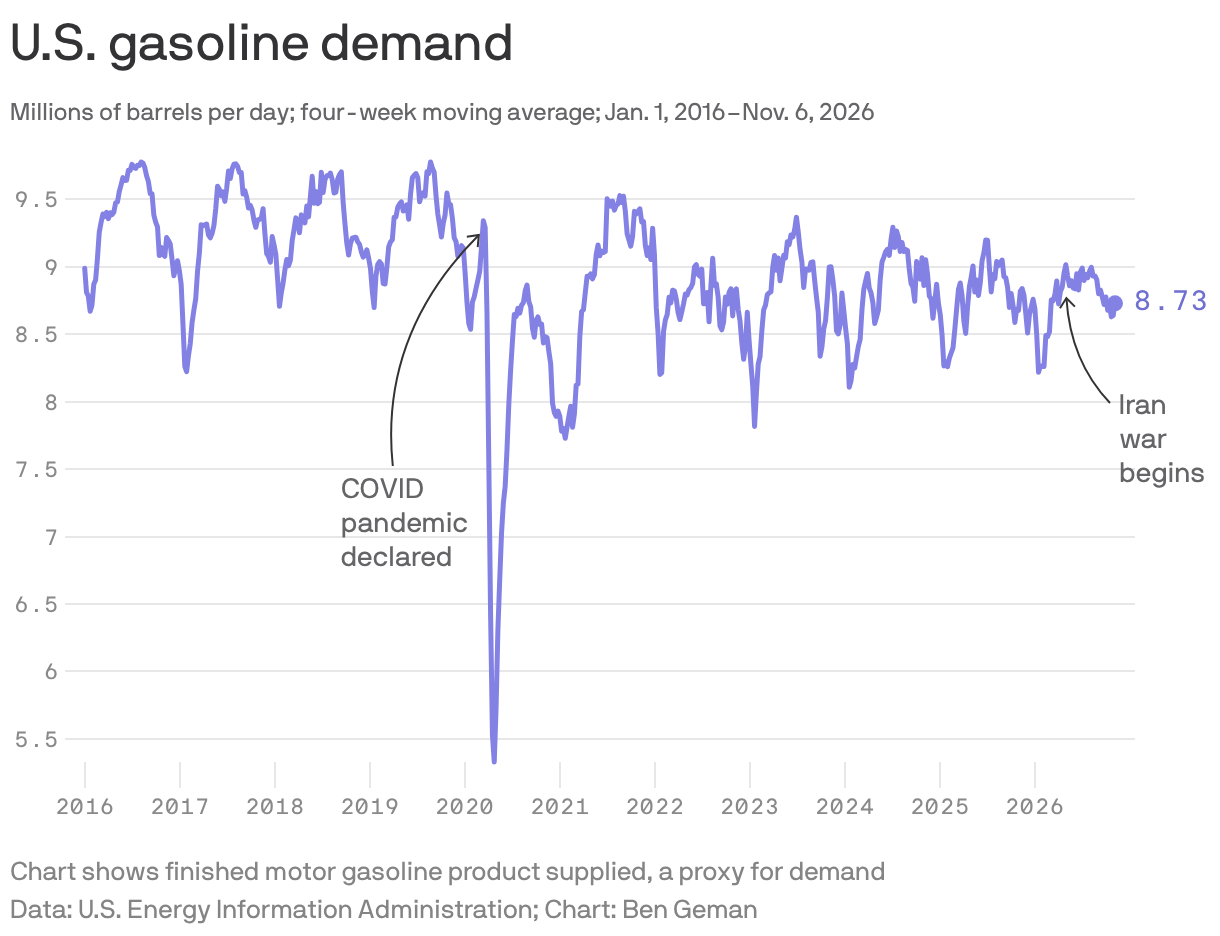
Pain at the pump may have changed some votes, but it's apparently not prompting big changes in how much Americans drive.
Why it matters: Most driving isn't especially optional, so people are absorbing the cost.
- This year Americans have paid an additional $88 billion for gasoline relative to a no-war baseline, according to Brown University's Climate Solutions Lab.
- The Energy Policy Research Foundation finds that U.S. households paid between $300 and $730 more on gasoline in March-August compared to the prior year.
State of play: Gasoline demand from the beginning of March, right after the Iran war started, through early November is very similar to the same stretch last year, per federal data.
- There's "no discernible evidence of a decline in gasoline consumption," UC-Berkeley energy economist Lucas Davis writes in a new post on the topic.
- That's despite gasoline prices being 31% higher since the war began compared to the same period last year.
The intrigue: Davis points out that the stubborn demand comes despite polling that shows Americans say high prices are changing their habits.
- He flags an April Washington Post-ABC News survey that showed 44% of respondents saying they had cut back on driving.
- Multiple polls show some version of this. For instance, 57% of respondents in a June Gallup survey said high prices were causing them to drive less.
How it works: Davis' post and the chart above rely on the federal Energy Information Administration's measure of gasoline product supplied.
- EIA calls it a proxy for demand, and measures gasoline leaving the supply chain, including refineries and bulk terminals.
- There's no perfect measurement. The Transportation Department tracks miles traveled, though there's a lag. The most recent data, for August, does not show a drop-off this year.
The bottom line: "[T]his is a valuable reminder of the gap between what people say and what they do," Davis writes.
- "Drivers may talk about cutting back, but studies in the economics literature consistently find that gasoline demand is inelastic in the short run," he writes.
