Heat wave's deadly impact grows

Add Axios as your preferred source to
see more of our stories on Google.

Misting stations during extreme heat along the National Mall in Washington, D.C., on July 3. Photo: Amid Farahi/AFP via Getty Images
Extreme heat gripping much of the U.S. has killed at least two dozen people over the past week, as about 40 million people remained under heat alerts Sunday.
Why it matters: Extreme heat is the nation's deadliest weather hazard, and the rising death toll underscores how dangerous prolonged heat can be.
The big picture: A prolonged heat dome stretching from the Midwest to the East Coast has kept tens of millions under heat alerts and made the weeklong heat wave one of the summer's deadliest weather events.
Zoom in: Officials in New Jersey announced 22 heat-related deaths over the weekend, as a massive heat dome envelops much of the eastern U.S.
- Officials also reported one heat-related death in Cook County, Illinois, and one in Hinds County, Mississippi, during the broader heat wave, according to local officials.
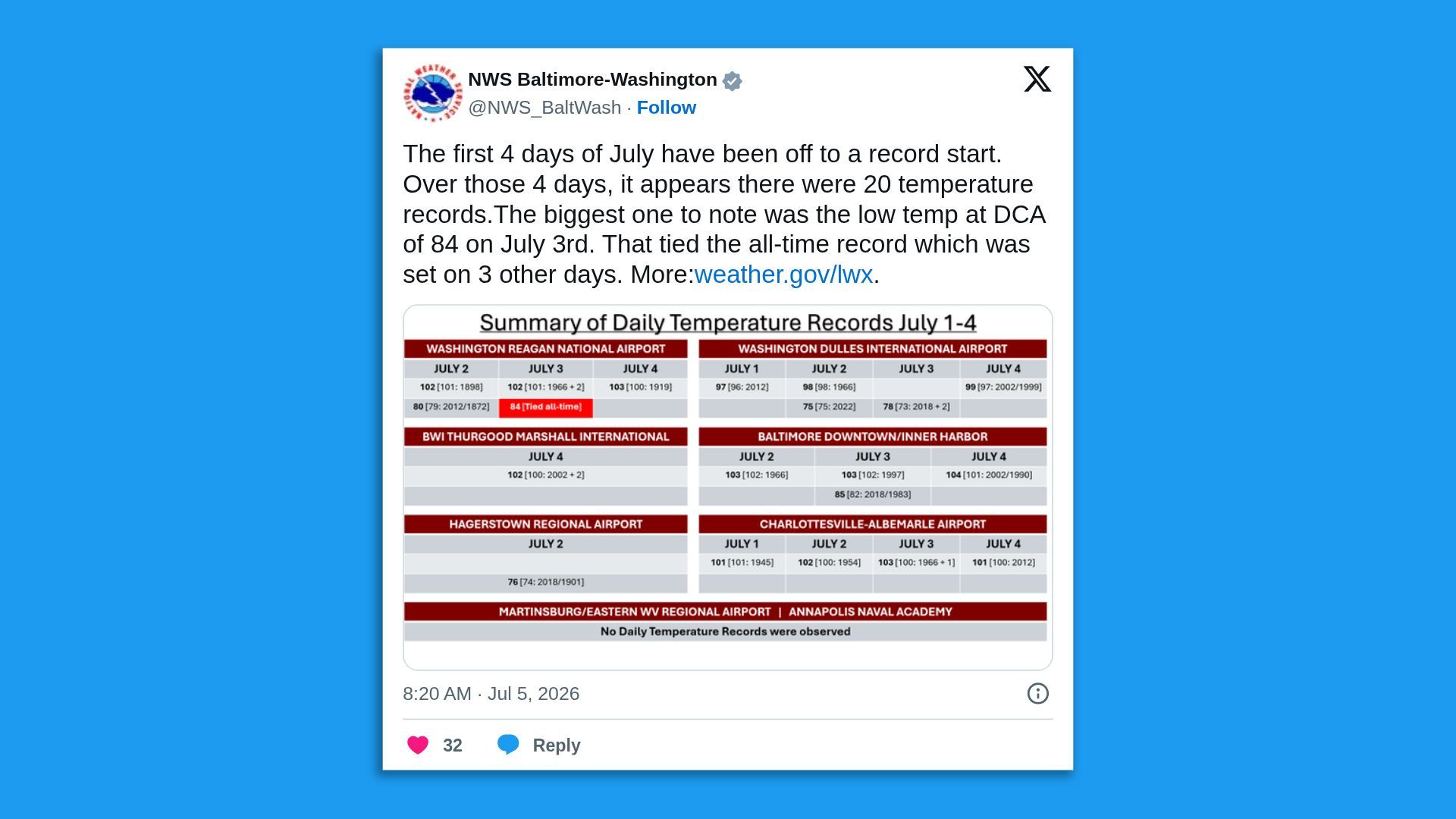
State of play: National Weather Service climate reports show daily record highs were set or tied across dozens of observing sites over the long Independence Day weekend.
- NWS climate records included Reagan National Airport in Washington, D.C., which saw back-to-back temperature records: a July 3 maximum of 102°F that tied for the record and a record July 4 high of 103°F.
Between the lines: Climate change is making heat waves longer, hotter and more frequent, studies show.
Zoom out: World Weather Attribution analysis found human-caused climate change would have made Europe's ongoing record heat "virtually impossible" 50 years ago.
- An estimated 20,000 people died in extreme heat across Europe last month, according to a preprint study.
What's next: : Last week's oppressive heat will continue to retreat through early this week as cooler temperatures and potentially flooding rains spread across parts of the Mid-Atlantic and Northeast, the National Weather Service said Sunday, the National Weather Service said in a forecast discussion Sunday.
- Above-normal heat will persist across the Southeast, with highs well into the 90s from the Carolinas to northern Florida.
- "Combined with high humidity and warm overnight lows in the 70s to near 80 degrees, these conditions will continue to pose an elevated risk of heat-related illness, particularly for those without adequate cooling or hydration," the NWS warns.
Go deeper: What increasing heat does to our bodies
