Axios AI+DC: Takeaways from the 2026 summit

Add Axios as your preferred source to
see more of our stories on Google.
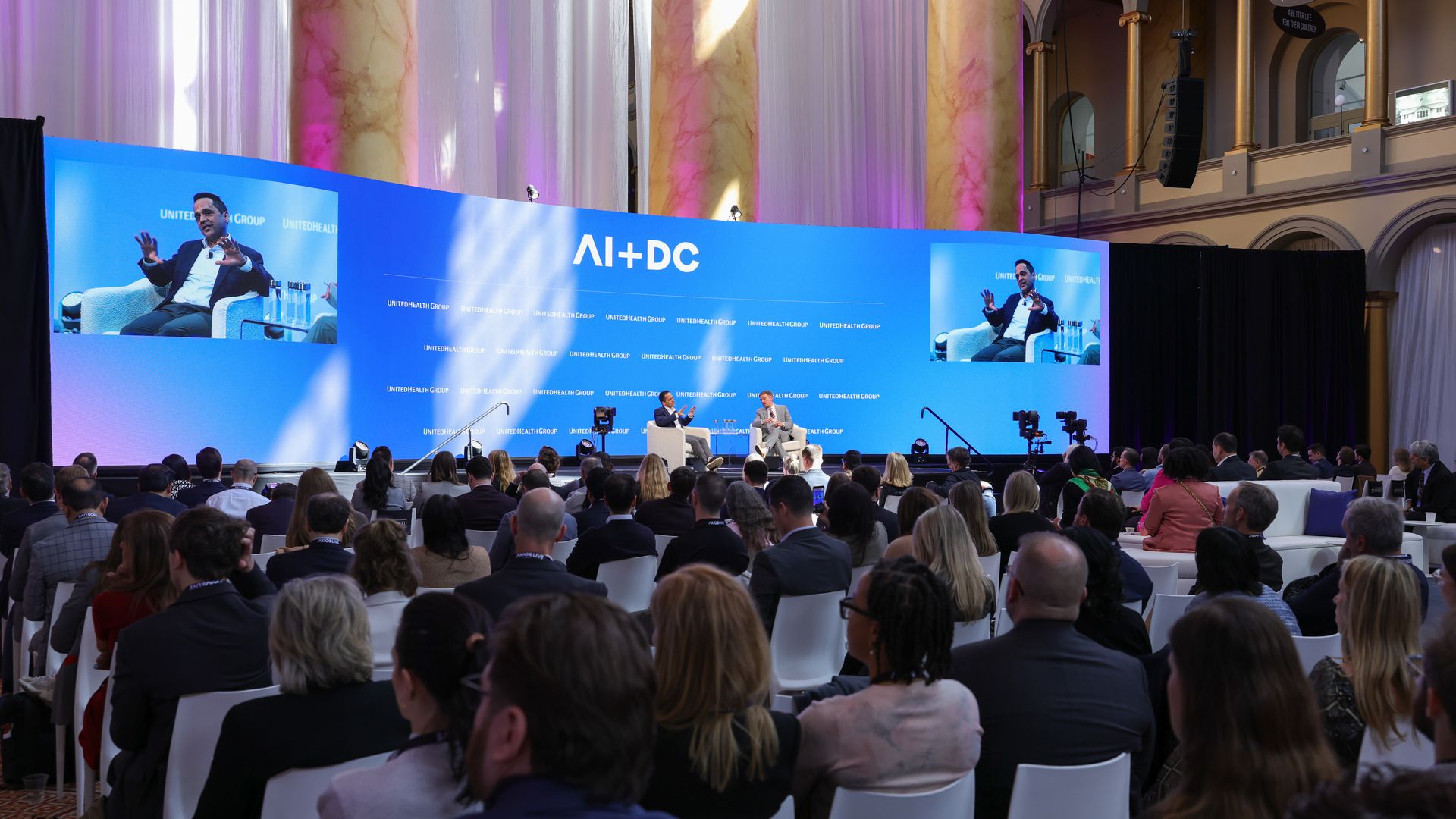
The Axios AI+DC Summit stage and crowd. Photo: Bryan Dozier for Axios
WASHINGTON – Axios held its fourth annual AI+DC Summit on March 25 to explore the next wave of AI transformation and its societal impacts.
Why it matters: The half-day event brought together top executives, policymakers and technologists to grapple with artificial intelligence as a generational shift with sweeping implications for the economy, geopolitics, workforce disruption and safety.
- The event was sponsored by Accenture Federal Services, Adobe, Allison, Anthropic, Build American AI, Skydio and UnitedHealth Group.
Catch up quick: Here are our top takeaways from the conversations …
1. The U.S. will need a "whole new workforce" for AI in the next few years to remain competitive in the global AI race, Meta vice president and chair Dina Powell McCormick said.
- "Just in the next two years, 500,000 electricians are needed to build all the infrastructure that's going to be needed just in the United States," McCormick said.
- "We talk about it as the workforce of America, because if you're competing on behalf of America, these are the real heroes that are building the very infrastructure that will help us win."
2. Sen. Josh Hawley (R-Mo.) said he hopes the new court decisions finding Meta and YouTube liable for teen mental health issues will be a "wake-up call to Congress" for social media regulation.
- "I think to have two juries now find these companies twice back to back in different states is a huge deal," Hawley said.
- Powell McCormick, responding to the latest California jury decision, said the company is working hard to "ensure that there's not harmful content."
3. Sen. Mark Warner (D-Va.) said he believes AI's economic disruption "is going to be exponentially bigger" than he thought just a few months ago.
- "The recent college graduate unemployment is 9%. I'll bet anybody in the room it goes to 30% or 35% before 2028," Warner said.
4. The newly released White House AI framework is something that "the country has expected of Washington for some time," said Michael Kratsios, director of the White House Office of Science and Technology Policy.
- "It's the start of a conversation with Congress where we urge them to create and draft legislation that can ultimately make it to the president's desk," Kratsios said.
- Amid growing concerns about AI-driven increases in consumer electric bills, Kratsios said President Trump brought all of the Big Tech companies together "essentially to agree to build, bring or buy their own power every time they build a data center."
5. AI is simplifying coding, making it easier for people without software development skills to "vibe code," or use AI prompts to have chatbots build apps or websites quickly. "We started our company – even 10 years ago, before vibe coding – with the express mission of creating a billion new software developers," Replit CEO Amjad Masad said.
- "It's very difficult to learn how to code," Masad said. "Now, with the rise of AI, what happened is AI turned out to be really good at coding."
Go deeper: This summit was the culmination of Axios' first AI+DC Takeover Week, a three-day series of events reflecting our commitment to serious, substantive coverage of a technology defining the next era of American power and global competition. Watch the events here.
Content from the sponsors' segments:
In View From the Top conversations, UnitedHealth Group EVP and Optum Insight CEO Sandeep Dadlani shared examples of how AI is improving health care. He explained that the Optum Real program "addresses the claims and reimbursement problem across America" to reduce the back-and-forth between payers and providers.
- "We started a pilot where patients were getting upfront cost estimates for their radiology and cardiology procedures," Dadlani said. "The accuracy of the upfront estimate [was] 95.6%. … This at scale takes out about $500 [billion] or $600 billion of administrative waste across health care in America, makes it more affordable, gives patient choice and so on."
Accenture Federal Services CEO Ron Ash said the public and private sectors have to unite on deploying AI solutions for government agencies at speed.
- "This is a call to action for all of us. … If we think about our adversaries, and specifically China, they're not doing nine-month procurements, dealing with protests and doing bake-offs across technologies," Ash said.
- "They are singularly focused on solving and driving models at scale across their government. We have to do the same."
Louise Pentland, Adobe's chief legal officer and executive vice president of legal and government relations, said AI is not replacing human creativity.
- "AI is truly an accelerator for creativity, and we want to see that be the premise in which we all galvanize around, so that we are really thinking about AI both from the creative's perspective, but also from a commercially safe, responsible perspective," Pentland said.
- Adobe built its Firefly product as an "IP-safe environment" for creators, and over 30 billion images have been generated with it, she said.
Anthropic head of public policy Sarah Heck said AI is increasingly a priority for Americans. "We're watching people think about the data centers in their backyard, or the way that kids are using AI in school," she said.
- Anthropic has been asking people around the world how they're feeling about AI. "There are sort of a bunch of positive things, and also things that we need to pay attention to," she said.
- "In the U.S., over 70% of Americans want to make sure that the government plays a role in the future of AI. … That's really a call to action for all of us."
