Iran war looms over global energy summit

Add Axios as your preferred source to
see more of our stories on Google.
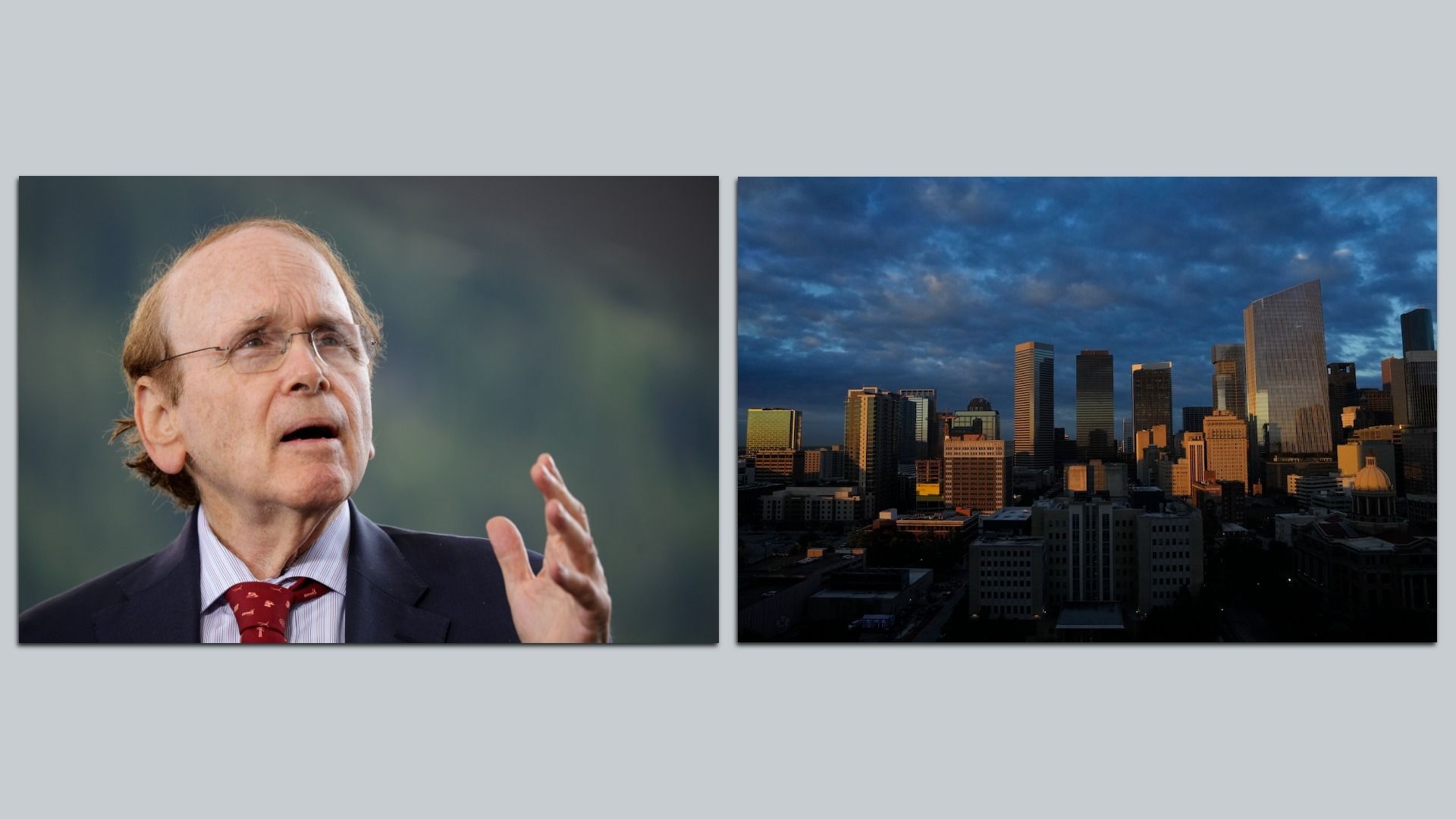
Photos: Jason Alden/Bloomberg via Getty Images/Yi-Chin Lee/Houston Chronicle via Getty Images
If you ask energy historian Daniel Yergin, the Iran war "has been brewing for 47 years."
The big picture: Surging oil and gas prices tied to Middle East tensions will hang over a Houston gathering next week that is one of the global energy industry's biggest annual events.
- Yergin, vice chairman of S&P Global, has been the face of the CERAWeek conference throughout its entire run of more than four decades.
- CERAWeek attracts more than 10,000 attendees from nearly half the world's countries.
The intrigue: "Rising oil prices had become the object of constant attention by presidents and prime ministers, as well as fodder of front pages for months," Yergin wrote.
- That could pass for commentary on today's war with Iran. But it's from "The Prize," his 1991 Pulitzer-winning history of oil — page 703.
"The continuity is amazing going back to the 1970s, which is what really shaped my own career and what I focus on," Yergin said in an interview earlier this week.
Flashback: Yergin traces the roots of today's tensions back to 1979.
- Strikes by Iranian oil workers helped topple the Shah — Iran's U.S.-backed monarch — and disrupted global supply, reshaping the geopolitics of energy for decades to come.
Friction point: The turmoil in "The Prize" lasted for months, and we're not there in the Iran war — yet.
- "It's not the nightmare scenario," Yergin said in our interview about today's war with Iran.
- What is the nightmare scenario? "This persists for more than weeks," Yergin replied.
Catch up fast: The Strait of Hormuz off Iran — a narrow artery for about 20% of the global oil and liquefied natural gas supply — has been effectively shut down since President Trump fired missiles into Iran on Feb. 28.
- Crude oil prices have been hovering around $100 a barrel this week, and U.S. average gasoline prices are up almost a full dollar since before the war began.
Driving the news: It's not hyperbole to say that the trajectory of the war could be altered by conversations — both on the main stage and behind closed doors — that happen in Houston next week.
- Numerous main-stage interviews — many hosted by Yergin — could jolt oil markets and headlines.
- These include Energy Secretary Chris Wright; United Arab Emirates Minister Sultan Ahmed Al Jaber, who's also CEO of the country's state-backed oil company; and retired Gen. Jim Mattis, who was Secretary of Defense during Trump's first term.
- Sunday night is also traditionally marked by dinners in which officials gather to talk privately about the state of the industry.
How it works: Pronounced seer-a, CERA stands for Cambridge Energy Research Associates, a consulting firm founded in Cambridge, Mass., more than 40 years ago by Yergin and James Rosenfield, a fellow S&P Global senior official.
Zoom in: Beyond the war, the biggest topic driving debate is likely to be AI — both the electricity it demands and the potential it can have on change.
- A technology-focused section of the conference — known as the Agora — has a whole hub of live programming focused just on AI for the first time this year.
State of play: The makeup and size of the conference directly reflects how the industry has grown and changed over the decades.
- Yes, fossil fuels still dominate, but clean energy has become a force of its own, and a protracted Iran war will likely underscore that shift.
- "There is going to be a recasting of renewable energy in terms of energy security instead of climate," Yergin said.
Reality check: Despite the echoes of the past, Yergin also underscored how today is a lot different from 1979, especially in terms of the U.S. emerging as the world's largest oil and gas producer.
- "Yet this crisis is unfolding in a world in which the global oil and gas system is more resilient and diversified than it has been for decades," he wrote in a recent op-ed.
What's next: "What the situation now cries out for is two or three different scenarios of what an end would look like," Yergin told Axios.
What we're watching: By the time the Houston gathering concludes on March 27, it will have been four weeks — or one full month — since Trump launched strikes on Iran.
The bottom line: That's the moment when time becomes measured in months, not just weeks — and when Yergin's "nightmare scenario" might emerge if the war hasn't abated by then.
Sign up here for Axios' Future of Energy newsletter.
