Your Thanksgiving turkey has a carbon footprint

Add Axios as your preferred source to
see more of our stories on Google.
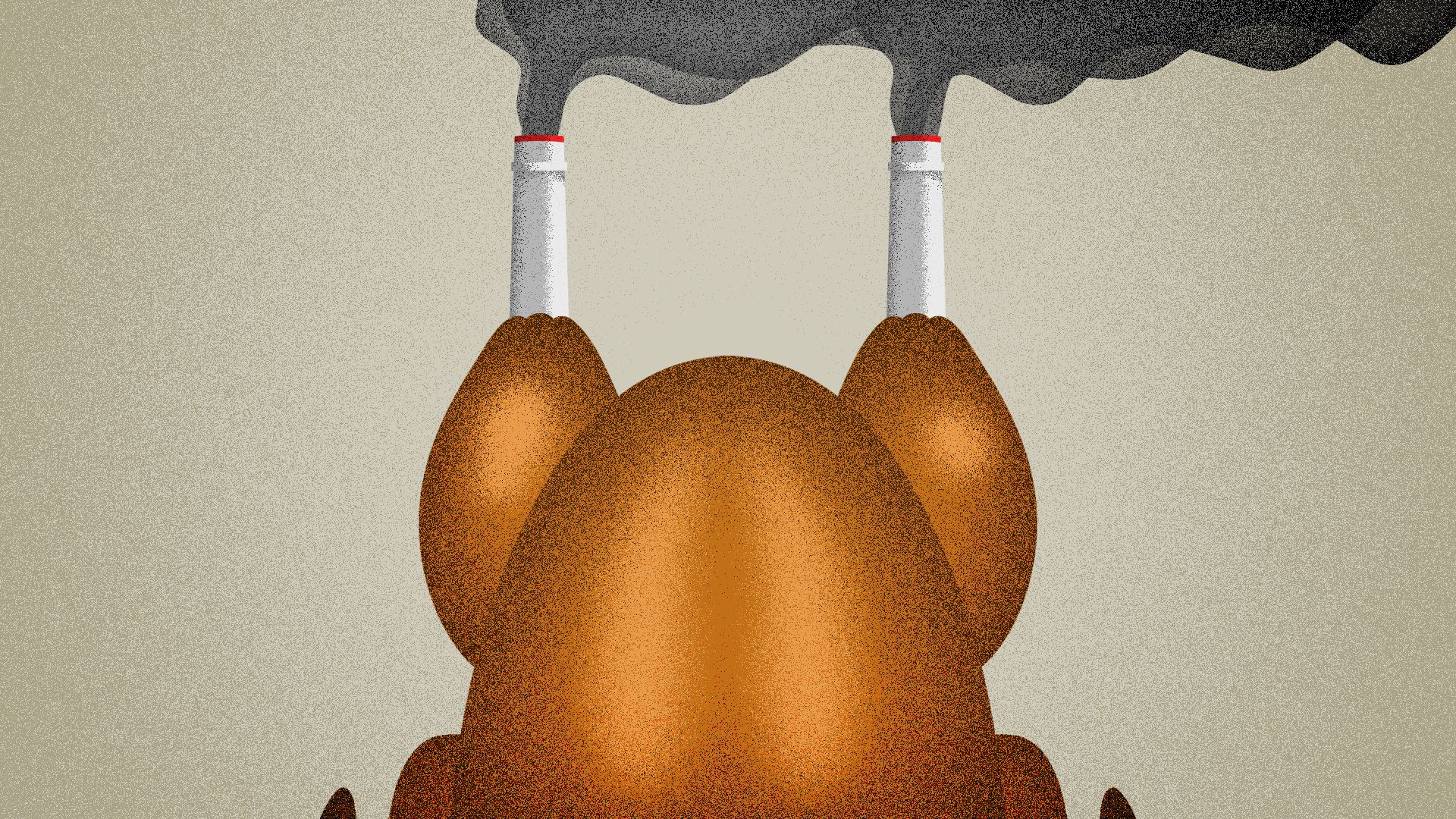
Illustration: Maura Kearns/Axios
You probably won't ponder your carbon footprint when you sit down to devour that Thanksgiving turkey — but some food and climate activists say you should.
Why it matters: With climate change fading in importance on some U.S. lawmakers' priority lists, activists say even small steps from the public are needed.
The big picture: The beloved bird is considered more environmentally friendly than beef. But turkey still produces, in production and post-production, the greenhouse gas emissions responsible for global warming — even more than chicken, according to the Environmental Working Group.
- "Raising and processing a four-ounce turkey serving is the equivalent of nearly three miles' worth of tailpipe emissions," said Iris Myers, the group's senior communications manager.
Exactly how is much your overall meal's carbon footprint? A lot depends on where you live and what kind of energy you use for cooking — natural gas, electricity from coal or something else.
- In 2016, Carnegie Mellon researchers calculated the state-by-state footprint of a typical feast, including roast turkey stuffed with sausage and apples, green bean casserole and pumpkin pie.
- They found that meals prepared in Washington state and Vermont emitted the lowest amounts of carbon dioxide. Hydropower and wind provide about two-thirds of Washington's energy. while renewables provide almost all of Vermont's.
- States that rely more on coal, such as Wyoming, West Virginia and Kentucky, had the highest Turkey Day emissions, the researchers found.
By the numbers: Thrown-away food is a big contributor to climate change. A new analysis by the anti-food waste group ReFED estimates that 320 million pounds of food will get tossed out this Thanksgiving.
- That's the equivalent of more than 800,000 metric tons of carbon dioxide, or about the same as driving 190,000 gasoline-powered vehicles for a year, ReFED said.
- Of those emissions, 4,800 metric tons of methane — a potent greenhouse gas — come from sending that food to landfills.
The bottom line: "Try not to buy more bird than you and your family will eat," Myers said.
