United's Riley on a quest for more carbon-friendly flights

Add Axios as your preferred source to
see more of our stories on Google.
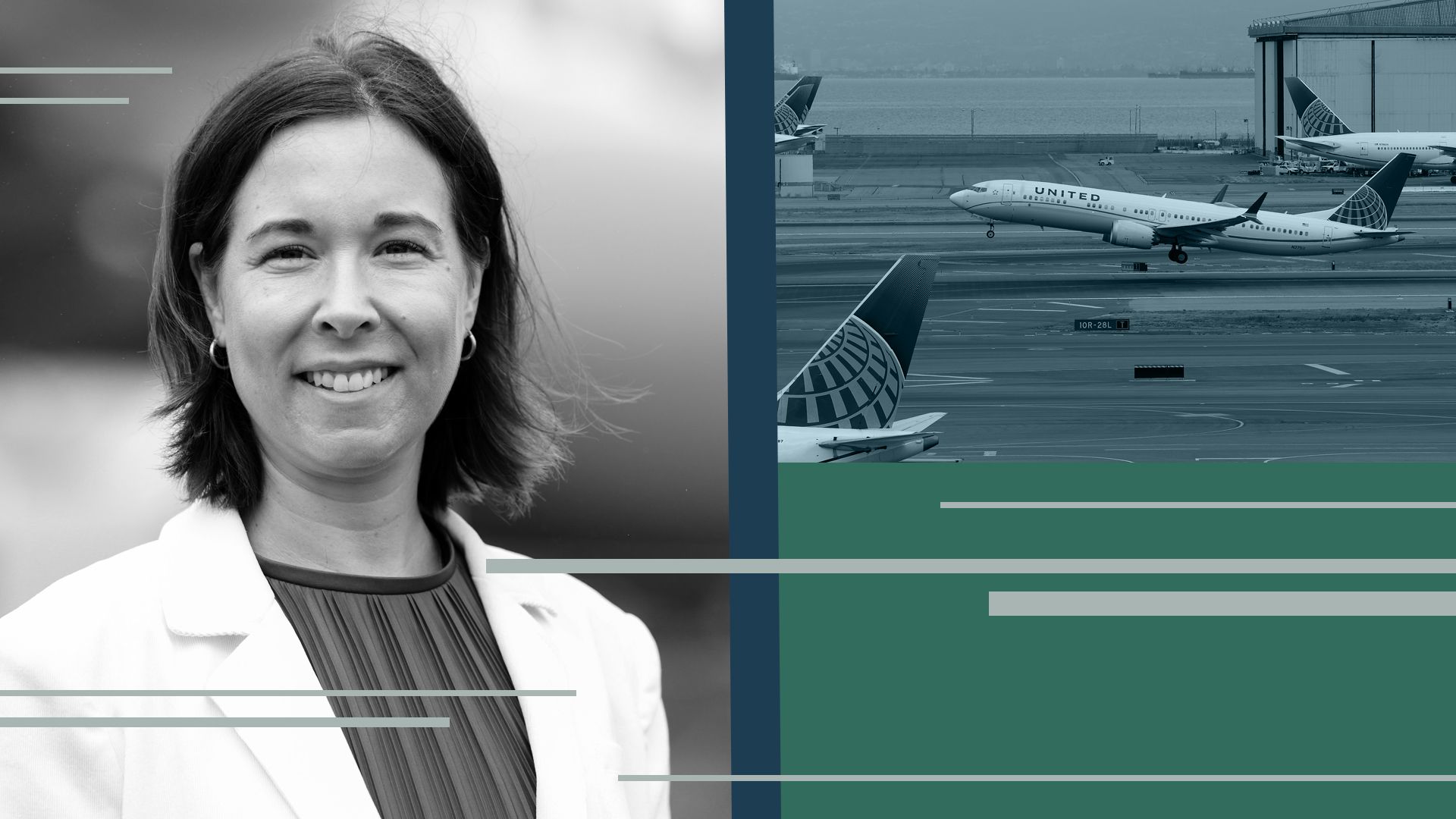
Photo illustration: Axios Visuals. Photos: Jason Alden/Bloomberg via Getty Images, Justin Sullivan/Getty Images
United Airlines' Lauren Riley is at the forefront of executives evangelizing for a switch to jet fuel with less of a carbon footprint.
Why she matters: As United's chief sustainability officer, Riley has sought to position the airline — the first to publicly commit to a carbon-reduction target — as a leader on sustainable aviation fuel, or SAF.
- United used 13.6 million gallons of SAF in its mainline planes — larger, long-haul aircraft — last year, almost double the previous year's use. But those planes guzzled almost 4 billion gallons of conventional fuel, a shade above the 2023 level.
Driving the news: Dulles International Airport outside Washington, D.C. — along with Newark and Houston — are starting to use SAF, leaving Denver as the only United hub without it, the airline told Axios exclusively.
- Neste Corp. began SAF deliveries to United in Houston in July and will continue until the end of October. Deliveries to Newark and Dulles started last month and are planned until the end of the year.
- Riley hopes Denver will soon follow suit.
She recently chatted with Axios about her work. Her remarks have been condensed.
On the growing use of SAF at hubs: "It's our demonstration that by using the existing fueling infrastructure, sustainable aviation fuel really can flow throughout the network, which is really exciting."
- "That means cost reductions because it's more efficient, right? It means it's less disruptive to the operation, and it means there's more opportunity to scale, frankly. "
On increasing supply for SAF: "I just took a tour of the Phillips 66 SAF refinery in Rodeo, right outside San Francisco. They primarily make renewable diesel and sustainable aviation fuels at that facility."
- "So we're seeing some of these traditional incumbents come online as well, in addition to those that have been early starters in the industry. It's beginning to diversify, which is exactly what we need to see."
On what's needed for more growth: "We need strong policy structures. The economics aren't there yet, but it's beginning to scale, and we're starting to see better economics than we've ever seen before ...
- "[What we're] hearing loud and clear from our financial partners, our financial institutions that have the capital to put into this market, is that it's too risky right now, because the policy is not durable."
On other emissions-reduction efforts: "What's important to me is that every single aircraft we purchase is about 20% more fuel efficient than the aircraft it replaces."
On air taxis: "There's a lot of activity that's coming forward from this administration to provide the environments to begin testing different components of introducing [air taxis] into the airspace."
- "Of course, safety is everything. So doing this in sort of a measured and responsible manner is really important."
