Axios House: Corporate leaders weigh in on ESG, reputation and results

Add Axios as your preferred source to
see more of our stories on Google.
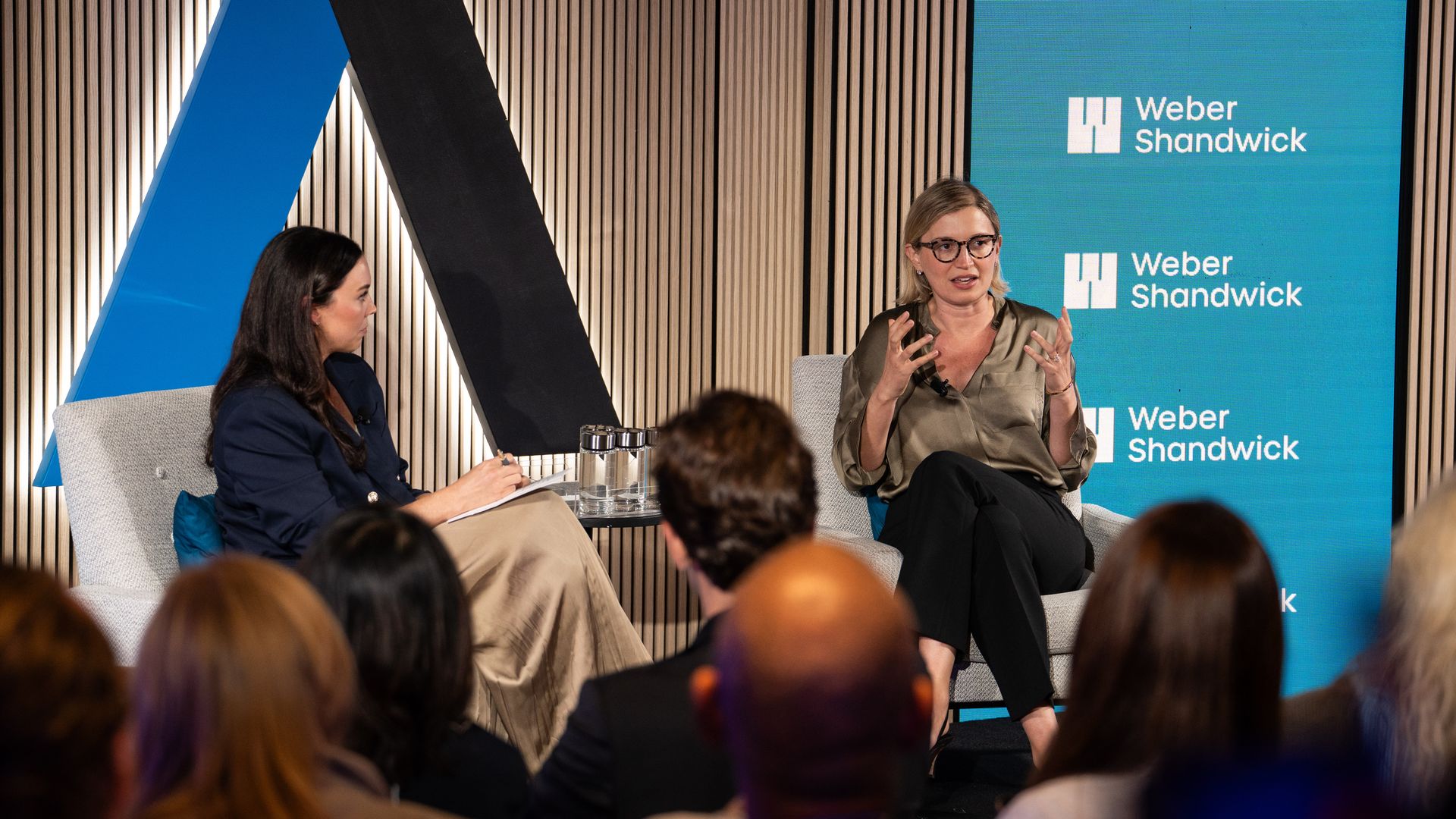
Axios' Eleanor Hawkins (left) and Carlyle global head of corporate affairs Megan Starr (right) in conversation at Axios House Climate Week and UNGA. Photo credit: Sam Popp on behalf of Axios
NEW YORK – Private and public companies approach ESG goals differently, Carlyle global head of corporate affairs Megan Starr said Tuesday at Axios House at Climate Week and the UN General Assembly.
Why it matters: As political and reputational risks mount, corporations are rethinking how they communicate environmental and social priorities.
- Axios' Eleanor Hawkins hosted conversations with Starr, Patagonia CEO Ryan Gellert, Patagonia chief impact and communications officer Corley Kenna and Gap Inc. chief communications officer Mame Annan-Brown. The Sept. 23 event was sponsored by Weber Shandwick.
What they're saying: "Privately held companies do a better job on things like decarbonization and frankly job growth. … Publicly held companies are better on diversity…[and] renewable energy purchasing," Starr said.
- Starr added that private companies actually drive faster change.
- "We're actually seeing ESG performance levers really being tied to financial performance and that's kind of the holy grail that we've all been waiting for."
By the numbers: Public companies cut scope 1 emissions by 0.4% from 2023 to 2024, while private equity-backed firms achieved a 2.3% reduction, Starr said.
- On scope 2 emissions, the gap was similar: 1% versus 5.4%.
Navigating corporate pressures can be tough, but when it comes to ESG in particular, Kenna said Patagonia has never used the term.
- "I actually think it's part of the kind of special sauce is [that] we haven't relied on the acronyms, on sort of corporate trends and fads," Kenna said.
- Gellert said navigating those nuances is all about reputation and trust. "There are things that take forever to build and seconds to blow up and…we take it really seriously."
- "I think our community also understands our business literally depends on a healthy planet in these places being protected," Kenna said. "That gives us a bit of permission to engage in it."
Separately, Annan-Brown noted that water is essential to the apparel industry, highlighting that its supply chain uses 20 billion liters of water, equivalent to roughly 11 Olympic-sized swimming pools.
- When it comes to bridging the climate gap, she said the company is recycling and reusing water.
- Gap also works with water conservation organizations to help address the global water crisis. "It's such an important platform to invite other partners in, because we're only as strong as we are as a collaborative."
Sponsored content:
In a View From the Top conversation, Weber Shandwick North America CEO and global president Jim O'Leary said the term "ESG" is dormant but not its substance. He based this on the company's new research, in which it surveyed 250 C-suite executives globally.
- "From a substance perspective, ESG is alive and well," said O'Leary. "And I think you could even argue that there has been a shift away from what was a bit of a performative version of ESG over the past several years to a much more performance-aligned or business-aligned version of the substance of ESG, and so I would argue that's a good thing."
