How AI is helping Al Gore warm up to nuclear power

Add Axios as your preferred source to
see more of our stories on Google.
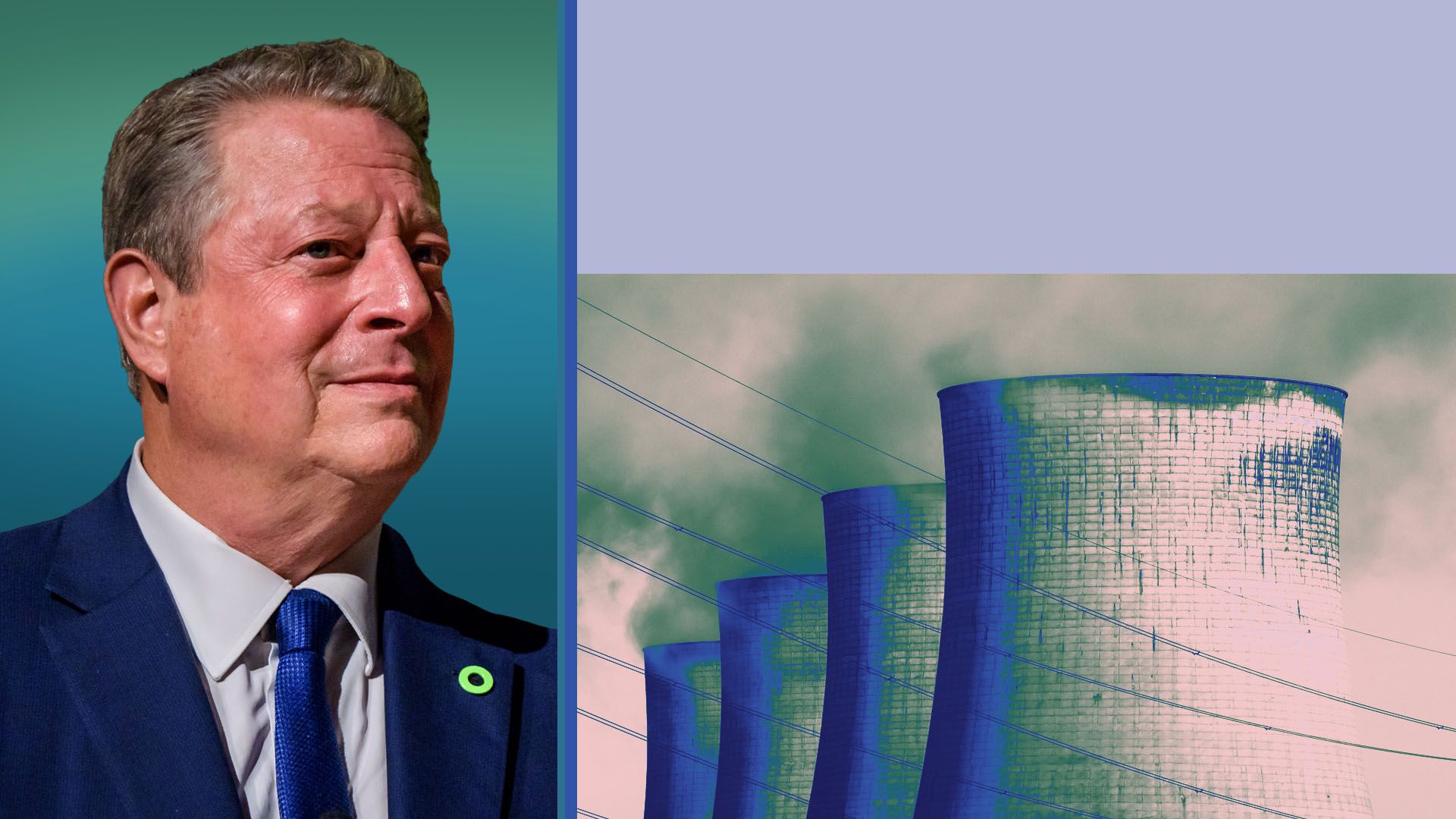
Photo illustration: Axios Visuals. Photo: Erik McGregor/LightRocket via Getty Images
Al Gore says AI's surging electricity demand merits giving nuclear power a fresh look — even with what he thinks is a persistent hefty price tag.
Why it matters: The former vice president and famous environmentalist has had an evolving perspective on nuclear. It encapsulates the tricky position the power source occupies in our broader energy and climate debate.
What he's saying: "The surge in demand for electricity is causing some reanalysis of what role nuclear might play when you have large, wealthy, consumer-facing businesses that need enormous amounts of new power," Gore said in an exclusive interview with Axios.
Later in the interview, he mused about how higher prices in recent decades halted growth in the nuclear sector.
- "For a variety of reasons, it has priced itself out of the market as the market used to exist. Now the market is different," Gore said, implying that hyperscalers building data centers would be able to stomach higher prices.
- "I think a lot of large users of electricity are recalculating whether or not they want to place very large, one-time bets for a huge increment of power in the form of nuclear. And I think you're going to see some resurgence of nuclear power."
The big picture: Nuclear power, one of the world's biggest sources of steady, zero-emitting electricity, has been largely stagnant over the last few decades.
- This has been driven, at least partly, by a few isolated — but high-profile — accidents that prompted long regulatory reviews that then hiked prices.
- Surging power demand is fueling talk of a U.S. nuclear resurgence. So is strong support from the Trump administration — a rare spot of common ground it shares with former President Joe Biden.
- Rising public support has also helped, with a Pew Research poll in June showing a record 59 percent backing it.
The intrigue: Gore was eager to dive deeper into nuclear power in our conversation. Unprompted, he sought to address various concerns about it.
- "I think that the waste can be stored safely. I think the terrorism threats are real, but they're shared by a lot of other kinds of facilities around the world," he said.
- "The proliferation issues are very real and have to be attended to with extreme care, safety of operation. I think we can handle that. I really do. But the cost issue is the one that's really a barrier to the expansion of nuclear."
Yes, but: Gore also said that he thinks the resurgence might not come from small modular reactors (SMRs) due to their price tag.
- "Some of the most responsible policy analysts that I respect are now shifting back away from SMRs as maybe a technological dead end again," Gore said.
- "I hope they're not, but it looks like the resurgence is back toward a larger size."
Context: A handful of new SMR technologies are under development — including in the U.S. — but they remain the exception to trends around the world where larger reactors are being built, especially in China.
- "China and South Korea are both able to build nuclear plants on time and on budget, but Western nuclear developers have not managed to emulate their success," states Gore's Generation Investment Management in its latest sustainability report out last week.
Zoom out: In 2000, as vice president, Gore said he didn't support an increased reliance on nuclear power, according to an article by the Nuclear Information and Resource Service, a nonprofit opposed to nuclear power.
- He cited nuclear's high costs as the reason why he predicted in 2012 it would play a "limited role" in our future energy mix.
My thought bubble: I don't reference these articles to criticize his changing position, but to show how much has changed in our world such that it compels even people at Al Gore's level to rethink their positions.
The bottom line: Gore's bullish-with-a-caveat position shows the potential resurgence of nuclear power. But past precedent suggests plenty of hurdles lie ahead.
