Trump's U-turn starts to influence clean-power downshift

Add Axios as your preferred source to
see more of our stories on Google.
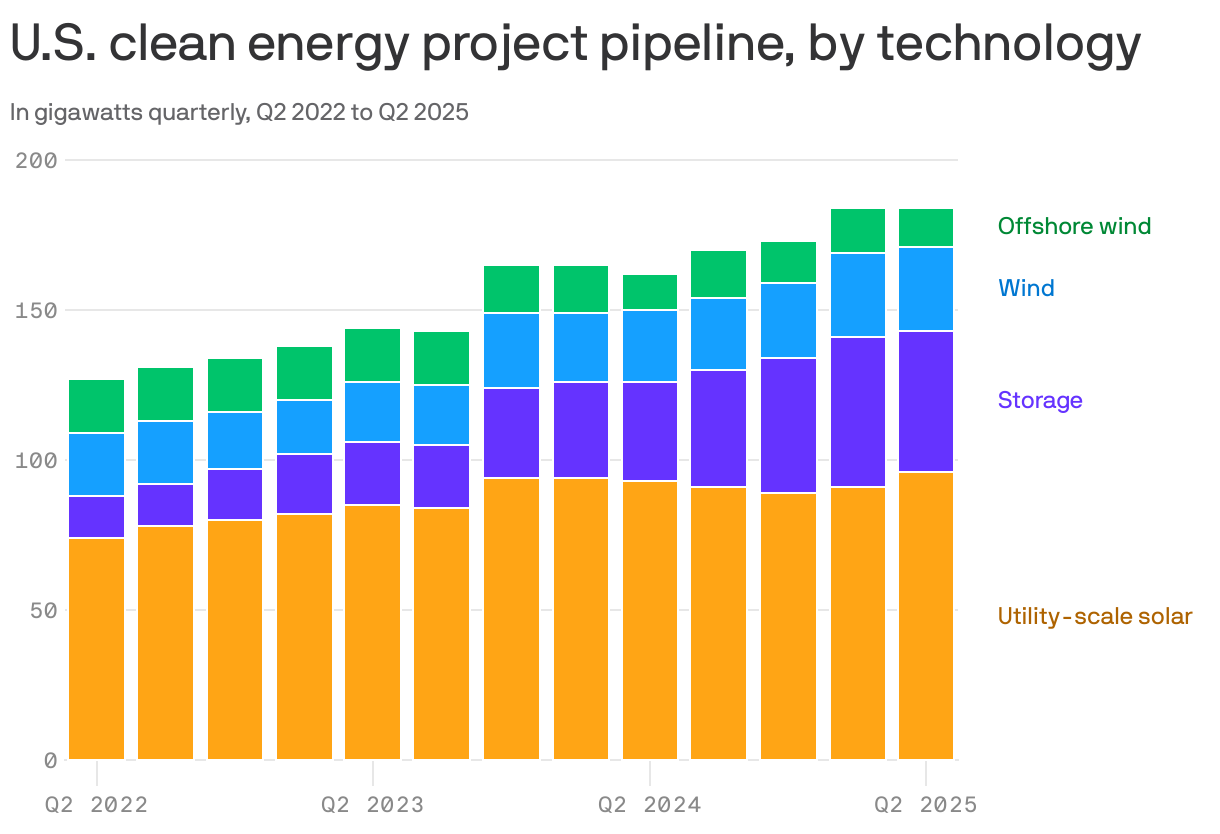
Combined levels of U.S. "clean" power installations barely grew in Q2, and the future project pipeline also stalled, new data shows.
Why it matters: The effects of Trump 2.0 U-turns on energy policy are coming into focus, the American Clean Power Association said alongside its latest market snapshot.
- The latest numbers are "early indicators of federal policy attacks and fluctuating trade policy," ACP said.
- They come a week after separate data from the Rhodium Group and MIT showed spikes in canceled EV and battery manufacturing plans.
Driving the news: ACP's Q2 and first-half market report tallies wind, utility-scale solar, and battery storage.
- Q2's capacity additions of 11.6 gigawatts were just 1% higher than Q2 2024, and the first half of 2025 saw a decline compared to last year.
- The pipeline of projects under construction or in "advanced development" did not grow, ACP found (check out the graphic above).
- The amount of future electricity contracted via corporate power purchase agreements dropped sharply.
Zoom in: The picture varies by technology.
- Installations of battery storage — a smaller sector than wind and solar — rose 63% in the first half of 2025 compared to 2024.
- Wind ticked up 12%, but utility-scale solar installations were 23% below the first six months of 2024.
What we're watching: The fallout from policies and decisions that surfaced since the period covered by the report.
- Think new restrictions for onshore wind and solar projects that have various ties to federal lands, and Trump officials' intent to scuttle permits for planned offshore wind developments.
- Meanwhile, developers are racing to tap wind and solar tax credits sunsetting under the new GOP budget law.
- Projects must start construction by July 4, 2026 or begin operations by the end of 2027 in order to access the subsidies.
The bottom line: "The uncertainty created by new bureaucratic delays and unclear demands is having a chilling effect on the pipeline for future energy projects," Jason Grumet, ACP's CEO, said in a statement.
