Climate's out — but chaos is in — as a clean energy driver

Add Axios as your preferred source to
see more of our stories on Google.
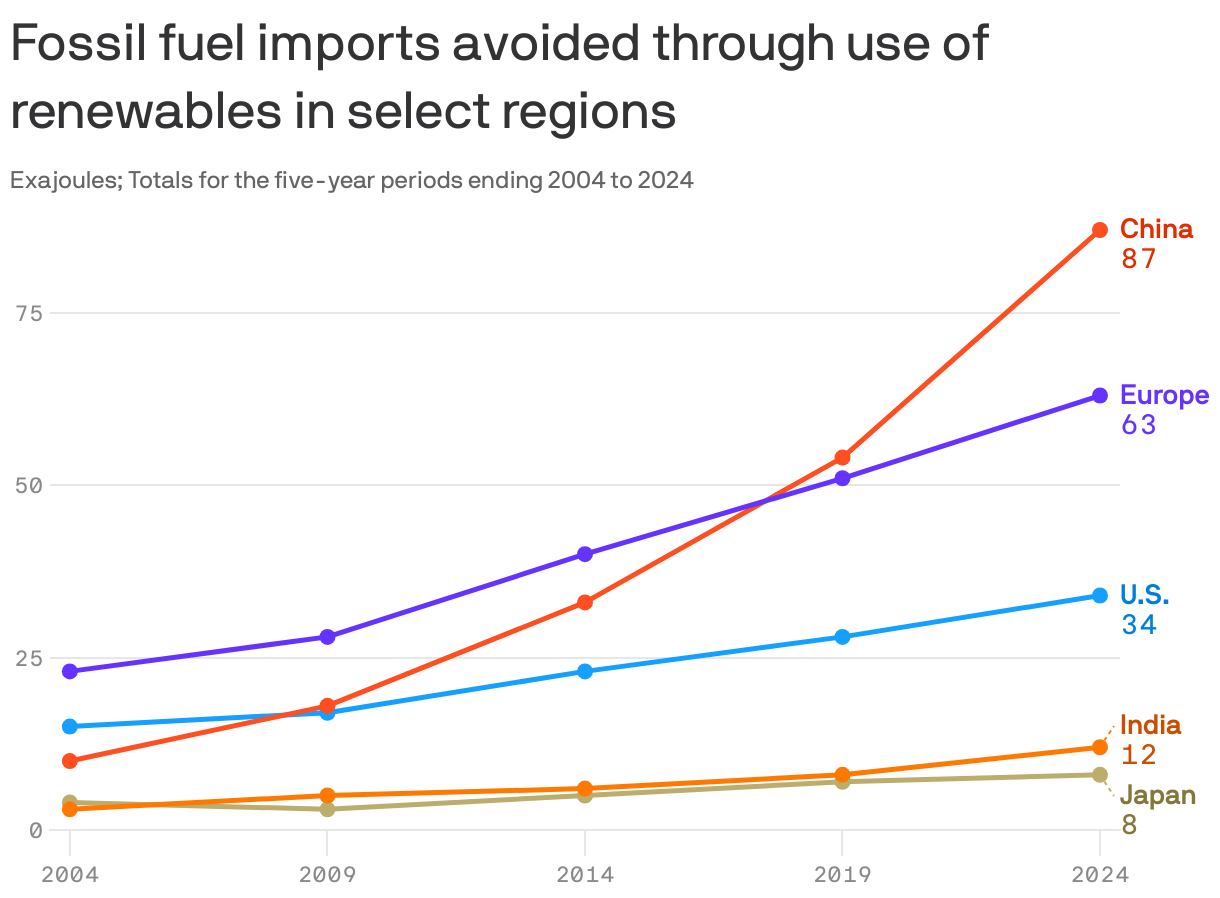
Global upheavals — from supply chain woes to wars — may increasingly spur countries to replace some fossil-fuel imports with homegrown electrons, a new report finds.
Why it matters: "2024 may well become seen as a beginning of a paradigm shift," the latest Statistical Review of World Energy finds.
- The energy transition is becoming "increasingly associated with a need to deliver energy security through energy independence to protect countries from the types of shocks and uncertainty that such events bring."
The intrigue: It goes through 2024, but the idea is consistent with an emerging — if contrarian — school of thought about the Trump 2.0 era.
- While President Trump isn't interested in global warming and renewables, his foreign and trade policies could make him an accidental climate hawk, the thinking goes.
- Bloomberg columnist Liam Denning had a recent piece: "Trump Is Cementing the Green Energy Transition He Loathes."
The big picture: "Investment in renewables in particular is increasingly being seen as a cornerstone of energy security, enabling countries to disconnect their energy systems from global fuel markets and geopolitical tensions," the World Energy report says.
- It cites Russia's war on Ukraine, Mideast tensions, COVID, extreme weather and more.
- That take is part of the huge annual data review from The Energy Institute, Kearney and KPMG.
The report tells a wider story about what the global renewables surge is and isn't achieving.
- Solar and wind together grew nine times faster than fossil fuels, rising 18% last year.
- But the whole energy pie is still growing too, including fossil fuels, so global energy-related CO2 emissions ticked up 1% to set another record.
- As fast as renewables are rising, global energy thirst is still growing even more, notes the annual report that for decades was produced by BP until 2023.
Zoom in: Low-carbon energy — renewables, nuclear and more — is avoiding lots of CO2 emissions that would otherwise occur.
- But it's still an addition — not a transition that's lowering total emissions yet.
- "This pattern, marked by simultaneous growth in clean and conventional energy, illustrates the structural, economic, and geopolitical barriers to achieving a truly coordinated global energy transition," a summary states.
Reality check: Displacement of imported fossil fuels with renewable power is concentrated in select markets and a "largely untapped opportunity" elsewhere.
- Major energy importers — including Japan and South Korea — have made much less progress, it finds.
- And overall global demand for coal, oil and gas is still rising.
Friction point: Trump's pullback from traditional alliances, trade wars, and use of fossil fuels as trade chips will help push countries toward domestic electricity sources, Denning writes.
- And don't forget veteran Carlyle analyst Jeff Currie's paper declaring the "New Joule Order."
- It similarly argues that risk and trade concerns — not climate policy — are driving countries to seek domestic sources instead of global commodities.
My thought bubble: A related trend is low-carbon sectors like renewables and hydrogen adapting their domestic messaging to the Trump era.
- You hear much less about climate and much more about how they can help the U.S. become "energy dominant."
- For instance, check out the American Clean Power Association's statement on the Senate's version of the budget reconciliation bill.
The bottom line: Sure, there's a case for Trump 2.0 — and the wider geopolitical landscape — creating momentum abroad for renewables and nuclear on security grounds.
- But that's just a piece of the picture, which also includes Trump dismantling domestic incentives, foreign aid, and leaving the Paris Agreement again.
