Minority homeowners face higher climate risks

Add Axios as your preferred source to
see more of our stories on Google.
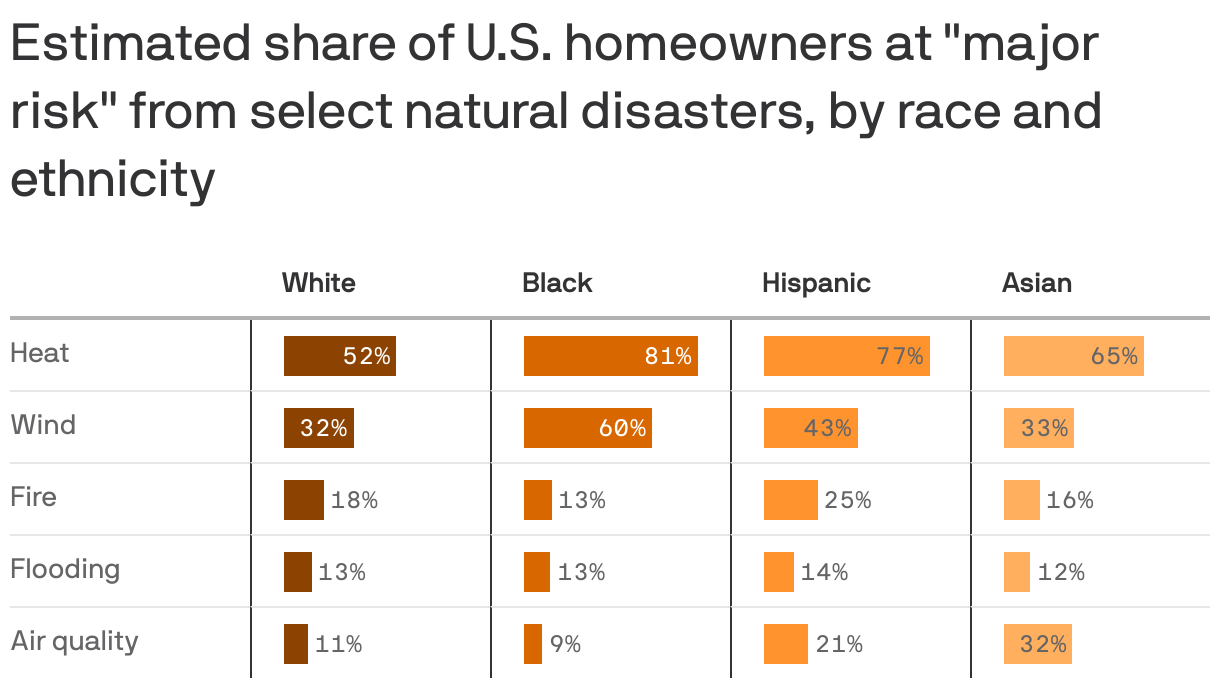
Minority homeowners are particularly vulnerable to certain major climate risks, a Zillow analysis finds.
Why it matters: The findings reflect history and a legacy of redlining and economic disparities that still shape where people live — and how they're affected by climate change.
By the numbers: Nationally, 81% of Black homeowners, 77% of Hispanic homeowners and 65% of Asian homeowners are at risk of extreme heat, compared to 52% of white homeowners, Zillow found.
- Meanwhile, 60% of Black homeowners, 43% of Hispanic homeowners and 33% of Asian homeowners are vulnerable to extreme wind, compared to 32% of white homeowners.
- Some 32% of Asian homeowners and 21% of Hispanic homeowners are vulnerable to poor air quality, compared to 11% of white homeowners and 9% of Black homeowners.
How it works: Zillow's analysis is based in part on climate risk data for homes listed for sale on the platform, using risk modeling techniques from First Street.
- It doesn't include renters, who also face various climate risks.
- See the full methodology here.
Between the lines: Some of the nationwide figures are a result of history and geography, says Zillow senior economist Kara Ng.
- For example: Black homeownership rates are higher in the South, she points out, where extreme heat is more common compared to other regions.
Zoom in: Some cities have especially stark differences between groups for certain climate risks.
- In New Orleans, for example, about 95% of Asian homeowners, 92% of Black homeowners and 86% of Hispanic homeowners are vulnerable to flooding, compared to 76% of white homeowners.
The bottom line: Climate risk is making homeownership more expensive due to rising insurance, energy and repair costs, Ng notes in her analysis — adding that vulnerable homes often take longer to sell and go for less money.
- "These impacts have the potential to widen the racial wealth gap and further set back minority groups that historically have been financially disadvantaged," she writes.
