Axios Event: U.S. pharmaceutical supply chain is in crisis, experts say

Add Axios as your preferred source to
see more of our stories on Google.
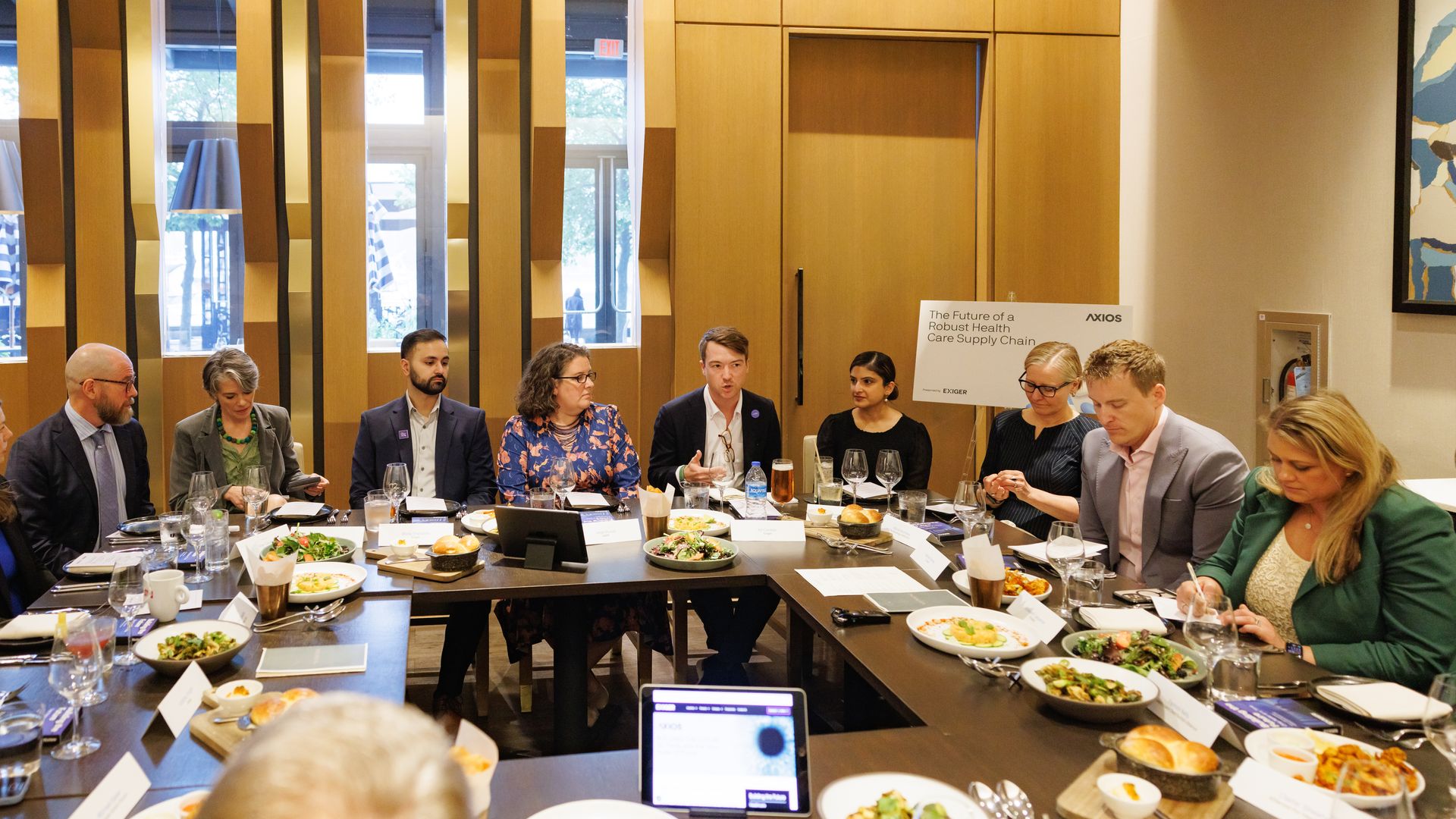
Attendees engaging during the discussion. Photo: Xavier Rodriguez & Carlos Martinez on behalf of Axios
WASHINGTON – The U.S. must change how it acquires and produces essential medicines to navigate growing risks to the pharmaceutical supply chain, leaders said at a roundtable discussion event on May 21.
Why it matters: Reliance on China and other nations for critical medical supplies is increasingly an economic, public health and national security challenge.
- Axios' Nathan Bomey and Victoria Knight moderated the discussion, sponsored by Exiger.
What they're saying: "You asked how close we are to a crisis, and the answer is actually we've been in a crisis for 14 years," said Allan Coukell, chief government affairs and public policy officer at nonprofit generic drug company Civica Inc.
- Coukell referenced a hurricane that hit a manufacturing plant in North Carolina, critically disrupting the domestic supply chain for large-volume parenterals, which have been on and off the shortage list for over a decade.
- "The issue there is that we have a system of procurement that's not incentivizing sustainability," he said. "For generic drugs, we're 14 years into an era where at any given time, there are hundreds of drugs on the shortage list.
- "So we can talk about onshoring and offshoring and the risk, and that's certainly worth talking about, but the fundamental problem is we're not procuring these essential products in a sustainable way."
Between the lines: "For me, the fundamental problem is we've incentivized people to move everything offshore," said Mark Ey, senior vice president and COO at the National Community Pharmacists Association.
- "The insurance companies have verticals that control every segment of the market, from the insurance to the processors to the pharmacies, and they're forcing people to make a product as cheaply as possible," he said.
- "Our pharmacies are dispensing product, and 70% of the brands we touch, we don't even make the cost of the drug, much less our overhead. And so if you allow the insurance verticals to continue, the economics just don't bear out to bring it on shore and have to pay more."
Case in point: Complex market dynamics combined with manufacturing disruptions have led to years-long shortages of many critical medications, affecting patients and pharmacies.
- "We're really making our patients suffer, because they don't have the medications that they desperately need, and our pharmacists and pharmacy teams don't have the ability to actually close those gaps and to get them things, and then those pharmacies are closing," said Brigid Groves, vice president of professional affairs at the American Pharmacists Association.
State of play: Tensions are mounting between the U.S. and long-time global trade partners as tariffs and the AI race spur new competition.
- "We are in what I call asymmetric warfare right now," said Michael Parrish, former chief acquisition officer at the U.S. Department of Veterans Affairs. "We're in a war with our friends across the ocean. It's not a hot war, but it has that ability, on a moment's notice … to shut down our critical supplies."
What's next: Industry and government are laser-focused on finding solutions to be able to produce more critical essential medicines at home.
- "We're working to bring back the active ingredient pharmaceutical supply chain using new technology to make it cost-competitive to compete against China," said Phlow Corp. CEO Eric Edwards.
- The U.S. should prioritize supply chains for critical essential medicines rather than pursuing a broad range of medicines, he said.
- "So when we look at our drug supply chain, it's about what are those where there is no therapeutic alternative, where if someone gets sick, you can't replace that medicine?" he asked.
- "I think if we're going to make change happen across a broken pharmacoeconomic model within our entire supply chain, we have to think about how we're going to selectively and intentionally choose the right medicines to start with versus trying to boil the ocean."
