Axios Event: AI is "hugely transformational" for Duolingo and education, CEO says

Add Axios as your preferred source to
see more of our stories on Google.
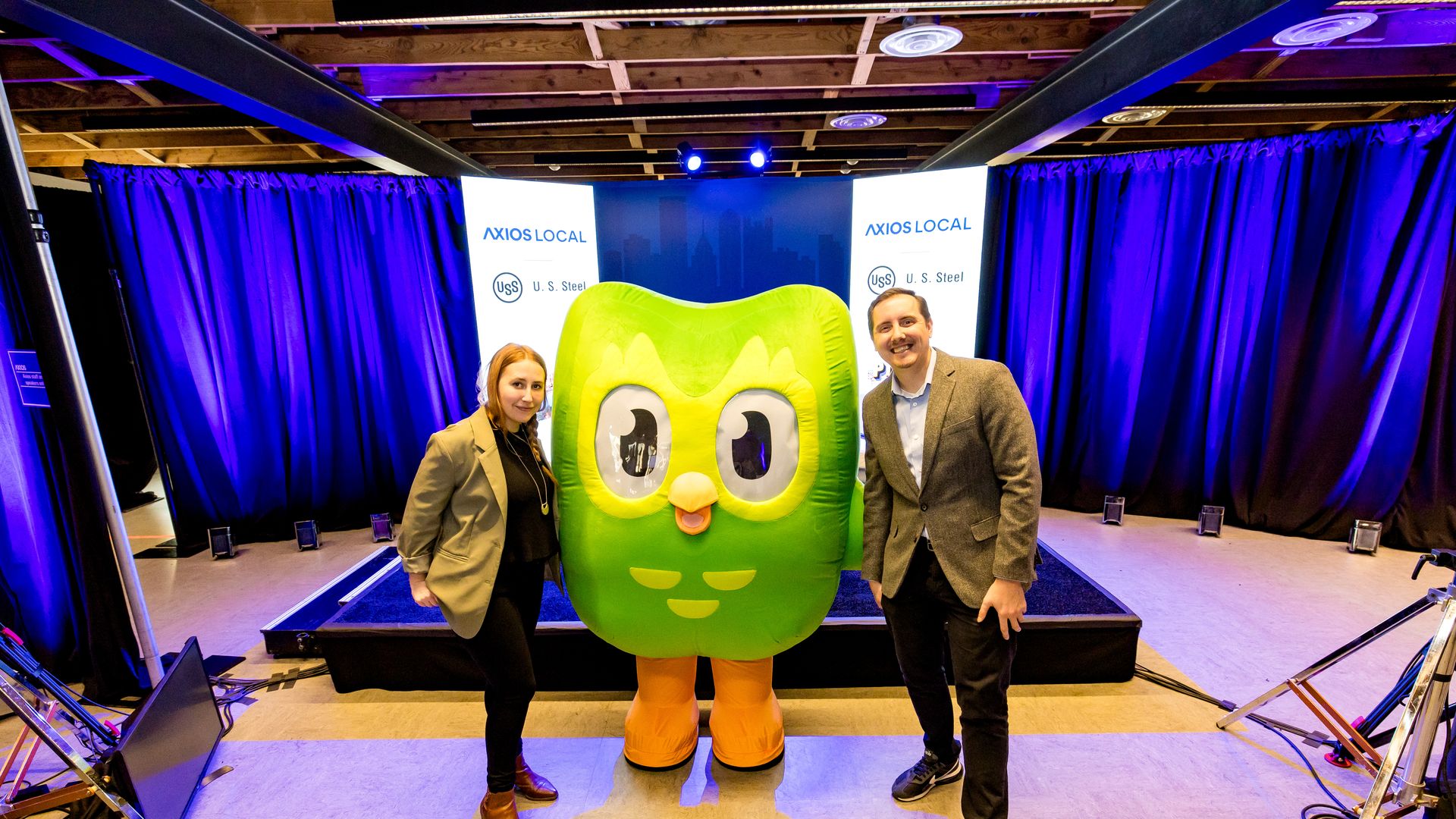
Duo the owl made a rare appearance at the event, pictured above with Axios Pittsburgh reporters Chrissy Suttles and Ryan Deto. Photo: Jorge Santiago on behalf of Axios
PITTSBURGH – AI could transform education, Duolingo CEO and co-founder Luis von Ahn told Axios at an April 2 event.
Why it matters: As one of the biggest tech companies in Pittsburgh, Duolingo is leading the way in AI through personalized content for users of the language learning app.
Axios Pittsburgh reporters Chrissy Suttles and Ryan Deto spoke with Von Ahn and Pittsburgh Mayor Ed Gainey at the event celebrating the launch of Axios Pittsburgh, which was sponsored by U. S. Steel.
What they're saying: "For us, [AI] is hugely transformational," Von Ahn said.
AI is making it easier for Duolingo to create more content faster, he added.
- For instance, in-app content like example sentences in lessons once written by creators are now generated using AI.
- Von Ahn said five years ago he declined to pursue the idea behind DuoRadio, a feature using cartoons to help people learn a language, because it was projected to take years to develop. More recently, AI was able to create it in two months.
Also, users now can practice conversations over a video call with AI, a huge step that had been missing in the learning process, Von Ahn said.
- "[T]he only way we knew how to do that was with other humans, but most people don't want to talk to other humans in the language that they're not good at," he said.
- "But with an AI [tool], people actually want to do that because they don't think the AI is judging them, even though it's almost entirely what it's doing."
The bottom line: "[A]t least for education, we're going to see a humongous change because we can give everybody a personalized tutor, and that's what we're working on at Duolingo," Von Ahn said. "Not just with language learning, but also with math and music. Soon we're going to do chess."
What's next: Pittsburgh's tech sector saw an upswing in the 2010s, but growth has since tapered off as companies move to bigger cities. The city is trying to change that.
- Von Ahn suggests one way to draw people to Pittsburgh is to develop more central places as gathering spots since neighborhoods are so spread apart.
Regional business leaders are focused on revitalizing downtown Pittsburgh to attract more residents, Mayor Gainey said, calling the area the city's "living room."
- "But how do you do it?" he asked. "You have to turn it into a neighborhood where people play, work and thrive. And that's why we've been laser-focused on affordability."
Content from the sponsored segment:
In a View From the Top conversation, Michael Williams, U. S. Steel vice president and chief human resources officer, explained how the company is approaching workforce development in the AI era by educating kids about manufacturing careers early.
- "U. S. Steel is very interested in AI, just like all companies are, right?" Williams said. "… But at the end of the day, AI is not going to turn a wrench for you in one of the mills."
- "We need to get people that are ready to come out and work in the skilled trades, and I think that starts in high school."
