China's oil slowdown is a global wild card

Add Axios as your preferred source to
see more of our stories on Google.
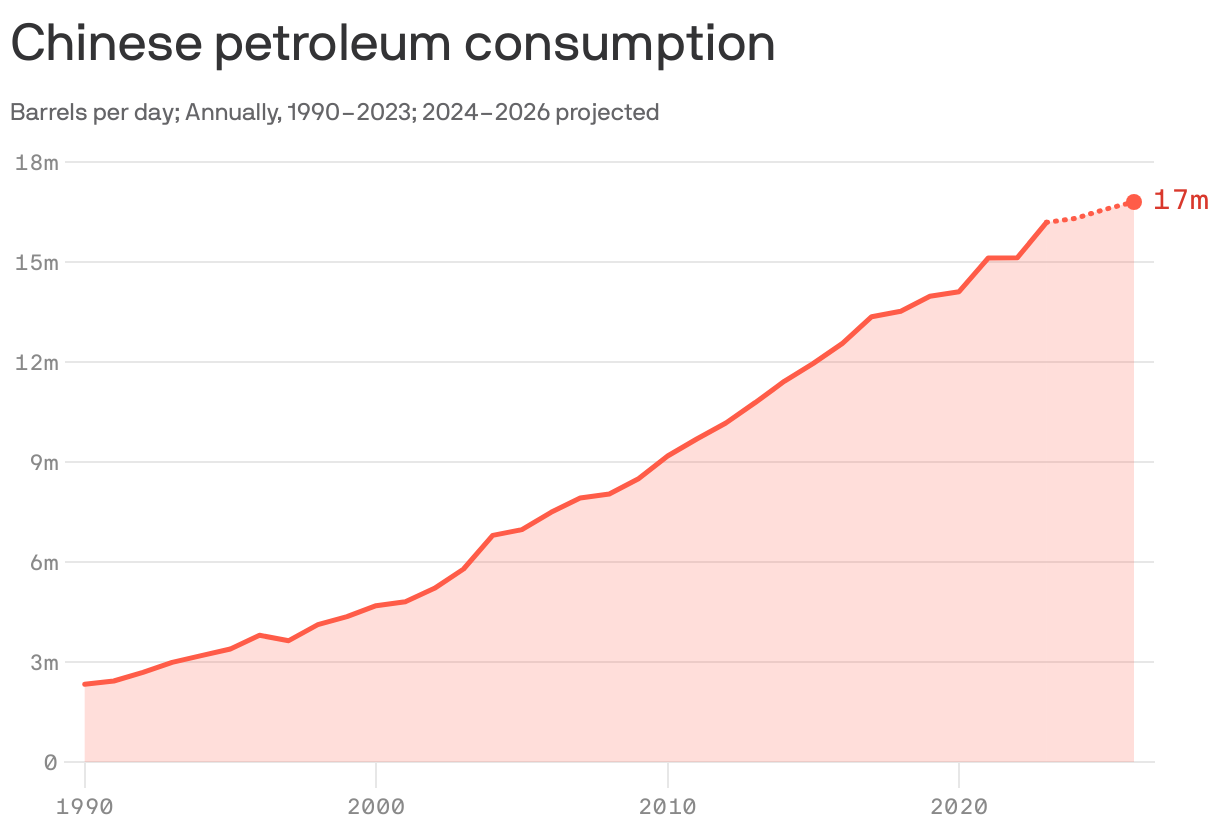
The growth of China's oil thirst is slowing, and whether it's a brief downshift or something deeper will influence the future of global petro-demand.
Why it matters: China's economy, stumbling in recent years, and its commodity markets have outsize sway.
When it comes to oil, it's the largest importer and second-largest consumer behind the U.S.
- Oil is the second-biggest source of China's CO2 emissions, which are by far the world's largest, though those emissions are well behind coal.
Driving the news: China accounted for a stunning 60%-plus share of global oil demand growth from 2013-2023, but it fell to under 20% last year, per the International Energy Agency.
- That's largely because soaring EV adoption has halted the rise in motor fuel demand, a helpful new IEA primer notes.
State of play: Combined gasoline, diesel and jet fuel use was 2.5% below 2021 levels last year, though the aviation side was higher.
- Pivoting from manufacturing to service-based growth is sapping momentum, too.
- By last fall, EVs, plug-in hybrids and traditional hybrids together surpassed 50% of China's passenger car sales.
"[T]he data strongly suggest that the combustion uses of petroleum fuel in China have already reached a plateau and that the potential for future growth may be very limited," the IEA analysts write.
Yes, but: I have just one word for you: plastics. Or actually petrochemicals more broadly, now the main reason China's oil use is still heading upward.
- But building a crystal ball on this is tricky. And that was even before Trump 2.0 trade policies introduced new headwinds to global economic growth.
- "Petrochemical demand has a really high correlation to GDP growth around the world," Rob Thummel, a senior portfolio manager with Tortoise Capital, said in an interview.
What we're watching: IEA sees China's total oil demand reaching a plateau later this decade.
- If that comes to pass, it will help determine the time when global thirst reaches its peak or at least plateau.
- A roundtable I watched at last week's CERAWeek by S&P Global conference explored the complexity of these predictions, and the analysts were divided.
The bottom line: "We are moving into a new era of uncertainty," said Roger Diwan, a top S&P analyst, name-checking China as a key reason.
