Axios Explains: Thanksgiving's troubled history

Add Axios as your preferred source to
see more of our stories on Google.
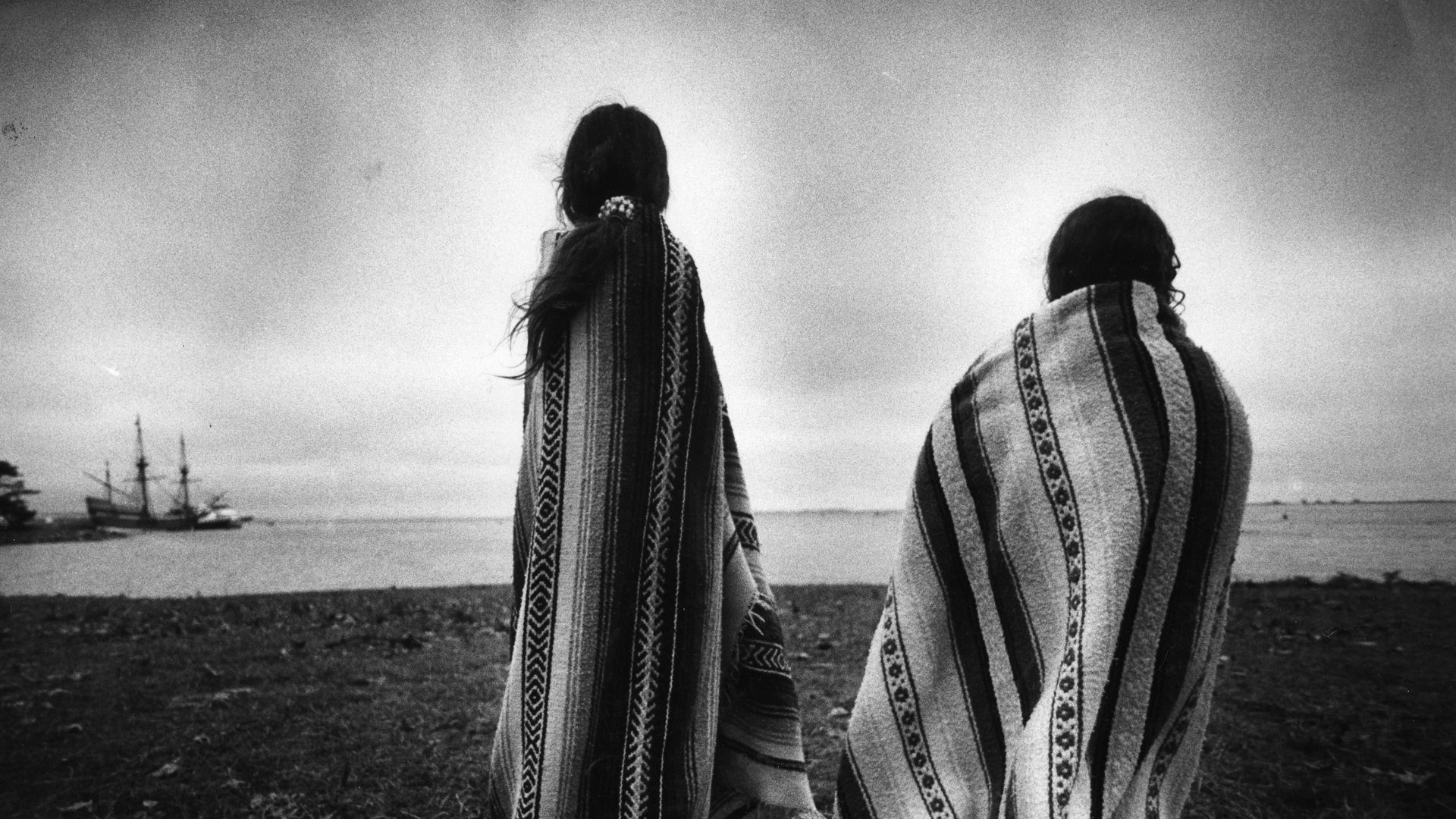
Weetoomoo Carey, 8, left, and her sister Jackolynn Carey, 5, Wampanoag Nipmucs from Mashpee, looked at a Mayflower replica near Plymouth Rock, Mass., where Native Americans gathered for a day of mourning in counterpoint to the Pilgrims' Thanksgiving on Nov. 26, 1992. Photo: Suzanne Kreiter/The Boston Globe via Getty Images
Thanksgiving in the United States is based on a mythical feast between the Wampanoag people and Mayflower Pilgrims. The holiday's real story is mixed with national unity and racial exclusion.
The big picture: The nation's annual Thanksgiving holiday on Thursday brings millions of families together, but the nation is growing more diverse and requiring new voices to tell the country's history.
State of play: Debates over Thanksgiving's origins have been reduced to political-cultural battles amid a divided nation, yet a new generation of historians say we need to understand the holiday better to understand ourselves.
The Myth of Thanksgiving
The story told to most elementary school students for decades goes like this: Starving Pilgrims who landed on present-day Plymouth Rock, Massachusetts, got needed help from friendly Wampanoag members.
- They showed the immigrant Pilgrims, who had escaped religious persecution in England, how to fish, hunt and harvest in the harsh New England climate.
- After a successful harvest, the Pilgrims invited the Wampanoag, including Chief Massasoit, for a feast where they held hands, prayed for thanks and ate turkey together.
Reality check: Historians believe a day of thanks did take place in Plymouth Colony in 1621, but it's unlike the event passed down to generations of children.
- According to the nonprofit group Partnership With Native Americans, the original feast lasted for three days and attendees ate fowl (but turkey wasn't mentioned in the early descriptions).
- The Wampanoag showed up for the feast out of concern over gunshots rather than from invitation. (This was their land, after all).
Zoom out: Around 50 years later, the colonists and the Wampanoag were at war after the colony expanded, and they enslaved other Indigenous people.
- Massasoit's son Metacomet — known to the English as "King Philip" — was killed and his head was mounted on a pike at the entrance to Plymouth as a warning to other Indigenous tribes.
- The Wampanoag were nearly wiped out, and that part of the Thanksgiving story didn't make it into the elementary lessons.
How Thanksgiving Became a National Holiday
Context: The first proclamation of an American "Thanksgiving" was November 1, 1777, when the 13 colonies joined together to celebrate the victory of the British at Saratoga.
- From then, Thanksgiving was sporadic and celebrated on different days in different states after the U.S. gained its independence.
The intrigue: Sarah Josepha Hale, editor of the widely circulated Godey's Lady's Book magazine, campaigned aggressively for a national Thanksgiving holiday as a tool for unity as the country moved closer to the Civil War.
- An abolitionist, Hale faced opposition from some governors in Southern states who saw Thanksgiving as a "Yankee" holiday pushed by northern abolitionist preachers.
- She wrote President Lincoln amid the Civil War about the need for a unifying holiday known as Thanksgiving, and the president declared the holiday five days after getting her letter in 1863.
- Hale would write recipes for Thanksgiving and promote the day for the rest of her life.
Yes, but: Although Hale was an abolitionist against the enslavement of Black Americans, she supported the idea of free Black people leaving the U.S. for "colonies" in Africa.
- She did not envision a world where Black Americans could participate in a unifying Thanksgiving with full, equal rights as white Americans.
Exclusion and mourning
Football games became a traditional Thanksgiving Day feature, but until the 1950s, many Black Americans were barred from playing college games or attending games in nonsegregated settings.
- Until the Civil Rights Movement, restaurants that held Thanksgiving gatherings excluded Black Americans, Latinos, Asian Americans and (ironically) Native Americans — all of whom would develop their own Thanksgiving traditions.
Conservatives, like the late Rush Limbaugh, attacked what they called revisionist histories of Thanksgiving and dismissed anything challenging the myth.
- Before he died in 2021, Limbaugh falsely claimed Native Americans had "little, if anything, to do with the prosperity" the Pilgrims experienced.
Ahead of the 500th anniversary of Columbus' landing in the Americas, Indigenous tribes held protests and began holding mourning events around Thanksgiving to tell another story.
- The National Day of Mourning, an annual demonstration launched in 1970 on the fourth Thursday in November, is still observed in many communities.
Go deeper: Indigenizing Thanksgiving
