Recycling can reduce mining — but there's not enough of it

Add Axios as your preferred source to
see more of our stories on Google.
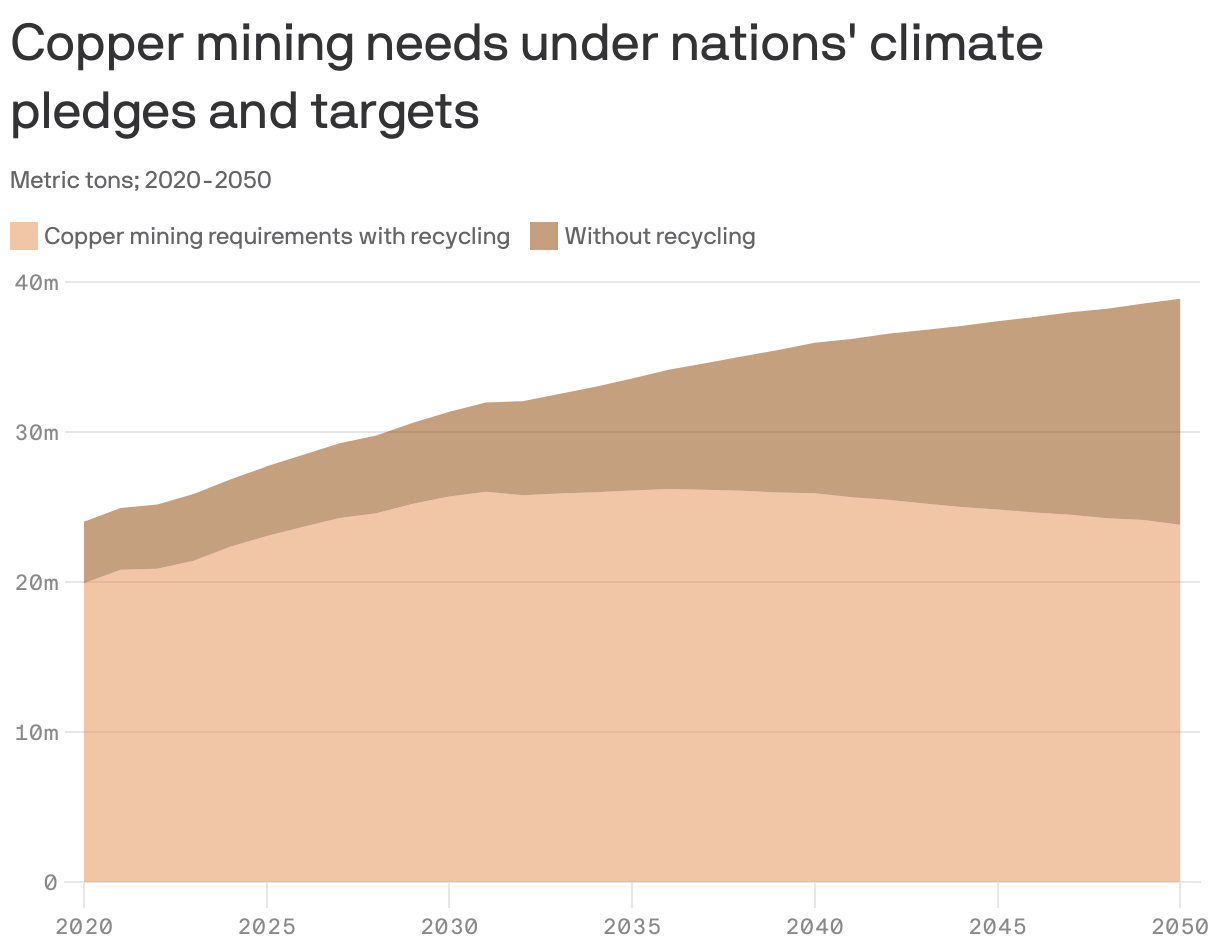
Recycling can hugely reduce mining needed for low-carbon tech, but for now it's not keeping pace with rising mineral use, new analysis shows.
Why it matters: EVs, renewables and grid expansions demand growing amounts of copper, nickel, lithium, cobalt and more.
- But all that mining has ecological drawbacks. And climate tech supply chains bring geopolitical risk as China dominates mineral processing.
Driving the news: A new International Energy Agency report tries gaming out how much extraction growth can be offset with recycling.
- In a scenario in which nations actually make good on their climate pledges, "a successful scale-up of recycling can lower the need for new mining activity by 25‑40% by 2050," IEA finds.
- Around $600 billion of new mining investment would still be needed through 2040 — but it's 30% higher still without recycling.
Zoom in: In this hypothetical case, recycling cuts new mine development needs by 40% for copper (see above) and cobalt.
- For lithium and nickel, it's 25% by 2050.
Friction point: Recycling isn't on pace to turn these projections into reality.
- The report sees "vast potential" for expansion with the "right incentives," even as it lauds growing amounts occurring already.
- Current efforts include the EU's plan to have recycled materials make up at least 25% of the bloc's strategic raw materials by 2030. Faster permitting is part of the policy.
What we're watching: IEA finds that long-term policy certainty can provide the "confidence investors and recyclers need to commit to new projects."
- It offers lots of ideas, like cutting trade barriers on recycled goods and wider use of "traceability," to name just two.
