Harsher heat waves are coming to cities around the world

Add Axios as your preferred source to
see more of our stories on Google.
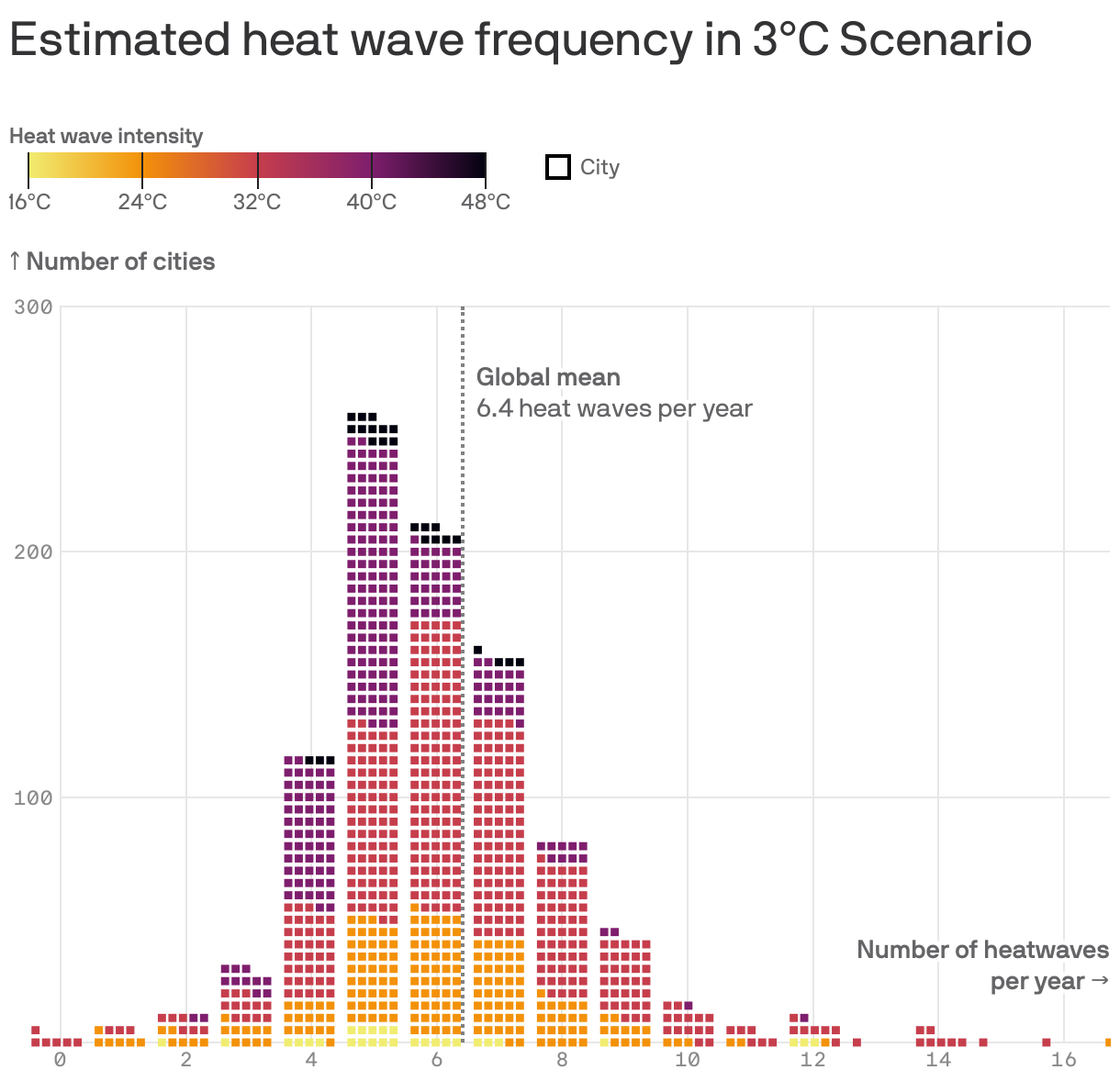
A new study sees the Earth's current warming path driving big increases in heat wave length and frequency in roughly 1,000 of the world's largest cities.
Why it matters: This city-by-city projection is unprecedented, per the World Resources Institute, which released the analysis.
- "This new global data provides a granular view never seen before at the subnational level," the nonprofit said of the peer-reviewed work.
What they did: Researchers modeled heat waves, insect-borne disease risk, and cooling demand if Earth warms 3°C (5.4°F) above preindustrial levels.
- They compared this to the Paris Agreement's stretch goal of 1.5°C, even though this has likely slipped away.
What they found: In a 3°C world, the average length of the year's longest heat wave would be 24.5 days.
- The 996 cities studied would average 6.4 heat waves annually.
- In a 1.5°C world, the longest average heat wave would be 16.3 days, and the average number of heat waves drops to 4.9.
What's next: With 3°C of warming, more than 16% of these big cities would see at least one heat wave lasting a month (!) or longer per year.
- WRI analysts see immense risks in regions already suffering from extreme heat.
- For instance, sub-Saharan Africa sees 56% more heat waves.
Threat level: Heat waves are deadly, sap economic productivity, and strain public health systems and infrastructure.
- "People in low-income cities are likely to be the hardest hit" by the greater risks, the authors' summary states.
Stunning stat: The findings are especially striking because by 2050, an additional 2.5 billion people will live in cities, with most growth in Asia and Africa, WRI notes.
- Over two-thirds of the global population will live in cities by 2050, the findings state.
How it works: It defines heat waves as 3 or more consecutive days where high temps equal — or top — the area's 90th percentile for daily maximums.
- But the analysis has limits, and the authors acknowledge multiple areas of uncertainty.
- They're likely underestimating some risks because they don't include the "urban heat island" effect, which keeps some some U.S. cities up to 8°F hotter than surrounding areas.
Reality check: There's no universal, consensus view of precisely how much warming — regionally and overall — awaits under nations' current policies.
- The analysis examines several models. Authors also point to a 2023 UN report which sees 2.9°C (5.22°F) if countries implement existing voluntary pledges under the Paris Agreement.
What we're watching: WRI says the report highlights the need for tougher emissions-cutting policies.
- But they also urge more investment in adaptation and resilient infrastructure.
- They hope the analysis will help city policymakers plan, and spur even more detailed work.
The bottom line: "This data should serve as a wakeup call to every city and national government leader," Rogier van den Berg, the global director of the WRI Ross Center for Sustainable Cities, said in a statement.
Andrew Freedman contributed
