Putin courts Xi in effort to pull off geopolitical "coup"

Add Axios as your preferred source to
see more of our stories on Google.
All eyes are turned eastward as Russia tries to convince China to back the long-proposed Power of Siberia 2 gas pipeline.
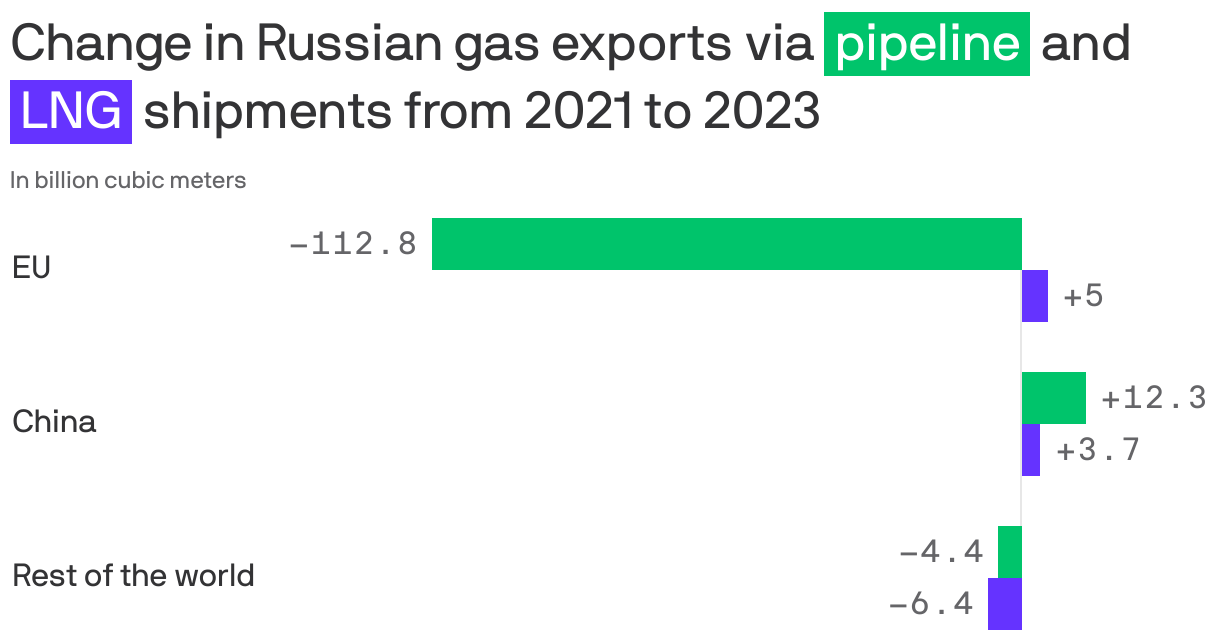
Why it matters: As Russian President Vladimir Putin meets with Chinese leader Xi Jinping during a two-day state visit, the market and geopolitical stakes are huge — especially following the massive decline in Russian gas flows to Europe since the invasion of Ukraine.
State of play: Initial reports from the visit show no explicit progress on winning Xi's endorsement of the project, but vows of deeper energy ties.
- The New York Times reports that Putin said the "leaders discussed working more closely in energy and nuclear power research, though made no mention of a proposed natural gas pipeline to China that Moscow would like to see built."
The big picture: A new commentary from analysts with Columbia's Center on Global Energy Policy explores why it's so vital for Putin.
- PS-2 would be a geopolitical "coup" for Moscow, not just a revenue stream, because it tightens its strategic alliance with China.
- It would mean "demonstrating to the West and the Global South that it is able to deepen its energy relationship with China despite the war."
Friction point: "One reason China is in no hurry to finalize an agreement for PS-2 is that the country is unlikely to need the gas before the mid-2030," CGEP's analysts write. That gives it leverage on price and more.
Yes, but: While Xi is likely to continue what have been years of playing hard to get, his posture could change, they add.
- "[I]f China can secure an attractive price for PS-2 gas, and if China's relations with the United States continue to deteriorate, Beijing could be motivated to reverse course."
Zoom out: A 2030 link to supply what's now 50 billion cubic meters of stranded Russian gas would displace a chunk of China's liquefied natural gas imports, adding to an expected LNG glut as more projects come online this decade.
The bottom line: If there's ever a deal, the market and geopolitical implications are global.
