Red-hot copper floats near highest levels since 2022

Add Axios as your preferred source to
see more of our stories on Google.
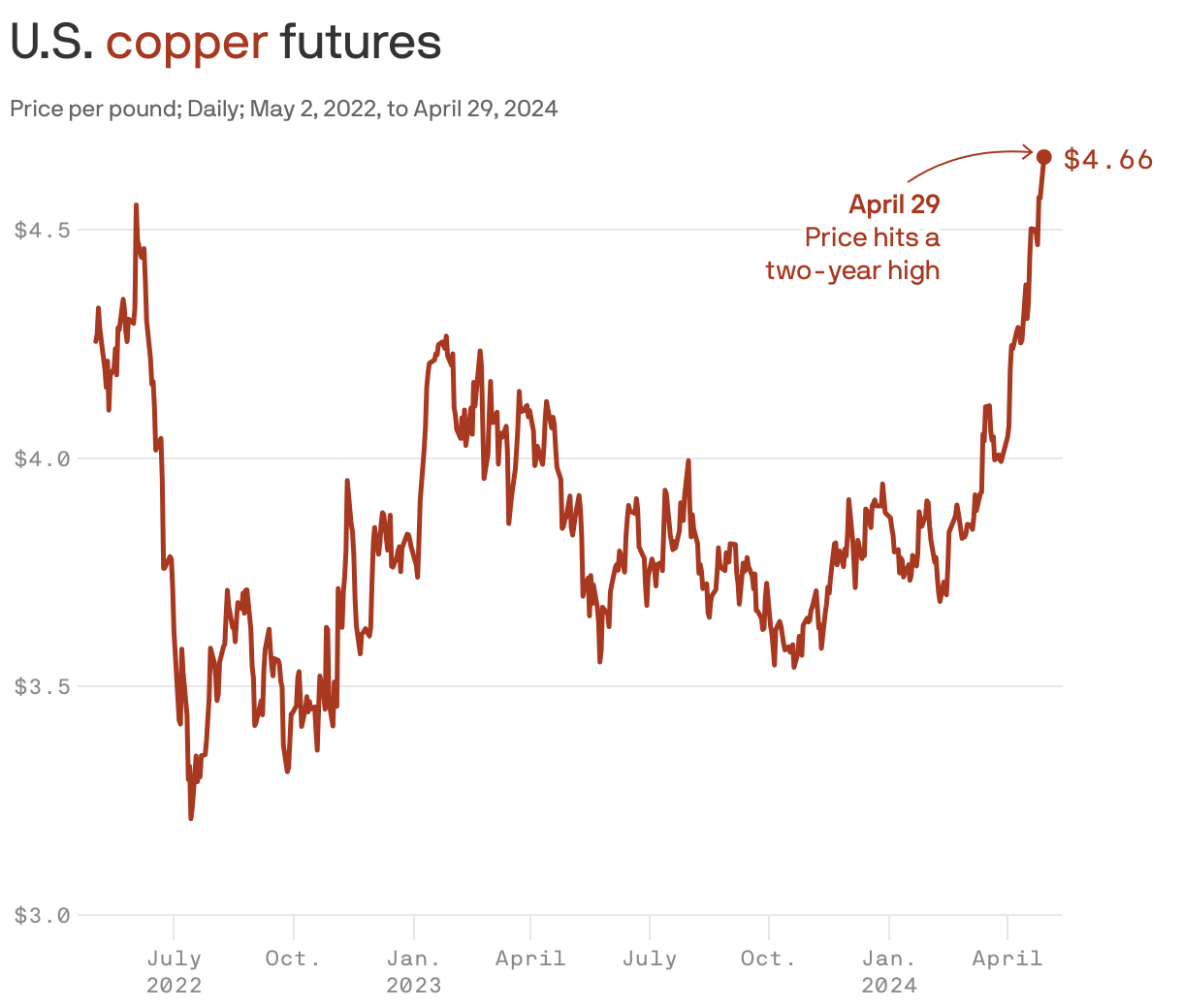
Copper prices have been on a tear, converging with a broad rally in commodities, and flirting with their highest levels since 2022.
Why it matters: Copper's versatility in construction, electronics, transportation and now AI applications makes it a go-to for industrial purposes, and as a useful gauge of economic health that's coined it the nickname "Dr. Copper."
- Meanwhile, accelerating investment in green technologies has also boosted interest in the metal.
By the numbers: According to a recent report by the World Bank, copper prices are projected to rise 5% in 2024, before holding steady next year. Simultaneously, other commodities like gold and aluminum are expected to rise 8% and 4% in the same year.
- On Monday, Copper prices closed at a two-year high, hitting $4.66 per pound before retreating with the broader market, holding near those levels in early Wednesday trading.
Context: Copper's strategic value was underscored last week, when mining giant Anglo American rejected a takeover of a $39 billion acquisition bid from the world's largest mining company, BHP Group. Anglo said the offer significantly undervalued the company and its prospects.
- A potential takeover would mean controlling 10% of copper's global output by the combined companies.
Zoom in: The red metal is highly conductive and resistant to corrosion, and is critical to the global transition to green energy.
- Renewable energy infrastructure like solar panels, wind turbines, and energy storage systems rely heavily on the metal's conductivity.
- The metal is used in electric vehicles and is also a key component in the manufacturing of battery systems, contributing to their reliability and overall performance.
Copper's price surge is also due to its limited supply.
- Copper mining is an expensive business, and can result in habitat disruption, water pollution, and emissions.
- The World Bank warns that the copper supply growth is expected to be modest this year, limited by production stoppages and declining ore grades in major producers in South America.
- Additionally, setting up new mines is capital-intensive and can take about 10 years, which can also curb the supply.
