Sober climate data shows why COP28 matters

Add Axios as your preferred source to
see more of our stories on Google.
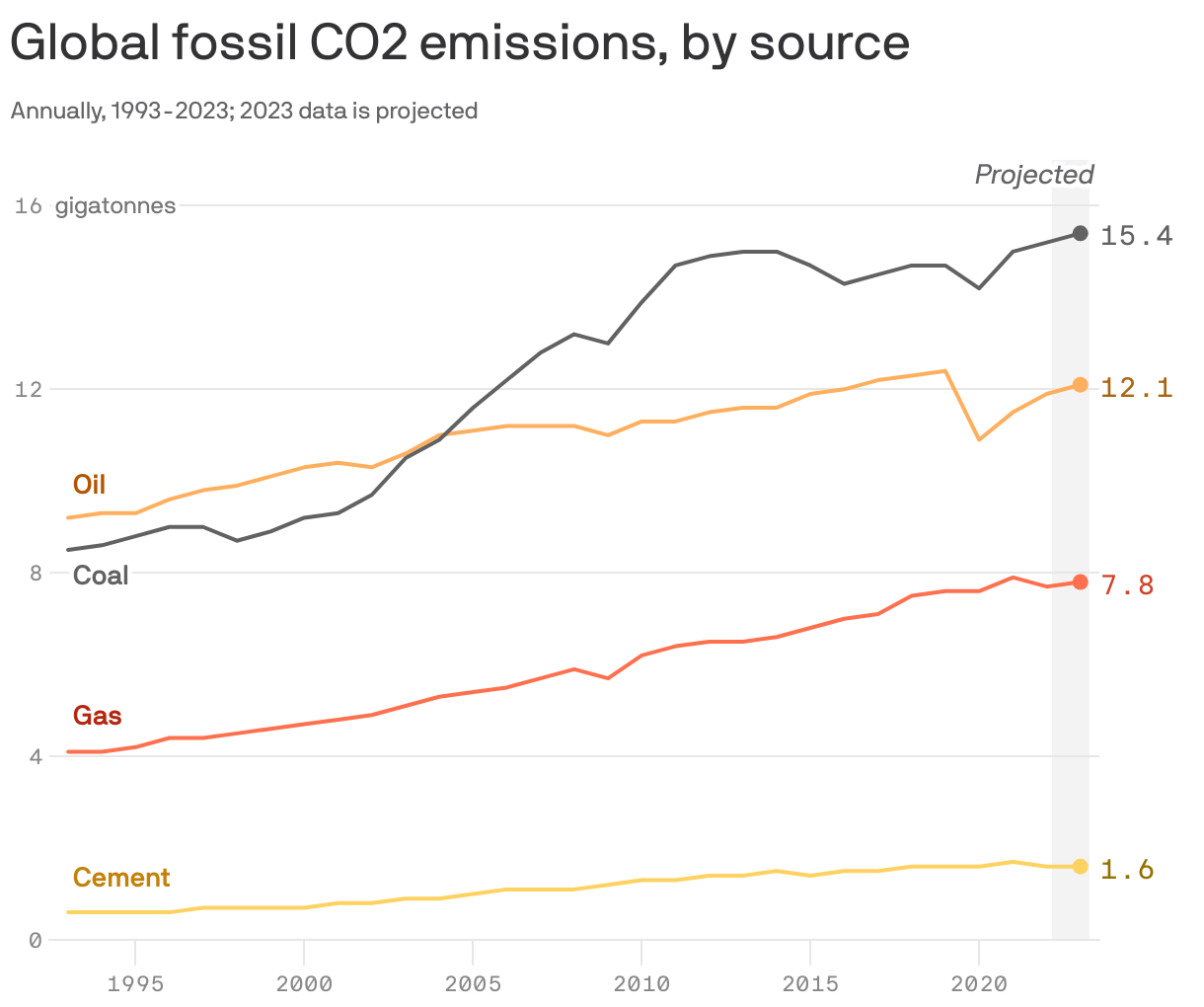
Taken together, three new analyses highlight the relentless march of climate change — and what's in store without much stronger policies.
Driving the news: The Global Carbon Project (GCP) estimates fossil-related carbon dioxide emissions rose another 1.1% to a new record.
- That's despite surging renewables, and falling emissions in developed economies like the U.S. and EU, the researchers found. Axios' Rebecca Falconer has more.
- And a World Meteorological Organization report concludes the rate of climate change "surged alarmingly" from 2011-2020.
What they found: Not only was it the warmest decade on record, but glacier and sea ice loss were "unprecedented," the UN weather agency said.
- Glaciers thinned by roughly 1 meter per year, while more countries reported record high temperatures than in any other decade.
Zoom in: "The Antarctic continental ice sheet lost nearly 75% more ice between 2011-2020 than it did in 2001-2010," a WMO summary notes, calling this "ominous" for sea-level rise.
What's next: Climate Action Tracker projects warming sailing dangerously past Paris targets, even if nations implement their current pledges.
- Their latest estimate ticked up slightly, to 2.5°C above preindustrial levels by 2100, thanks to increasing emissions in countries with "weak" targets.
- It's worse when you look at real-world actions based on current policies, which bring an estimate of 2.7°C — no improvement from their 2021 estimate.
Yes, but: Researchers see some bright spots.
- GCP sees China's emissions rising 4% this year (not good!), but strong renewables deployment is preventing even higher growth.
- U.S. coal emissions are falling sharply, while EU fossil emissions are down 7.4% this year.
What we're watching: Who knows whether this grim choose-your-own-adventure of threat metrics will influence COP28 negotiations.
- These reports certainly underscore the urgency of the need for very steep emissions cuts, which are nowhere in evidence yet.
- But government policies and investments are motivated by all kinds of considerations and national interests. And scary data is nothing new.
The bottom line: The window to meet Paris goals is shutting fast.
- The University of Exeter's Pierre Friedlingstein, a GCP co-author, said in a statement that "it now looks inevitable we will overshoot the 1.5°C target."
- "Leaders meeting at COP28 will have to agree [to] rapid cuts in fossil fuel emissions even to keep the 2°C target alive."
