Oil tame below $100 per barrel despite Israel-Hamas crisis

Add Axios as your preferred source to
see more of our stories on Google.
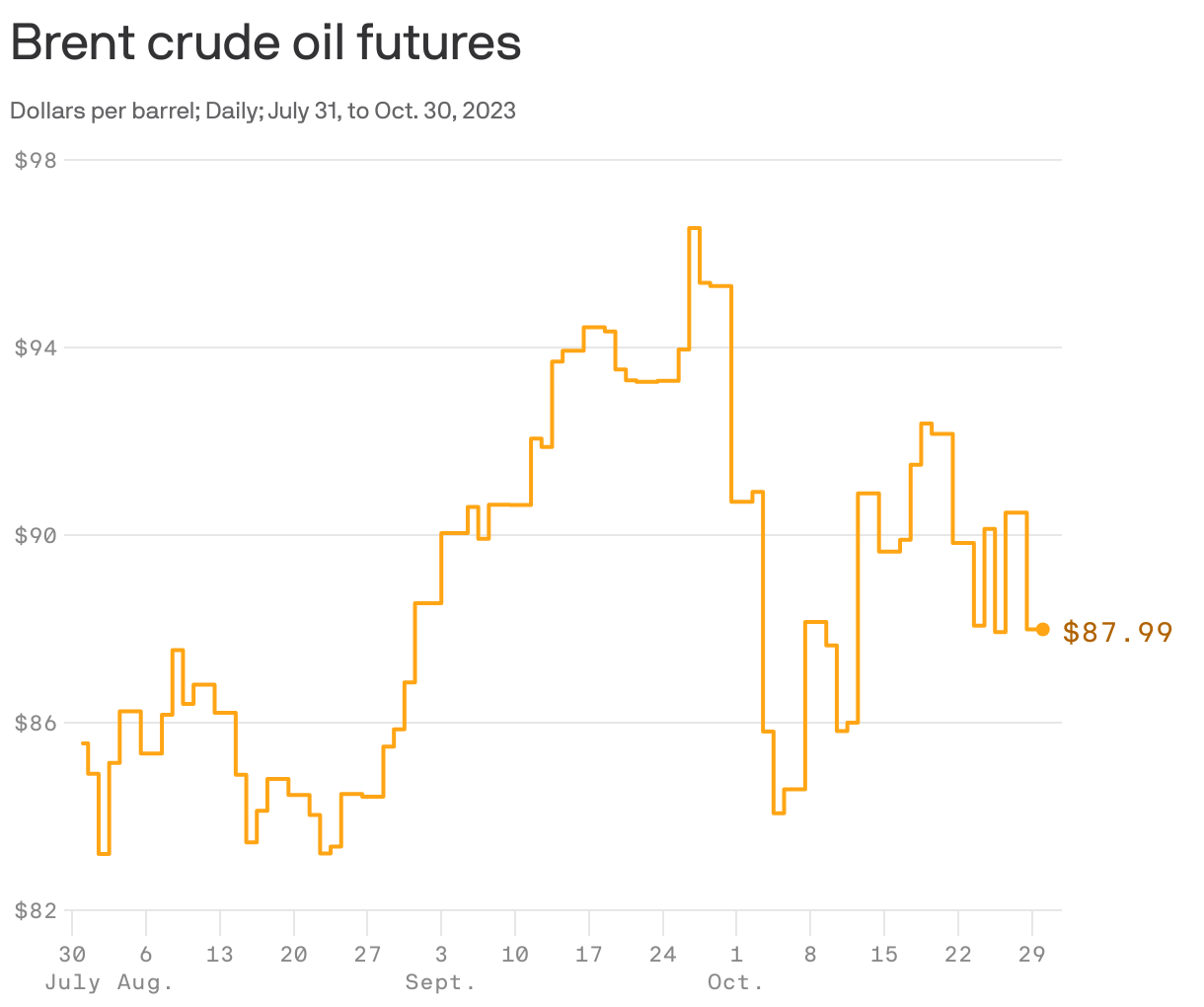
Global oil markets don't yet foresee the Israel-Hamas war escalating in a way that eats into crude oil flows.
Driving the news: Prices have come back to where they were right after markets first reacted to the Oct. 7 Hamas terrorist attack against Israel.
What they're saying: Oil analyst Ellen Wald said potential for conflict to spread to the Persian Gulf still exists, but traders don't see this as an "immediate potential consequence."
- "If the U.S. makes any military moves in the Gulf, or Israel attempts to strike at targets inside Iran or near or around the Gulf, then prices would react accordingly," she tells Axios via mail.
- This possibility has "moved farther out in time given Israel's current preoccupation with the hostages and Gaza itself, as opposed to Iran."
The big picture: The crisis comes amid an uncertain economic outlook.
- The U.S. economy grew briskly in Q3, but there are storm clouds gathering over the global outlook as China slows and conflicts abroad rage.
- The "higher for longer" interest rate environment is also curbing prices.
Yes, but: The World Bank's baseline forecast sees Brent prices averaging $90 per barrel this quarter and $81 next year as global growth slows.
- But their new report weighs various crisis escalations, including a "large disruption" case that pulls 6-8 million barrels per day off the market. That could send prices to the $140-$157 range, the organization estimates.
The bottom line: "If the conflict were to escalate, the global economy would face a dual energy shock for the first time in decades — not just from the war in Ukraine but also from the Middle East," World Bank chief economist Indermit Gill said in a statement.
