Peak oil demand "on the horizon"

Add Axios as your preferred source to
see more of our stories on Google.
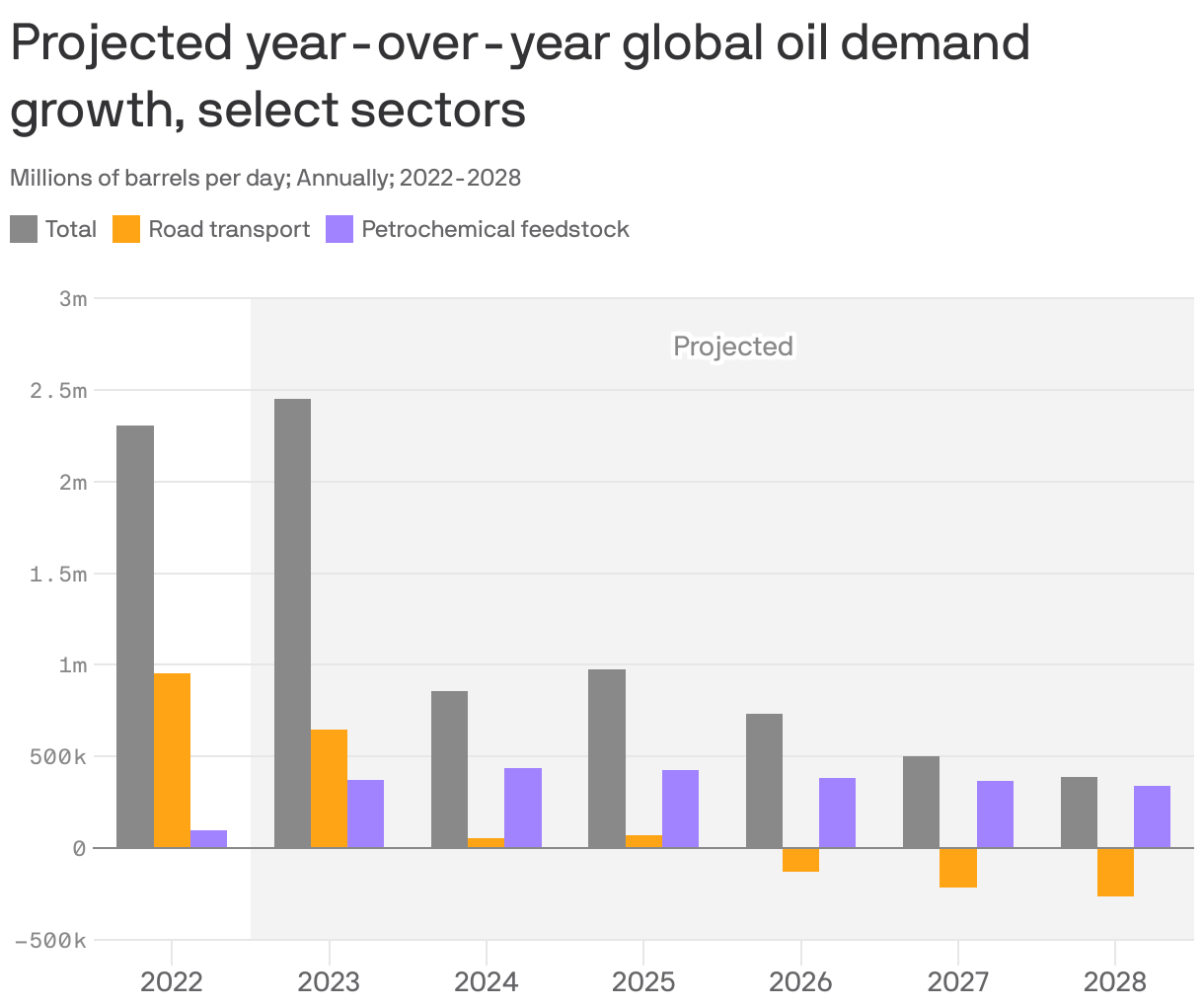
The International Energy Agency sees global oil demand growth slowing "markedly" in coming years, with a peak "on the horizon."
Driving the news: The IEA's new five-year outlook sees worldwide use rising 6% to 105.7 million barrels per day in 2028.
- But the pace of growth is expected to slow greatly (see above).
- It's a window into the agency's thinking with energy markets being wildly turbulent for unpredictable reasons, i.e. COVID-19 and Russia's war on Ukraine.
Why it matters: The trajectory of oil consumption affects carbon emissions, investment strategies and geopolitics, among other things.
Zoom in: Petrochemicals used in plastics and other products are a major source of demand growth in the forecast. Aviation fuel is, too.
- But demand for road transport fuels goes into reverse starting around mid-decade.
The big picture: Theories about "peak oil" supply once dominated energy economics discussions for decades but never came to fruition.
- More recently, climate change has driven more attention to when demand might peak.
What they're saying: A rapid shift to a "clean energy economy" is driving the latest outlook, IEA head Fatih Birol said in a statement.
- An oil demand peak is "in sight before the end of this decade as electric vehicles, energy efficiency and other technologies advance."
What we're watching: The supply picture, which the IEA says could "significantly tighten" in coming months. But the outlook improves during the wider analysis window that runs through 2028.
- The Russia-Ukraine crisis has sped up "clean" energy investment and oil capacity.
State of play: The IEA sees markets "adequately supplied throughout our forecast period" — assuming recent increases in upstream investment are maintained.
- The U.S. leads supply growth, though increases will slow after this year.
Reality check: Take all this with a grain — or boulder — of salt! Supply and demand are notoriously hard to game out.
- And what happens after a peak — a plateau, a gradual decline, or a steep one — matters even more.
