Plugging the U.S. fossil fuel revenue gap won't be easy

Add Axios as your preferred source to
see more of our stories on Google.
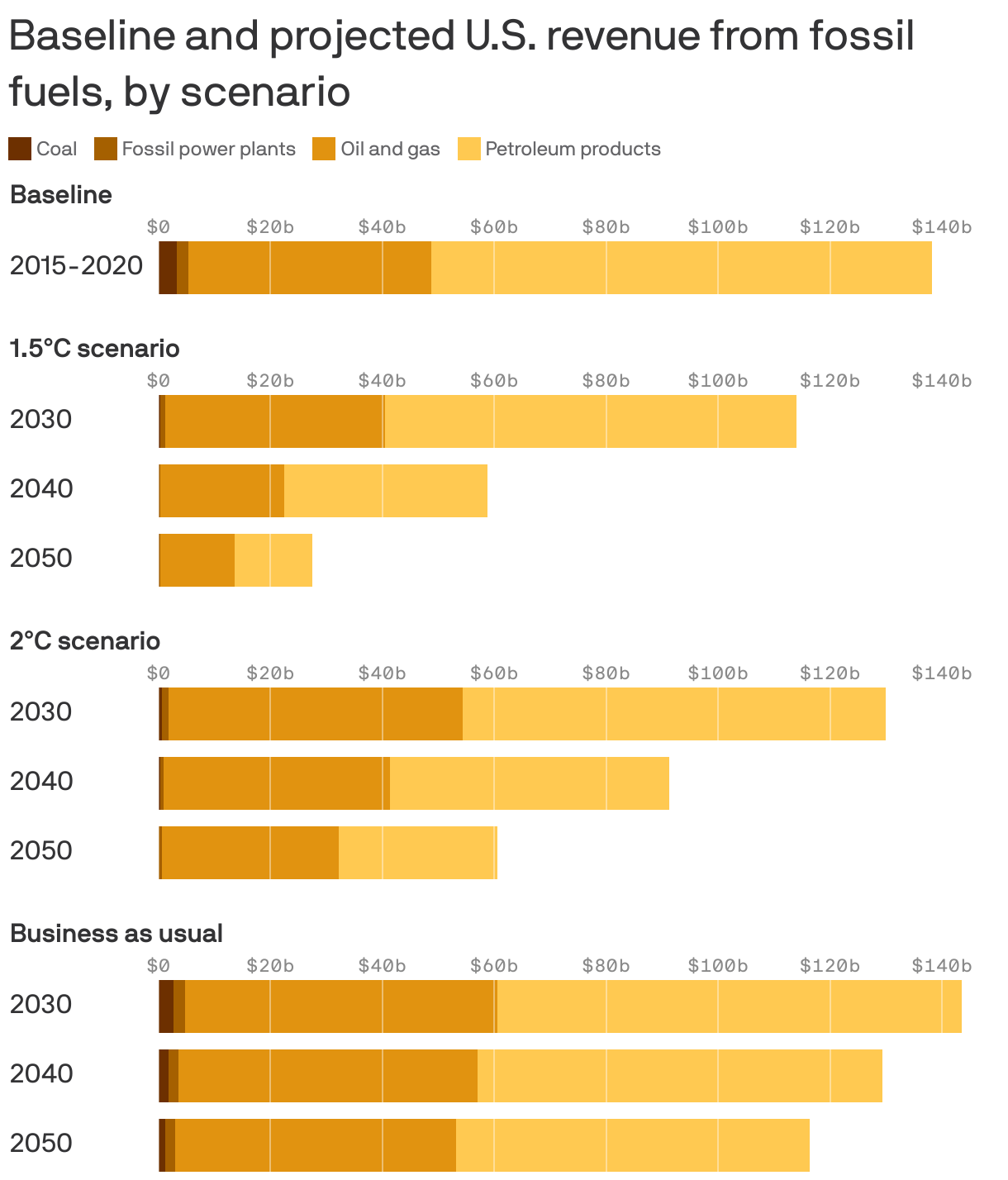
Fossil fuel-related government revenues are slated to plummet if the U.S. deeply cuts greenhouse gas emissions, and policy tools to make up the shortfall face hurdles, a new paper finds.
Why it matters: The analysis from the nonpartisan Resources for the Future is a rare holistic look at revenue flows across levels of government — federal, state, tribal and local.
How it works: Oil, gas and coal provided an average of $138 billion annually in 2015-2020.
- Fuel excise taxes are the biggest source (at $48b for states and $40b for the federal government annually), while others include production royalties, pipelines, local property taxes, and corporate taxes.
Zoom in: It projects revenues in scenarios consistent with holding temperature rise to 2°C or 1.5°C above preindustrial levels — benchmarks for avoiding some of the worst harm.
- In the 1.5°C case, revenues decline 18% by 2030 and 80% by 2050. The drop is also significant under 2°C scenario, at 6% and 56%, respectively.
- There's still some decline even absent any new policies, largely thanks to vehicles becoming more efficient and electric, the power market's move away from coal and other forces.
The big picture: The declines are not a reason to delay efforts to cut emissions, the authors say, citing the steeper costs of failure to rein in warming.
- The broad mix of policy options to address revenue losses include carbon pricing, changing motor fuel taxes to a system based on miles traveled, ending fossil fuel subsidies and higher marginal rates.
Yes, but: None of this is easy, with the paper noting that "each option faces considerable political hurdles in the immediate future."
Go deeper: Biden's latest Fed pick signals brewing climate battles
