Local Brief
How much health insurance is costing Texans


Add Axios as your preferred source to
see more of our stories on Google.
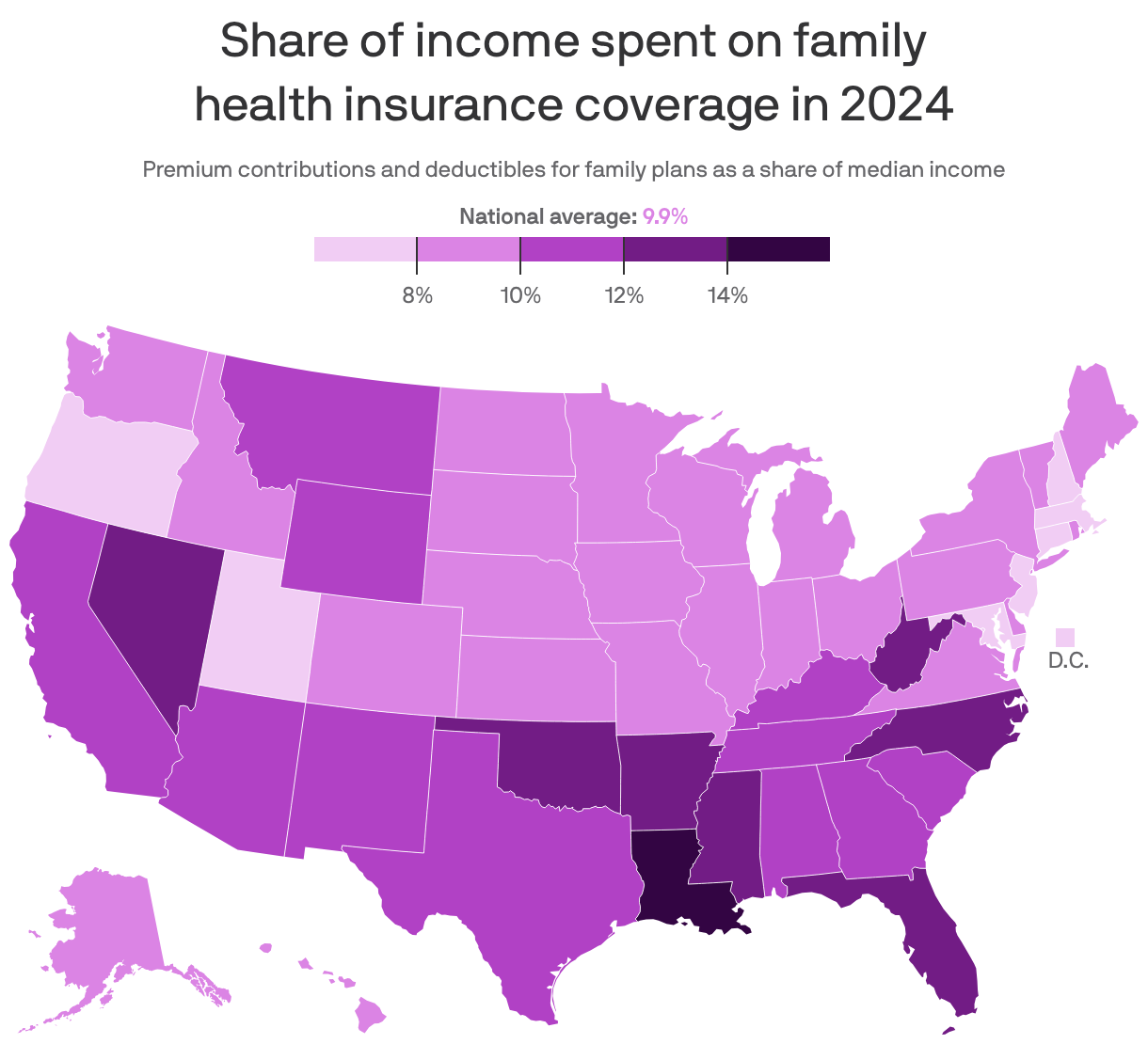
Health insurance costs ate up 10% or more of median family income in 19 states including Texas, according to a recent analysis.
Why it matters: The findings show how tough it can be to afford health care, even with insurance.
How it works: The state-by-state breakdown of federal data by the Commonwealth Fund looked at how much people spent on premiums — their contribution to the cost of their insurance — and on deductibles, their out-of-pocket costs before insurance starts to pay for medical services.
What they found: The share of income people spent on premium contributions and deductibles for family coverage in 2024 ranged from a high of nearly 16% in Louisiana to a low of about 6% in the District of Columbia, according to the analysis.
- Texans spent 11% of their income on premiums and deductibles.
The big picture: Health costs are expected to keep rising due to hospital consolidation, higher prices for medical services and supplies, GLP-1 drugs and more demand for behavioral health care, researchers said.
- While employers still pay about 70% of the cost of premiums for family coverage, workers on average paid more than $7,200 annually, the analysis found.
The bottom line: If incomes don't keep pace with medical inflation in the coming years, the cost of employer coverage and accessing care could become prohibitively expensive for many middle-class workers.