Axios Communicators

February 26, 2026

ππ» Hi and welcome back!
- Have story ideas, tips or pitches? Email me.
Today's newsletter, edited by Christine Wang and copy edited by Kathie Bozanich, is 1,976 words, 7.5 minutes.
1 big thing: AI "hot takes" are becoming a market risk

Companies across sectors are confronting an increasingly unavoidable narrative: AI can replicate your business.
Why it matters: Narrative volatility is a new risk category that communications teams must prepare for in the age of AI.
- All it takes is one widely read doomsday essay, research paper or X thread to knock billions off a company's market cap.
Case in point: A viral 7,000-word memo that warned of a hypothetical AI future β in which companies rush to replace human workers with AI tools that themselves are rapidly commoditized β sent markets tumbling.
- Meanwhile, essays from AI founders and researchers are shaping investor psychology, and product rollouts from AI giants like Anthropic are being treated as existential threats to companies in the software or cybersecurity sectors.
State of play: This week was particularly volatile. IBM shares plunged 13% after Anthropic's legacy code announcement.
- Stocks of companies that were mentioned in the doomsday memo β like DoorDash, American Express, Uber and Mastercard β all fell by 4% or more.
Reality check: Regardless of the facts, if the narrative sticks (even temporarily) it can move stock prices, trigger activist questions, spook employees, invite political scrutiny and potentially shift consumer behavior.
- This is why communication experts say companies cannot afford to be slow to respond.
By the numbers: Fortune 500 CEOs view AI and "new technology" as the top risk to their industry, per a new Conference Board survey.
- This is a shift, given that in 2025, geopolitical issues were the top concern (59%), followed by "cyber" (56%).
Zoom in: Companies must define their role in the AI era before an external voice or viral X thread does. This requires two talk tracks:
- How AI strengthens the business by improving margins, speed, product quality or customer experience, and explaining how management is thoughtfully integrating it.
- Why the company remains indispensable due to human judgment, expertise, relationships, proprietary data, brand credibility, physical infrastructure or products AI cannot easily replicate.
What they're saying: Vague claims of AI capabilities won't calm markets. The key is specificity, says Adam Mendelsohn, CEO of strategic advisory firm Upland Workshop.
- "Every communications professional has to have a really clear and detailed way of articulating how their company is going to manage AI," he said. "And I think for publicly traded companies, they should be spending a lot of time right now educating analysts, educating buy-side, about their unique ability to manage AI."
- "You should be thinking defensively now, because when these narratives take hold, they become industry-wide. And the question is, have you put yourself in a position to separate yourself from your contemporaries or your competitors?"
Zoom out: Reputation is increasingly intertwined with valuation, according to a recent Burson analysis.
- Companies with the strongest reputations earn nearly 5% more in unexpected shareholder returns than their counterparts.
What to watch: AI companies themselves aren't in the clear when it comes to reputation.
- A majority of Americans β 58% β don't trust AI much or at all, a recent The Economist/YouGov poll found, while 77% of Americans say they are concerned AI could pose a threat to humanity.
- Plus, concerns about AI's impact on jobs, safety, privacy and energy continue to percolate.
π Thought bubble from Axios senior AI reporter Madison Mills: Substacks are the new short seller report in an environment where all the major banks are competing to land big AI IPOs.
- Broadly, analysts have not been as forthcoming about any concerns they have on the AI trade.
- Paul Kedrosky, a venture capitalist, tells Axios that's because banks want to remain in favor with AI firms so they can handle their IPOs and other deals.
- Enter independent authors: their takedowns feel like clarity to investors who are steeped in uncertainty about AI's path forward. It's narrative roulette on Wall Street.
2. Trump pressures Netflix to fire board member Susan Rice

President Trump on Sunday threatened Netflix, suggesting it would "pay the consequences" if it didn't "immediately" fire Susan Rice, who served as ambassador to the United Nations in the Obama administration.
π‘ Why it matters for communicators: If you haven't prepared a playbook for this type of meddling, you're behind.
Catch up quick: This isn't the first time the administration has weighed in on corporate governance, leadership and hiring practices.
- Trump previously demanded the resignation of Intel's CEO, and he called for the ouster of Microsoft head of global affairs Lisa Monaco due to her work in the Biden administration, yet applauded Meta for appointing his former national security adviser Dina Powell McCormick as president.
Zoom in: On Sunday, the president posted on Truth Social that Netflix should "fire racist, Trump Deranged Susan Rice, IMMEDIATELY, or pay the consequences."
- "She's got no talent or skills - Purely a political hack! HER POWER IS GONE, AND WILL NEVER BE BACK. How much is she being paid, and for what???" he added.
- Trump's words came in response to a post from right-wing activist Laura Loomer, who criticized Rice and called Netflix an "anti-American" and "woke" company for having her on its board.
Catch up quick: Rice argued in a recent podcast that Democrats won't "forgive and forget" companies that "take a knee" to Trump.
- On Monday, Netflix co-CEO Ted Sarandos told the BBC, "This is a business deal. It's not a political deal."
- "This deal is run by the Department of Justice in the U.S., and regulators throughout Europe and around the world."
Zoom out: The president's words shouldn't have bearing over the approval of Netflix's merger agreement with Warner Bros. Discovery, but they can still influence WBD's sale process and place pressure on investors and regulators.
- Paramount has asked WBD investors to tender their shares to support its bid, and Trump's comments could be seen as a barrier to Netflix's deal closing.
What to watch: Sarandos is expected to visit the White House today to discuss the deal, according to reports.
3. Exclusive: Legacy media flock to Beehiiv

The Washington Post is launching a new creator-led newsletter on Beehiiv as part of its newly announced WP Creator initiative.
Why it matters: The Post is the latest legacy media outlet to turn to Beehiiv as a way to expand reach and regain relevance by meeting readers in their inbox.
- The Post's new creator-led newsletter, Verified, will be authored by former political reporter Dylan Wells and will chronicle the multibillion-dollar creator economy and its disruption across industries.
State of play: The Post joins a slew of other major publishers that are already on Beehiiv, including Time, Newsweek, TechCrunch, the Texas Tribune, the Boston Globe, Los Angeles Magazine and The Ringer.
- Beehiiv also hosts independent journalists like Oliver Darcy, Joanna Stern and Dave Jorgenson as well as creators like Colin and Samir, DeuxMoi and Josh Richards.
- Meanwhile, the Wall Street Journal, the Economist, Financial Times and the New Yorker are experimenting on Substack.
What they're saying: Website traffic and monthly page views are antiquated metrics, especially in a world where distribution is unreliable, Beehiiv co-founder and CEO Tyler Denk tells Axios.
- "This is a media model that's being built around owning that relationship, and then determining what are the business models that you can build around that," he adds.
- "So if newsletter is the core, can you build community? Can you build podcasts? Can you build video? Can you do events and merch? None of that is possible if you can't actually reliably get in front of your audience."
What's next: The platform is expected to roll out audio and video add-ons in the months ahead.
4. CCO churn stabilizes, new report finds
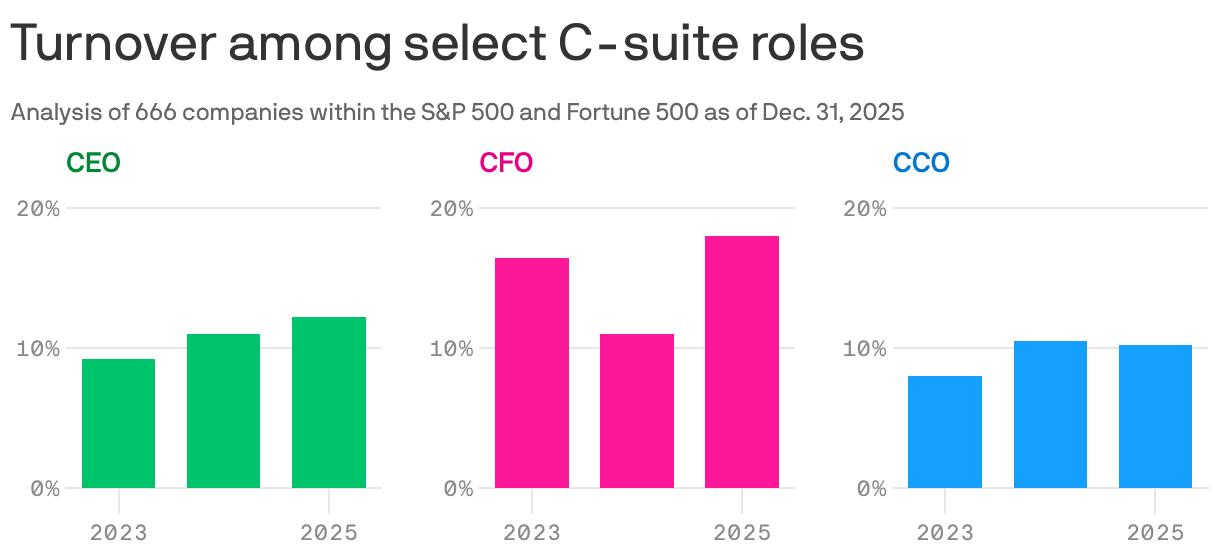
Even with a record number of CEO exits, turnover among chief communications officers has stabilized, according to a new report from Patino Associates and CASA.
Why it matters: CCOs are being seen as the steady hand who can help with continuity amid economic uncertainty, geopolitical tension and AI transformation.
By the numbers: The average tenure of a CCO in the U.S. in 2025 was 4.9 years, resulting in a turnover rate that was essentially flat (10.2%).
- Chief financial officers saw a turnover rate of 18% β compared to 11% in 2024 β and CEOs changed at a rate of 12.2%.
Zoom in: In the cases in which CCOs exit, their successors are more likely to be hired from within, according to the study.
- 60% of companies filled CCO positions with internal candidates, almost double that of last year.
- "The internal hires provide an understanding of the business," says Michael Patino, CEO of Patino Associates. "The good ones already operate well across the organization and therefore have strong relationships and advocates."
- "CEOs and management teams are less comfortable with a learning curve. They want to know that someone really does understand their business on day one ... in order to be able to help that business go where they want to go in the next 12 months."
Yes, but: Not all internal hires are promotions.
- 28% of internal hires were stepping into roles smaller than those held by their predecessors.
- For example, a chief corporate affairs officer could be replaced by an internal candidate in a comms chief role.
What they're saying: Throughout 2025, CCOs were more likely to be set up for success in a way they weren't previously, says Patino.
- "We're seeing a greater respect for the function and a greater understanding of the impact of the function," he says. "Because hiring managers and CEOs are approaching recruiting with a more well-thought-out perspective, we're actually seeing fewer oopsies."
- "We're also seeing more of a customization of the function. It's really about what are the needs of my business, of my leadership team. They're not looking for just a functional leader β they're looking for a business leader."
What to watch: The remit of a communications lead tends to depend on the business' needs, based on macro factors.
- In some cases, this has led to the creation of the CCO+ title, with 31% of comms leaders holding roles that oversee at least one other function.
5. ICYMI: Target names Alexis Williams as chief corporate affairs officer

Target has named Alexis Williams as chief corporate affairs officer, Axios was first to report.
- Why it matters: Williams and her team will be tasked with revamping the retailer's reputation following years of political backlash and sagging sales.
Details: Williams will report to Michael Fiddelke β who took over as CEO this year βand will oversee the team responsible for communications, stakeholder management, risk, enterprise storytelling and reputation.
- Williams most recently served as chief corporate affairs officer at Stagwell, where she led its Future of News initiative.
- Prior to that, she spent almost a decade at Politico, where she supported business development, events and special projects.
The big picture: Target has faced brand and reputation strains due to boycotts in response to its waffling DEI commitments, backlash related to immigration raids in Minneapolis and declining foot traffic.
Yes, but: Fiddelke is focused on a corporate turnaround, and Williams' team will tell that story to employees, consumers, regulators and community members.
6. π 1 thing to go: Skills on the rise
Executive and stakeholder communications is ranked as one of the fastest-growing skills needed in the modern workplace, according to a new report from LinkedIn.
- "Clear, effective communication with key decision-makers sets professionals apart in today's fast-paced, interconnected work environment β allowing them to build trust and influence, navigate complex priorities and drive alignment across teams and functions," per the report.
Zoom in: For those working in media and communications, the top rising skills include AI literacy, cross-functional collaboration and brand storytelling.
- π§ If you've been reading Axios lately, none of these should come as a shock.
What's next: 38% of job skills changed globally between 2016 and 2023. AI is expected to bump it up to 70% by 2030, per LinkedIn.
What to watch: How communication leaders are building out their teams in the age of AI.
β Thanks for reading! For more, apply to join Mixing Board, powered by Axios.
Sign up for Axios Communicators